The Wave of Indian Culture – Stone Temples Tell the Story of the Sea Road
Why did the kings of Southeast Asia enshrine distant Indian gods and buddhas at the center of their kingdoms?
As we saw in the previous chapter, Southeast Asia lay along the 'Sea Road.' Along that road came Indian merchants, monks, and Brahmins (those who performed rituals). What they brought was Sanskrit, Hinduism, Buddhism, and the idea that 'the king has divine power.' But India did not invade. It is thought that local kings actively adopted these ideas in order to organize their own kingdoms.
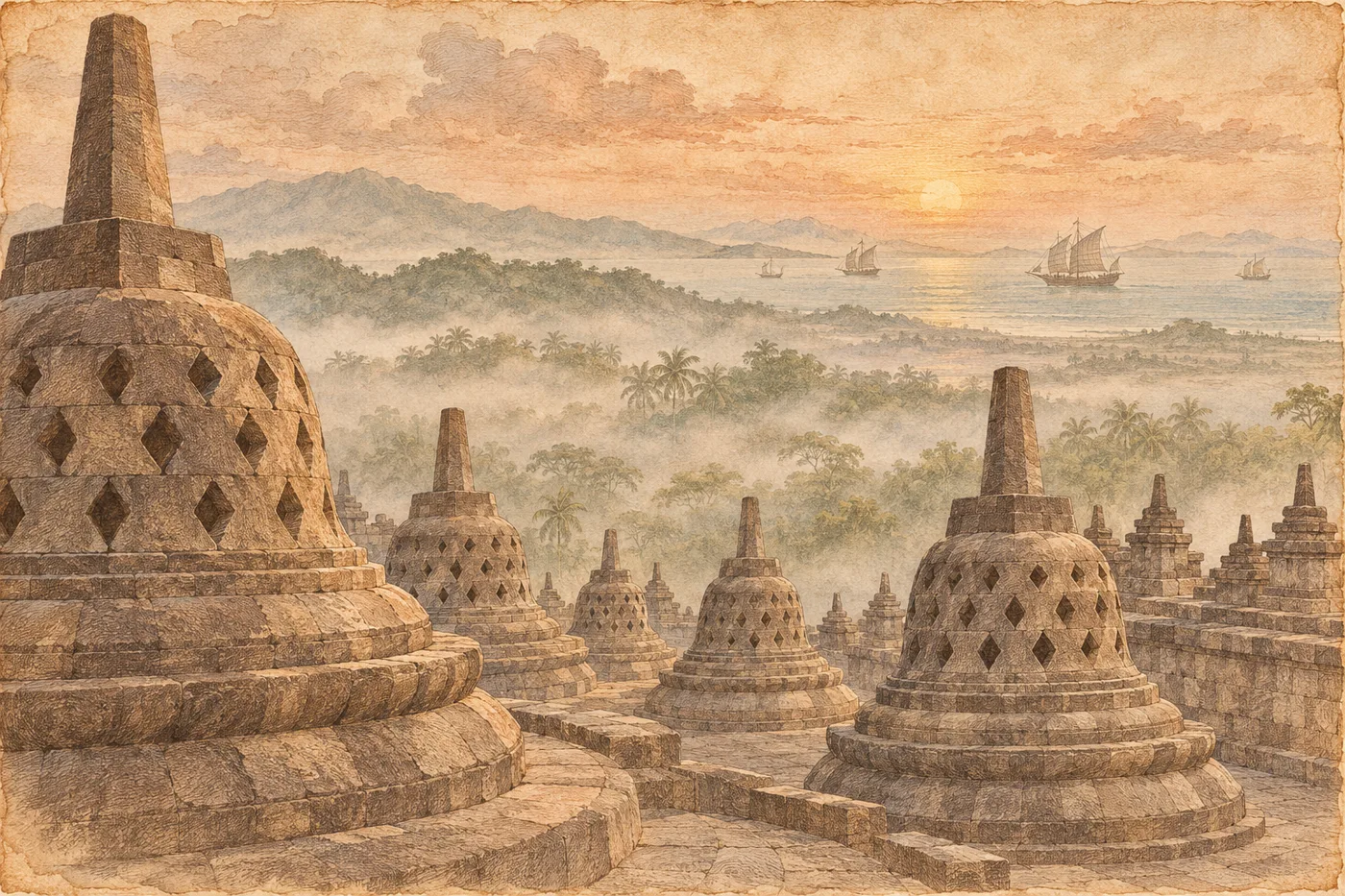
In the 8th–9th centuries on central Java, under the Sailendra dynasty (according to one theory), the great Buddhist temple Borobudur was built. It is said to have been completed around the 9th century. As you walk up the stone corridors, reading the stories in the reliefs carved on the walls, you head toward the circular terraces at the top. Over 500 buddha statues greet visitors across the entire site. The act of climbing itself becomes a journey toward enlightenment.
On the mainland, the Khmer Empire grew strong. Tradition holds that Jayavarman II was crowned in 802 and laid the foundation of the kingdom in the Angkor region. The kings built canals and reservoirs near Tonle Sap Lake to grow rice, and constructed vast royal capitals.
In the early 12th century, Suryavarman II built Angkor Wat, a great temple dedicated to the Hindu god Vishnu. It later came to be used as a Buddhist temple and is still depicted on the flag of Cambodia today. Jayavarman VII, at the end of the 12th century, was a devout Buddhist; he built Angkor Thom and the Bayon temple, and is said to have established hospitals and rest houses across the land.
In 1296–97, Zhou Daguan, a member of a Yuan diplomatic mission, stayed in Angkor. His book 'The Customs of Cambodia' is a valuable record describing the royal palace and the daily life of the people.
Then, in the 15th century, the capital moved south, and Angkor ceased to be the center. It is said that it was attacked by Ayutthaya from the west in 1431, but the reasons are not single. Still, Angkor Wat was not abandoned; it was kept by monks who continued to protect it. In the next chapter, we will visit new port cities that flourished through maritime trade.
Mini timeline
- c. 802Jayavarman II is said to have been crowned, laying the foundation of the Khmer Empire
- c. 9th centuryBorobudur is built on central Java
- early 12th centurySuryavarman II builds Angkor Wat
- late 12th centuryJayavarman VII builds Angkor Thom
- 1296–97Zhou Daguan stays in Angkor
People in this chapter
A devout Buddhist who undertook great projects such as Angkor Thom. He is also known for building hospitals.
He left a written record of life in Angkor. 'The Customs of Cambodia' is one of the few contemporary accounts of the period.
Meanwhile, elsewhere
Connection to Japan
When Borobudur was built, Japan was in the early Heian period; when Angkor Wat was built, it was around the end of the Heian period.
Why it still matters
Borobudur was registered as a World Heritage site in 1991, and the Angkor complex in 1992. Both are still cherished by local people as places of prayer.
Perspectives differ
- The 'Indianization' perspective
- In the past it was explained as 'Indian culture spreading to Southeast Asia,' but today the emphasis is on local kings and societies actively selecting and adapting what they adopted.
- The dating of Borobudur
- It is commonly held to have been built from the late 8th to early 9th century, but there are various theories about which dynasty advanced the construction and the precise dates.
- The purpose of Angkor Wat
- There are theories that it was both a temple and a royal tomb, or that it incorporates astronomical knowledge, but how certain this is remains debated.
- Why Angkor declined
- Multiple theories exist — war with Ayutthaya, breakdown of the water management system, climate change, the rise of maritime trade — and no single cause can be determined.
Facts checked (5, verified by AI on the web)
- Confirmed Borobudur dates from the Sailendra period (8th–9th centuries) and has 504 buddha statues (including 72 on the top terrace) World History Encyclopedia: Borobudur
WHE records it as Sailendra period, completed early 9th century, with 'over 500' buddha statues. The text says 'over 500' across the site, which is consistent (the count of 504 is not confirmed in WHE). The constructing dynasty is debated → text says 'according to one theory'. - Confirmed Jayavarman II performed his coronation on Phnom Kulen in 802, marking the beginning of the Khmer (Angkor) period Huntington Archive (University of Chicago): Cambodia introduction
University of Chicago sources confirm that Jayavarman II was crowned an independent king of Cambodia in 802, with the ceremony held on Kulen Mountain north of Angkor. There are other theories about the exact location. - Confirmed Angkor Wat was built by Suryavarman II (reigned c. 1113–c. 1150), dedicated to Vishnu, later used as a Buddhist temple, and is depicted on the Cambodian flag Encyclopaedia Britannica: Angkor Wat
- Corrected & confirmed Zhou Daguan arrived in Angkor in 1296 and stayed for a little over a year (accompanying a Yuan diplomatic mission) Data Asia: Customs of Cambodia(周達観『真臘風土記』紹介)
Zhou Daguan arrived in Angkor in 1296 and stayed 'a little over a year,' according to the source. The exact months (August 1296–July 1297) were not confirmed in the sources consulted, so the claim was revised to 'arrived in 1296 and stayed a little over a year'. - Confirmed Ayutthaya captured Angkor in 1431; thereafter the capital moved south オーストラリア国立図書館: The decline of the Khmer Empire
The text says Siamese forces besieged and occupied Angkor in 1431, and the remaining Khmer court moved south toward Phnom Penh.
Sources
World History Encyclopedia: Borobudur
Huntington Archive (University of Chicago): Cambodia introduction
Encyclopaedia Britannica: Angkor Wat
Data Asia: Customs of Cambodia(周達観『真臘風土記』紹介)
オーストラリア国立図書館: The decline of the Khmer Empire
* AI-drafted and cross-checked; human review is in progress. Status: