Angkor — The Khmer Kingdom That Mastered Water
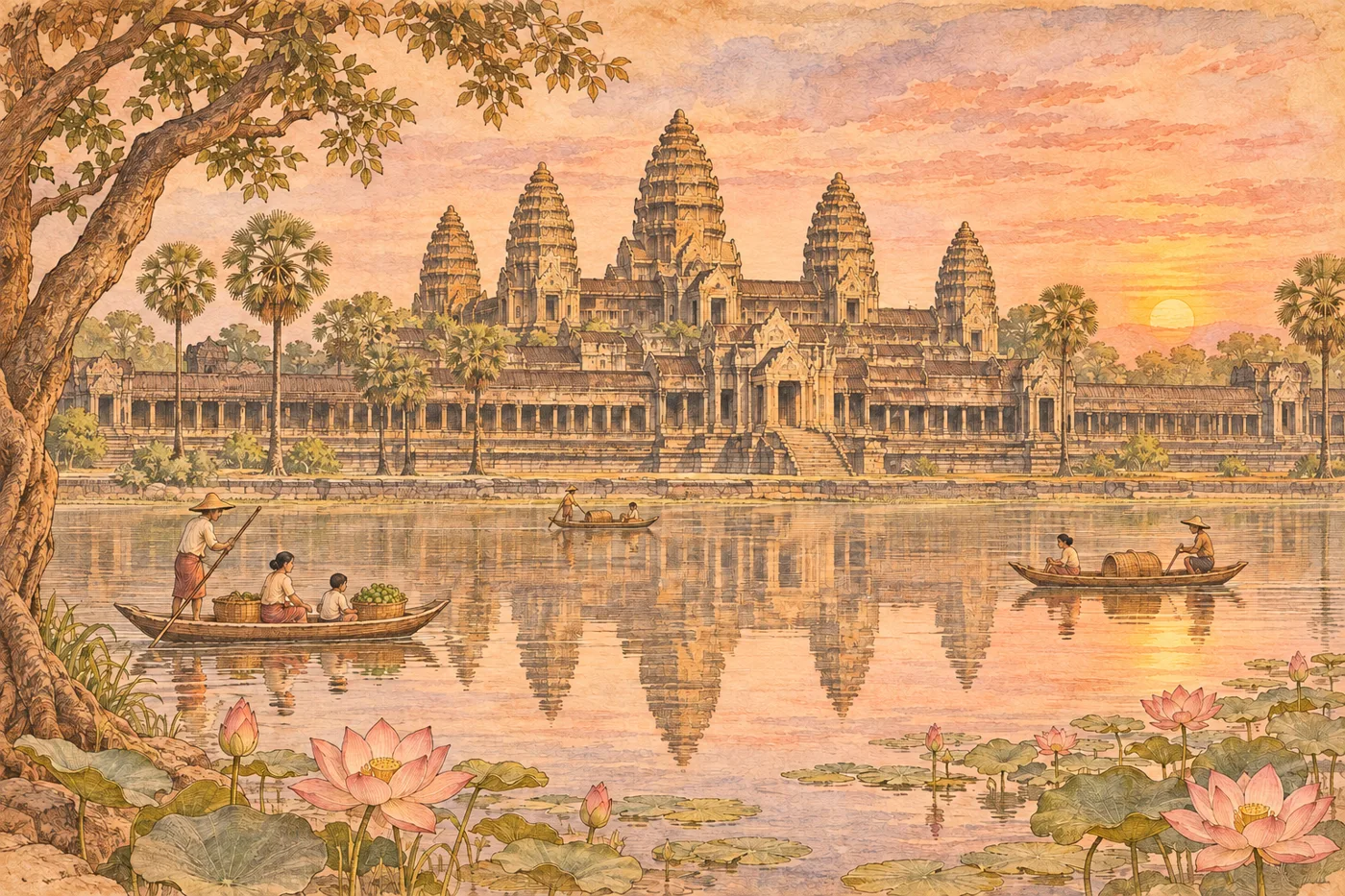
Why did a vast capital and temples arise in the middle of a tropical forest?
According to Khmer inscriptions (carved in later times), in 802 Jayavarman II performed a coronation ritual, laying the foundation for what would become the Angkor dynasty. For the next 600 years or so, the Khmer kingdom held great power in mainland Southeast Asia.
This region has a distinct rainy season and dry season. The Khmer people built large reservoirs called baray, canals, and embankments to control the water. Nearby was Tonle Sap Lake, which expanded during the rainy season and provided abundant fish. It is said that water was used not only for rice fields.
In the first half of the 12th century, under Suryavarman II (reigned c. 1113–c. 1150), Angkor Wat was built. Dedicated to the Hindu god Vishnu, the temple is surrounded by a moat about 1.5 km east–west and 1.3 km north–south. Its walls are carved in detail with scenes from myths and battles.
At the end of the 12th century, Jayavarman VII (reigned c. 1181–c. 1218) restored the kingdom. The king was a devotee of Mahayana Buddhism and built a new capital, Angkor Thom, along with the Bayon temple, known for its towers with faces on four sides. Inscriptions record that he also built roads and hospitals.
In 1296, as a member of a Yuan mission, Zhou Daguan visited Angkor. He later wrote A Record of Cambodia: The Land and Its People, leaving an account of the capital, daily life, and the lively market women. It is a precious record of how it looked at that time.
In the 15th century, Angkor declined in power. It is said to have been attacked by the Ayutthaya army in 1431, but that was not the only reason. Various factors are considered, including climate change and the shifting of political centers. Angkor Wat continued to be cherished as a Buddhist temple afterward.
Mini timeline
- 802Jayavarman II performs a coronation ritual
- first half of the 12th centuryAngkor Wat is built
- c. 1181Jayavarman VII ascends the throne
- 1296Zhou Daguan visits
- 1431Said to have been attacked by the Ayutthaya army
People in this chapter
He restored the kingdom and left many buildings, including the Bayon temple.
He compiled his observations of Angkor into A Record of Cambodia: The Land and Its People.
Meanwhile, elsewhere
Connection to Japan
In 802, Heian-kyō had only recently been established. When Angkor Wat was built, Japan was in the late Heian period, under cloistered rule. Zhou Daguan’s visit in 1296 corresponds to the late Kamakura period.
Why it still matters
Angkor was registered as a World Heritage Site in 1992. Angkor Wat appears on the national flag of Cambodia and is a symbol of the country.
Perspectives differ
- Causes of decline
- There are various theories: attack by Ayutthaya, climate change, deterioration of waterworks, shifts in trade routes, and religious or political changes. Which was the main cause is not clear.
- Was Angkor Wat a temple or a tomb?
- There is a theory that it was both a temple dedicated to Vishnu and a mortuary shrine for the king after his death. Evidence includes its westward orientation, but researchers' views are not unified.
- What were the waterworks for?
- Some see them as irrigation for fields, others emphasize religious and symbolic meanings, and still others see them as serving multiple purposes such as water storage for the dry season and flood control. Debate continues.
- Was 1431 really a turning point?
- The account of its fall in 1431 is said to be based on Ayutthaya chronicles and other sources. Recent research suggests that the decline of the city center began earlier and progressed gradually, leading to debate about the significance of that date.
Facts checked (7, verified by AI on the web)
- Confirmed In 802, Jayavarman II ascended the throne and the Khmer kingdom began, according to tradition Britannica: Khmer empire
Commonly given as 802 (some sources say 790). The inscription is from a later period. - Confirmed Suryavarman II built Angkor Wat around 1113–1150 Britannica: Khmer empire
Britannica says Suryavarman II gained sole power around 1113. - Confirmed Jayavarman VII (c. 1181–c. 1218) built Angkor Thom and the Bayon Britannica: Khmer empire
Britannica gives his accession as 1181. Some sources give the end of his reign as c. 1220. - Confirmed Zhou Daguan visited in 1296 and wrote A Record of Cambodia Monash University: Journey to medieval Angkor
Monash University records state: 'In August 1296, the Chinese diplomat Zhou Daguan arrived in Angkor' and calls his work the only descriptive record of the capital. His stay lasted about 12 months. - Corrected & confirmed Angkor was attacked by Ayutthaya in 1431, but decline was long-term with multiple factors PNAS: Geoarchaeological evidence from Angkor reveals a gradual decline (2019)
The 1431 capture by Ayutthaya is a fact, but some research suggests the urban center's decline began earlier. Drought may also have played a role. Text and debate section have been revised. - Confirmed Registered as a World Heritage Site in 1992 UNESCO World Heritage Centre: Decision 3438 (Angkor)
December 1992. The registered name was corrected to 'Angkor'. - Confirmed Jayavarman VII was a devotee of Mahayana Buddhism and built roads and hospitals Britannica: Khmer empire
Britannica confirms he was a devout Mahayana Buddhist and built over 100 hospitals and rest houses. He also patronized Hinduism and other faiths. Reign c. 1181–c. 1215 (some sources say c. 1220).
Sources
Britannica: Khmer empire
Monash University: Journey to medieval Angkor
PNAS: Geoarchaeological evidence from Angkor reveals a gradual decline (2019)
UNESCO World Heritage Centre: Decision 3438 (Angkor)
* AI-drafted and cross-checked; human review is in progress. Status: