The Kingdom of Ghana and Gold — Trade Across the Sahara
Why did a kingdom south of the desert come to be known as the 'land of gold'?
South of the Sahara Desert in West Africa, where grasslands stretch wide, the Kingdom of Ghana flourished. In fact, it was located not in today's Republic of Ghana, but in what is now thought to be southeastern Mauritania to western Mali. Its people were mainly the Soninke (it is said that 'Ghana' was originally a word for the king).
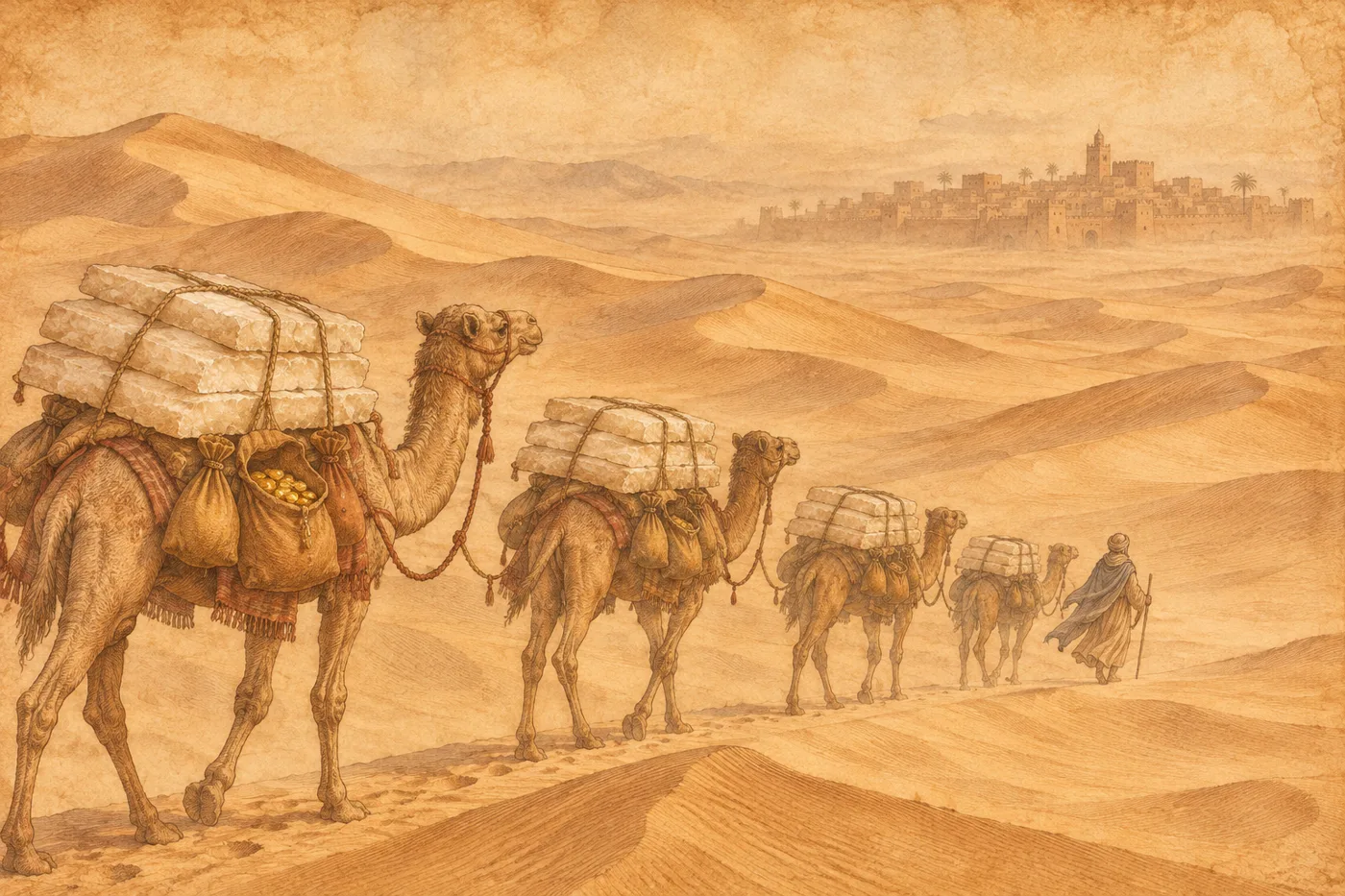
What enriched this kingdom was trans-Saharan trade. Berber merchants from North Africa loaded their camels and crossed the desert. The camel, able to travel long distances with little water, is an animal built for the desert. From the north came salt and cloth; from the south came gold.
For the people south of the Sahara, salt was essential for life. Meanwhile, the gold found near the southern forests fetched high prices in the Mediterranean world. It was an exchange of salt for gold. The Kingdom of Ghana, lying along this trade route, collected taxes from merchants and amassed great wealth.
Around the mid-11th century, a Muslim geographer named al-Bakri (whose work is dated to about 1068), who lived in what is now southern Spain (then al-Andalus), wrote about this kingdom. According to him, the king's palace was magnificent, the king adorned himself with gold ornaments, and all gold nuggets in the country belonged to the king. Even among the peoples of distant Europe and the Middle East, Ghana became known as the 'land of gold.'
However, Ghana's glory did not last long. In the latter half of the 11th century, it is said that the Almoravid dynasty attacked from the north. Increasing aridity and the shift of trade routes eastward and westward are also thought to have contributed to the weakening of the kingdom's power. Eventually, the next great empire, the Mali Empire, arose in this region.
The Kingdom of Ghana itself left few written records of its own. Much of what we know comes from Arabic travelogues and information from excavated ruins. Still, this kingdom teaches us that the Sahara was not a 'wall separating the world,' but a 'sea-like road connecting the world.'
Mini timeline
- Up to around the 8th centuryFormation of the Kingdom of Ghana (some theories date it earlier)
- 1068Al-Bakri writes about Ghana
- About 1076The Almoravid dynasty is said to have attacked the capital (various theories)
- 13th centuryThe Mali Empire rises and inherits this region
- 1957The British Gold Coast gains independence and adopts the name 'Ghana'
People in this chapter
Never visiting himself, he wrote about the Kingdom of Ghana based on stories he heard from travelers.
Known as the king whose luxurious life was recorded by al-Bakri (the spelling of his name varies by source).
Meanwhile, elsewhere
Connection to Japan
Japan was in the Heian period. Murasaki Shikibu is said to have written *The Tale of Genji* around the beginning of the 11th century.
Why it still matters
Although located elsewhere, the modern Republic of Ghana proudly adopted the name of this ancient kingdom when it gained independence in 1957. In Saharan salt mines, camel caravans were still transporting salt until recent years.
Perspectives differ
- Date of founding
- Theories range from as early as the 4th century to around the 8th century; nothing is certain.
- Location of the capital
- The capital is believed to be the Koumbi Saleh ruins in southeastern Mauritania, but this is not confirmed.
- Cause of decline
- The theory that the Almoravid attack was the decisive blow was long dominant, but recent research downplays its impact and emphasizes desertification, internal problems, and shifting trade routes.
- Existence of 'silent trade'
- The famous story that people in the gold-producing region exchanged salt for gold without ever meeting the merchants face-to-face is well-known, but how common it actually was is unclear due to a lack of sources.
- Bias in the records
- Much of what we know about the Kingdom of Ghana relies on records by outsiders; the perspectives of the kingdom's own people are not well preserved, a point that requires caution.
Facts checked (5, verified by AI on the web)
- Confirmed The Kingdom of Ghana was located in present-day southeastern Mauritania to western Mali. World History Encyclopedia: Ghana Empire(事典)
Encyclopedias state that the Kingdom of Ghana was in what is now southern Mauritania and Mali, and the U.S. Library of Congress country profile also places it in southeastern Mauritania and southwestern Mali. - Confirmed 'Ghana' was originally a title for the king. Britannica「Ghana (historical West African empire)」
Rulers called their country 'Wagadu,' and the common name is said to have derived from the king's title, ghāna. - Unverified Al-Bakri's work is from around 1068. Britannica: Abū ʿUbayd al-Bakrī
World History Encyclopedia (Ghana Empire) opened; only mentions al-Bakri's visit in 1076, no authorship year. Britannica returns 403. Year 1068 not confirmed. - Corrected & confirmed The Almoravid attack was around 1076 (various theories). Conrad & Fisher「The Conquest That Never Was」(History in Africa)
The 'conquest' of 1076 is based on a questionable source (al-Zuhri), and whether conquest actually occurred is debated. The text uses 'is said to have' and '(various theories)' for consistency. Britannica records Sundiata destroying the capital in 1240. - Confirmed The founding of the Kingdom of Ghana was by around the 8th century. Library of Congress Federal Research Division: Country Profile: Mali
U.S. Library of Congress materials state that the Kingdom of Ghana may have begun as early as the 5th century, was prominent by the 8th, and flourished from about 700 to 1078. World History Encyclopedia dates it to around the 6th century. The text's debate section includes a range.
Sources
Britannica「Ghana (historical West African empire)」
Britannica: Abū ʿUbayd al-Bakrī
Conrad & Fisher「The Conquest That Never Was: Ghana and the Almoravids, 1076」
World History Encyclopedia: Ghana Empire(事典)
Library of Congress Federal Research Division: Country Profile: Mali
* AI-drafted and cross-checked; human review is in progress. Status: