Yoruba and Ife — City of Copper and Terracotta
Why is the old West African town of Ife called the "place where the world began" for the Yoruba people?
In what is now southwestern Nigeria, there is an old town called Ife (Ile-Ife). The Yoruba people have long considered this the birthplace of the world. According to tradition, the god Oduduwa separated the land and water and founded the first kingdom here. Ife was a spiritual center and has been regarded as the "homeland" of the Yoruba royal houses that later spread across various regions. Its name still holds a special resonance for many people.
Ife is said to have been founded around 500 AD. However, it truly flourished from the 11th to the 15th century. The town grew wealthy through trade, and there seem to have been skilled artisans at the king's court. Why this kingdom declined is not clear. Explanations place the decline in either the late 15th or the 16th century, so there is a range of dates. Nevertheless, the artifacts left behind quietly tell of a prosperous city.
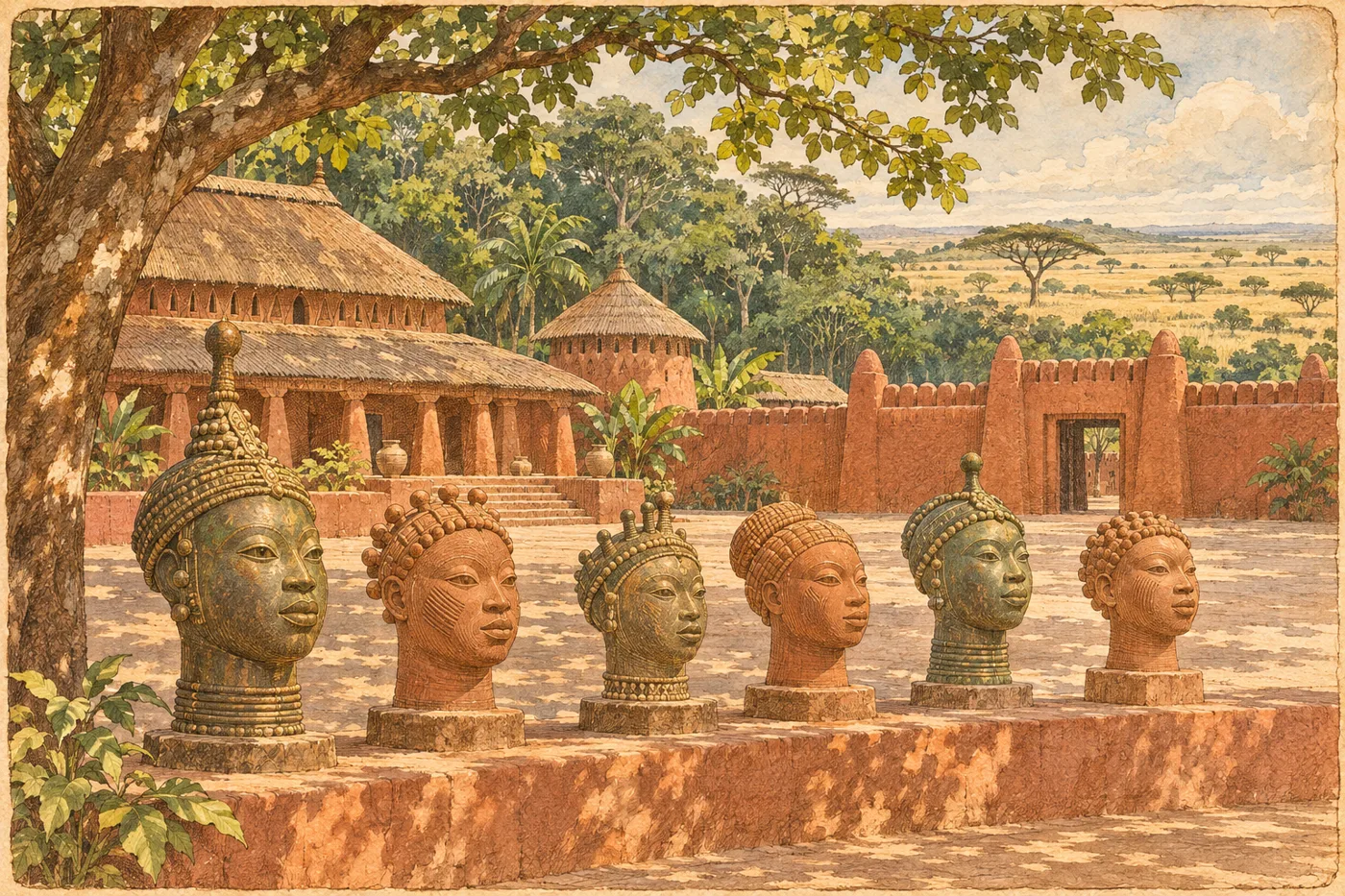
What made Ife famous are the human head sculptures. There are heads made of copper alloy using the lost-wax casting technique, and terracotta heads. Based on excavation layer analysis and dating methods such as thermoluminescence, they are said to date from around the 11th to 15th centuries. In 1938-39, a group of 17 head sculptures was found together on a site near the royal palace. The faces have fine vertical lines and are highly realistic. Even the clay figures have expressions as if they were alive.
Exactly what these heads represent is not clearly known. They are thought to be either kings, gods, or ancestors, or perhaps to have had a religious purpose. The facial lines are variously explained as decoration, marks of status, or shadows of a veil. According to Yoruba thought, a person's power and character reside in the head, which is said to explain why head sculptures were so important. The lack of a definitive answer only fuels the imagination.
The royal house of Ife spread to various regions. According to tradition, Oranmiyan, said to be a son or grandson of Oduduwa, is considered the ancestor of the lineage that later led to the Oyo Kingdom. Oyo was a large state that ruled a vast territory with horses and bows from the 17th to the 19th century. The art of Benin also shares similarities with Ife; Benin tradition says that the king of Ife sent artisans there. It seems there were also deep ties with the forest states to the east.
In the early 19th century (1810s-1830s), internal rebellion combined with attacks from Islamic powers to the north caused Oyo to collapse, splintering into smaller states. Around this time, large numbers of Yoruba-speaking people were taken across the Atlantic as slaves. Their beliefs survived in new forms in places such as Brazil and Cuba, and even today in Nigeria, the tradition of the Ooni (king) of Ife and worship of the Orishas continues. Even far from their homeland, faith became a spiritual anchor for the people.
Mini timeline
- Around 500The town of Ife is said to have been founded.
- 11th–15th centuryIfe flourishes; copper alloy and terracotta head sculptures are said to have been made (dates vary).
- Late 15th–16th centuryThe decline of the Ife kingdom is placed in this period (various theories).
- 17th–19th centuryThe Oyo Empire flourishes.
- Early 19th century (1810s–1830s)Internal rebellion and attacks from Islamic powers to the north combine, leading to the collapse of Oyo.
- 1938–39A group of 17 head sculptures is found together on a site near the royal palace in Ife.
People in this chapter
Spoken of in tradition as the god or first king who founded Ife.
Said to be a son or grandson of Oduduwa, linked in tradition to the origins of Oyo.
Meanwhile, elsewhere
Connection to Japan
Ife's heyday from the 11th to the 15th century corresponds to Japan's mid-Heian period through the Kamakura and Muromachi periods (Kamakura shogunate established around 1185, Muromachi shogunate in 1338). The collapse of Oyo in the 1810s–1830s falls during the Bunka and Bunsei to Tenpō eras of the Edo period.
Why it still matters
Ife still has an Ooni (king) and is known as a center of Yoruba faith and culture. The head sculptures are displayed in museums in various places. Worship of the Orishas has also spread to places such as Brazil, Cuba, and the United States.
Perspectives differ
- Dating of the head sculptures
- The heads are said to date from the 11th to 15th centuries, but the dates for individual pieces vary, and the exact chronology differs among researchers.
- Who the heads represent
- Explanations vary—such as kings, gods, or ancestors—and who they represent remains unclear; there is also no definitive answer for the meaning of the facial lines and veils.
- Oduduwa tradition and history
- The tradition that Oduduwa was the founder of Ife's royal house is widely told, but whether he was a historical figure and where he came from are subjects of debate. Because the tradition is passed down orally, there are multiple versions.
- Relationship with Benin
- There is a tradition that Ife's techniques were transmitted to Benin, but how exactly this transmission occurred is viewed differently among scholars.
Facts checked (9, verified by AI on the web)
- Confirmed Ife is said to have been founded around 500 AD, flourished from the 11th to 15th centuries, the reason for its decline is unknown, and its end is variously placed in the late 15th or 16th century. World History Encyclopedia: Ife(事典)
Confirmed in encyclopedia (reason for decline unknown, two accounts for the end date). - Confirmed The head sculptures were made by the lost-wax method, chemical analysis dates them to the 11th–15th centuries, and a dozen or more heads were found near the palace around 1938–39. Their purpose is unknown. World History Encyclopedia: Ife(事典)
Confirmed in an encyclopedia, but the page centers on copper-alloy (brass) heads and does not confirm dates for the terracotta heads. The number found differs by source (12, or 17). The text gives terracotta dates as approximate. - Confirmed There is a belief that power resides in the head, which explains why head sculptures were valued. World History Encyclopedia: Ife(事典)
Confirmed in encyclopedia (explanation of ase, iwa). - Confirmed Oranmiyan was Oduduwa's son, and Oyo originated from an exiled king of Ife. Oyo expanded with cavalry and bows from the 17th to the 19th century. World History Encyclopedia: Oyo Empire(事典)
Confirmed in encyclopedia (treated as oral tradition). - Confirmed In the 1820s, attacks from northern Islamic states such as the Fulani caused Oyo's collapse, after which many Yoruba people were sent to the Americas. World History Encyclopedia: Oyo Empire(事典)
Confirmed in encyclopedia. - Confirmed Benin tradition holds that the king of Ife sent artisans. World History Encyclopedia: Ife(事典)
Confirmed in encyclopedia. - Unverified Worship of the Orishas took new forms in Brazil and Cuba / The Ooni still exists in Nigeria today. Smithsonian Folklife Festival Program Book 1989 (Yoruba/Santeria)
Smithsonian source confirms Yoruba people were brought to Cuba in large numbers between 1790 and 1865, and the Orisha faith became Santería. The existence of Candomblé in Brazil and the current Ooni of Ife could not be confirmed in official source texts. Overall remains unverified. WHE Yoruba page only mentions syncretism in Latin America. - Confirmed Anecdote that Europeans initially did not believe Ife's head sculptures were made by Africans. World History Encyclopedia: Ife(事典)
Ife page text confirms: European discoverers could not believe that ancient Black Africans had created such masterpieces. Individual names (e.g., Frobenius) are not on the page. - Unverified Events in other regions and Japan in the meanwhile/japan sections. World History Encyclopedia: Ife(事典)
Specific subject not identified; not verified this time.
Sources
World History Encyclopedia: Ife(事典)
World History Encyclopedia: Oyo Empire(事典)
World History Encyclopedia: Yoruba(事典)
Smithsonian Folklife Festival Program Book 1989(サンテリア/ヨルバ)
* AI-drafted and cross-checked; human review is in progress. Status: