Hausa City-States and the Sokoto Caliphate — Learning and faith built one of West Africa's largest empires
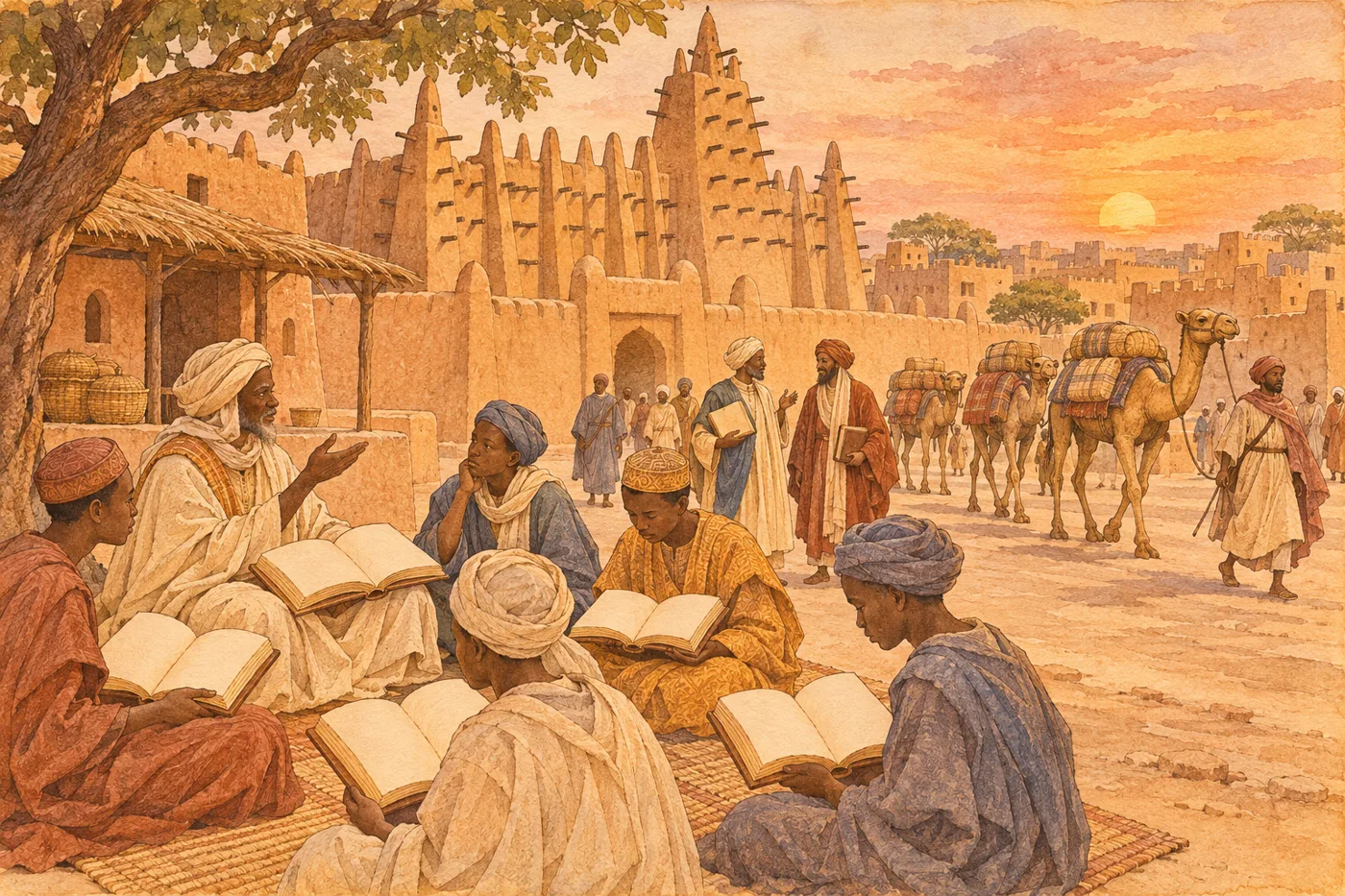
Why did a collection of scattered city-states come together into a single large empire in the 19th century?
From what is now northern Nigeria to southern Niger stretches a land where Hausa-speaking people live. Here stood walled city-states such as Kano, Katsina, Zaria (Zazzau), and Gobir. Tradition holds that Kano was founded around 999 (an event around 1000), but this date is based on oral tradition.
These cities were the southern termini of trade routes across the Sahara. From the north came salt, cloth, and horses; from the south, gold and kola nuts. Kano was also known for dyed cloth and leather goods, and by around the 16th century it was one of the region's most prosperous cities. The cities sometimes fought each other and never united into a single kingdom.
From the 18th into the early 19th century, in the land of Gobir, the Fulani (Fula) Islamic scholar Usman dan Fodio preached his teachings to the people. As his following grew, conflict with the king deepened. In 1804, he is said to have been chosen as 'Commander of the Faithful' and rose up in jihad (holy struggle).
Within a few years, the fighting spread far and wide, and the Hausa city-states, along with many surrounding regions, were incorporated into a new state. It is said that Usman divided the empire into eastern and western halves, placing them under his brother Abdullahi and his son Muhammad Bello. Bello ruled the eastern half from the new capital of Sokoto and later became the overall leader of the empire. This was the Sokoto Caliphate (also called the Sokoto Empire).
The state was a loose federation of more than thirty provinces called 'emirates,' which swore loyalty to the caliph in Sokoto. Usman's daughter Nana Asma'u is known as a poet and educator. She left poems in Hausa, Fula, and Arabic, and spread learning among women. At the same time, it is thought that a very large number of enslaved people lived in this state, supporting agriculture and other work.
From the late 19th to the early 20th century, as the European powers carved up Africa, the British advanced north from their bases in the southern protectorate. In March 1903, Sokoto fell. In July of the same year, the last resistance was broken at Burmi, and the Caliphate came to an end. The British, through a system of 'indirect rule,' kept the local emirs in place while incorporating the region into their protectorate.
Mini timeline
- ca. 1000Tradition holds that Kano was founded (around 999).
- 1804Usman dan Fodio begins the jihad.
- ca. 1809–17Sokoto is said to have been developed as a capital.
- ca. 1817Usman dies; Muhammad Bello becomes the leader of the empire.
- 1903The British occupy Sokoto; the Caliphate ends.
People in this chapter
He valued teaching and learning, and began the jihad in 1804.
Usman's daughter, she spread learning among the people through poetry and education.
Meanwhile, elsewhere
Connection to Japan
The year the jihad began, 1804, was the late Edo period in Japan. Sokoto fell in 1903 — the 36th year of Meiji, the year before the Russo-Japanese War.
Why it still matters
The Sultan of Sokoto (a title that succeeds the former caliphate) is still recognized today in Nigeria as a religious leader for Muslims. Kano's old city and the tradition of Hausa-language poetry remain beloved.
Perspectives differ
- Nature of the jihad
- Some scholars see it as a movement to revive religion, while others view it as driven by tax and political grievances mixed with ethnic conflicts. The debate among researchers continues.
- Date of Kano's founding
- The date 999 is based on traditions such as the Kano Chronicle and has not been confirmed by independent evidence. The 'Bayajidda legend' concerning Hausa origins is also debated as to whether it is historical fact.
- Size and population of the empire
- The view that this was 'one of the largest empires in 19th-century West Africa' is widely shared, but figures for population and territory vary greatly by source and remain unclear.
- How to evaluate slavery
- It is known that this state had a large enslaved population. Scholars differ in how they situate this within the Islamic world and how they view the changes after British rule.
Facts checked (8, verified by AI on the web)
- Corrected & confirmed In 1804, Usman dan Fodio began the jihad and was named 'Commander of the Faithful' World History Encyclopedia(事典): Hausaland
WHE (encyclopedia) records that Usman dan Fodio conquered the Hausa city-states from 1804. The point about being chosen 'Commander of the Faithful' could not be confirmed in a readable public source, so the text says 'is said to have been.' - Unverified Sokoto was developed from a camp into a city by Bello around 1809
WHE 'Sokoto Caliphate' returns 403; could not be confirmed. - Unverified Sokoto fell in 1903, and Attahiru I was defeated at the Battle of Burmi in the same year
WHE 'Sokoto Caliphate' returns 403; could not be confirmed. - Corrected & confirmed Tradition holds that Kano was founded by Bagauda around 999 Britannica (Hausa・Kano の成立伝承)
The date is based on tradition from the Kano Chronicle and not independently confirmed. The text and debate section explicitly note 'tradition.' - Confirmed Nana Asma'u was born around 1793, a daughter of Usman, and known as a poet and educator African History Extra: Nana Asma'u
Her death year is given as either 1864 or 1865. The text does not give her birth or death years. - Confirmed The Hausa states are traditionally known as the 'Hausa Bakwai' (Seven Hausa States), with variations in the list World History Encyclopedia(事典): Hausaland
WHE (encyclopedia) lists the traditional seven city-states (Hausa Bakwai) as Biram, Daura, Gobir, Kano, Katsina, Rano, and Zaria (Zazzau), noting that 'seven' is a traditional count with some variations in membership. - Unverified The British attacked Sokoto by advancing north from the Niger River delta side
WHE 'Sokoto Caliphate' returns 403; could not be confirmed. - Confirmed Usman died around 1817, and Bello succeeded him African Studies Quarterly (University of Florida): Ochonu, Colonialism within Colonialism
An academic journal from the University of Florida states that Usman's death (1817) saw Bello succeed him, dating the jihad to 1804–08.
Sources
World History Encyclopedia(事典): Hausaland
Britannica: Sokoto
Britannica: History of Nigeria
Britannica: Hausa Bakwai
Britannica: Frederick Lugard
African Studies Quarterly (University of Florida): Ochonu, Colonialism within Colonialism
Britannica (Hausa・Kano の成立伝承)
* AI-drafted and cross-checked; human review is in progress. Status: