Griot & Oral History — A World Where Speech was the Record
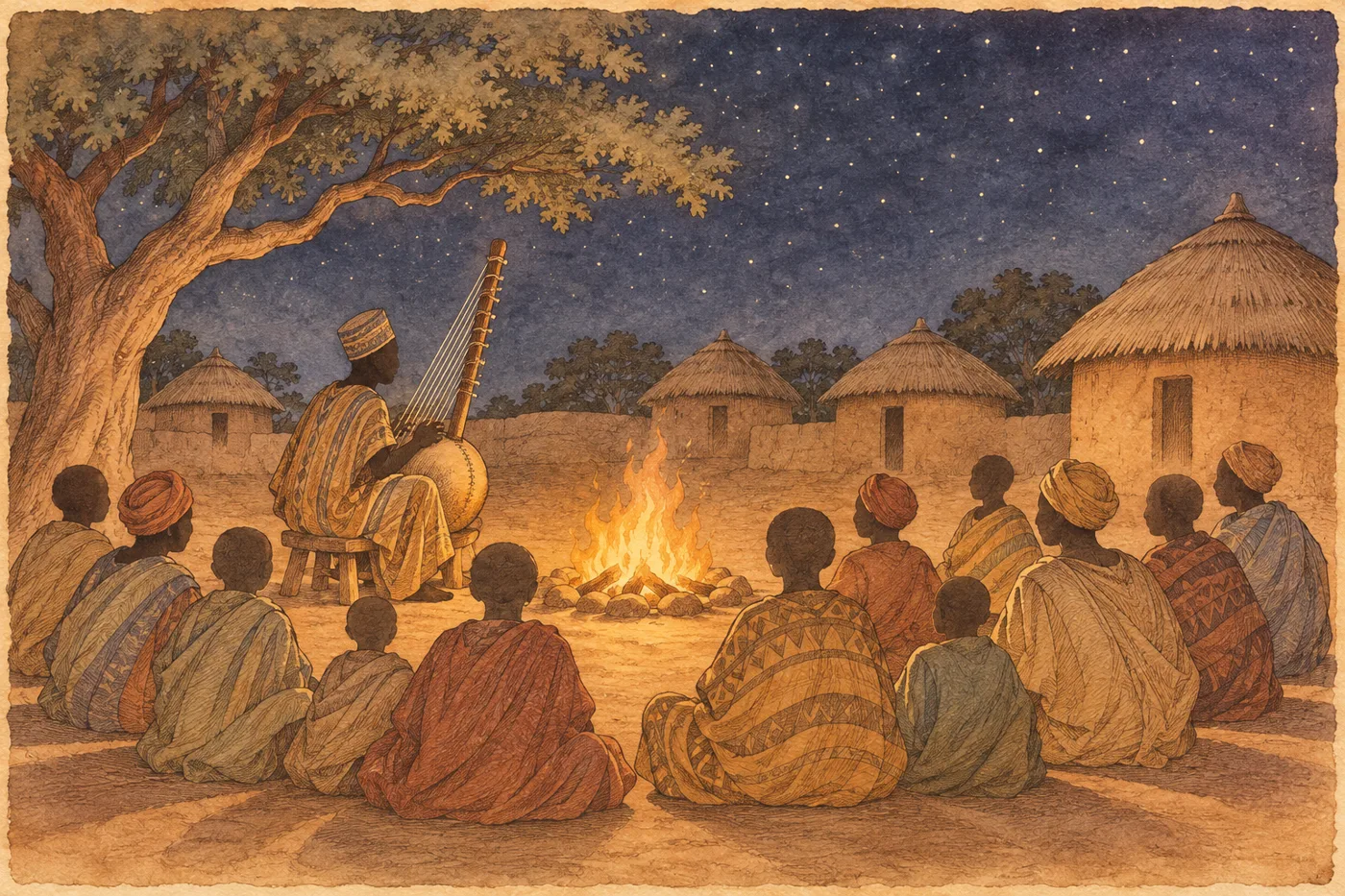
Without writing, how have the tales of kings from hundreds of years ago reached us today?
West Africa has storytellers called 'griots.' In the language of the Mande people, they are also called 'jeli' (or 'jali'). From childhood, they learn words, songs, and instrumental skills, memorizing the genealogies of kings and families as well as past events, and they recite and sing them before audiences. Many are said to be born into families that have carried on this role for generations, with skills passed from parent to child, master to apprentice.
Griots are not merely singers. They served at the side of kings, offering advice; at ceremonies and weddings they would sonorously recite the lineages of noble houses; and they sometimes acted as mediators in disputes. Before great battles, they are said to have encouraged the people by chanting the names of ancestors. By remembering and recounting the past, they bore the role of sustaining society's memory. Spoken words also served as the basis for pledges and pride.
The representative of such oral narratives is the 'Epic of Sundiata.' It is the story of Sundiata Keita, who would go on to found the Mali Empire around the 13th century, telling of how the prince defeated Sumanguru, the king of Sosso. The site of the battle is Kirina, dated to about 1235. This epic, accompanied by the sounds of instruments like the kora and balafon, is still handed down through the recitations of jelís today.
The story also features Balla Fasséké, a jeli who stands by Sundiata. He is the prince's friend and teacher, a storyteller. The pattern of a king and a griot working together to tell history well illustrates the role that oral narrative played in this world. On the other hand, the story includes magic and miraculous events, blending fact and legend.
Written historical sources from the outside world also exist for the Mali Empire. The Islamic traveler Ibn Battuta visited in 1352, and the 14th-century historian Ibn Khaldun also wrote about Mali. Records from Cairo survive regarding the pilgrimage of Mansa Musa in 1324–25. However, oral traditions and written accounts often disagree on details.
Rather than trusting only one side, researchers consider history by comparing oral traditions and written sources. The voice-recorded past tells us about events that did not survive in writing, but it also changes shape slightly with each telling. Written records are viewed through the eyes of distant observers, but they also come with the bias of an outsider's perspective. Reading the two together reveals things that might otherwise be missed.
Mini timeline
- c. 1210Sundiata is said to have been born
- c. 1235Sundiata's side defeats Sosso at the Battle of Kirina
- 1324–25Mansa Musa undertakes a grand pilgrimage
- 1352Ibn Battuta visits Mali
- 19th centuryGriot oral narratives begin to be written down and translated
People in this chapter
He is the protagonist of the epic. His life dates and character differ in detail between oral tradition and written sources.
He is Sundiata's griot, described as a friend and teacher. He is a figure who symbolizes the role of the storyteller.
Meanwhile, elsewhere
Connection to Japan
Around 1235, Japan was in the Kamakura period, a few years after Hōjō Yasutoki and others established the Goseibai Shikimoku (1232), a legal code for warriors. In Japan too, biwa-playing monks are said to have recited The Tale of the Heike, with oral performance transmitting history.
Why it still matters
The Epic of Sundiata is still told in Mali, Guinea, Senegal, and The Gambia, and in some regions it is taught to children in schools. Jelís also work as modern musicians, continuing their role of passing on people's memories. There are also initiatives related to intangible cultural heritage by international organizations, but we will not go into detail here.
Perspectives differ
- How much of the oral tradition is historical fact?
- The Epic of Sundiata includes many legendary elements such as magic. Scholars are divided on how much of it can be read as historical fact.
- Date of the empire's founding
- The Battle of Kirina is dated to about 1235, but sources differ by several decades on the founding and end of the empire, and there are various theories.
- Sundiata and Islam
- Arab chronicles record that Sundiata converted to Islam, while the oral tradition is said to depict him as embracing Islamic genealogy but also valuing traditional sorcery and spiritual power. Interpretations of his actual image are varied.
- Does the narrative change?
- The epic varies in form depending on the storyteller, region, and era. Whether these differences are seen as 'distortions' or a 'living tradition' depends on one's standpoint.
Facts checked (6, verified by AI on the web)
- Confirmed Griots (jalis) are professional storytellers trained from childhood, bearers of royal memory who recited genealogies before major battles. UC Berkeley ORIAS: Sundiata
Confirmed in the ORIAS text: trained from childhood, guardians of royal memory, advisors, reciting genealogies before battle. - Confirmed Griot (jeli) is a hereditary occupation passed down by birth, with skills transmitted through apprenticeship. Wesleyan University (MUSC265 course project): Jelis, Music and History
From a university course project site. It states 'born into the role' and 'become an apprentice to an older jeli.' Since it is a concise student page, it is used only for confirmation of general descriptions. - Confirmed The Epic of Sundiata originated as an oral narrative and is still told in Mande-speaking areas (Guinea, Mali, Senegal, The Gambia, etc.). UC Berkeley ORIAS: Sundiata
Confirmed in the text: oral as original form, still told in multiple countries today. - Confirmed The Battle of Kirina is dated to about 1235 (Sundiata's birth c. 1210). World History Encyclopedia(事典): Sundiata Keita
Confirmed: Kirina in 1235, birth in 1210. ORIAS retelling also says 1235. The empire's duration varies by source; 'c.' is used in the text to avoid assertion. - Confirmed Oral traditions and the records of Arab writers such as Ibn Battuta (1352) and Ibn Khaldun do not always match. World History Encyclopedia(事典): Sundiata Keita
Confirmed in the text: discrepancies between Arab chronicles and oral tradition, including differences in accounts of conversion to Islam. The 1324–25 pilgrimage and Ibn Battuta's 1352 visit confirmed via South African History Online. - Confirmed The griot tradition (Sosso Bala) was inscribed on an international organization's intangible cultural heritage list in 2008. UNESCO無形文化遺産: Cultural space of Sosso-Bala
Text confirms: Guinea's cultural space of Sosso Bala was inscribed on the Representative List in 2008 (3.COM) (proclaimed a masterpiece in 2001), with the Kouyaté family griots of Nyagassola as custodians, transmitting the Epic of Sunjata.
Sources
UC Berkeley ORIAS: Sundiata
UC Berkeley ORIAS: Sundjata (retelling by Nick Bartel, 2015)
Wesleyan University (MUSC265 course project): Jelis, Music and History
World History Encyclopedia(事典): Sundiata Keita
South African History Online: The Mali Empire (c. 1235-1600 CE)
* AI-drafted and cross-checked; human review is in progress. Status: