Benin and Dahomey — Forest Kingdoms and Bronze Art
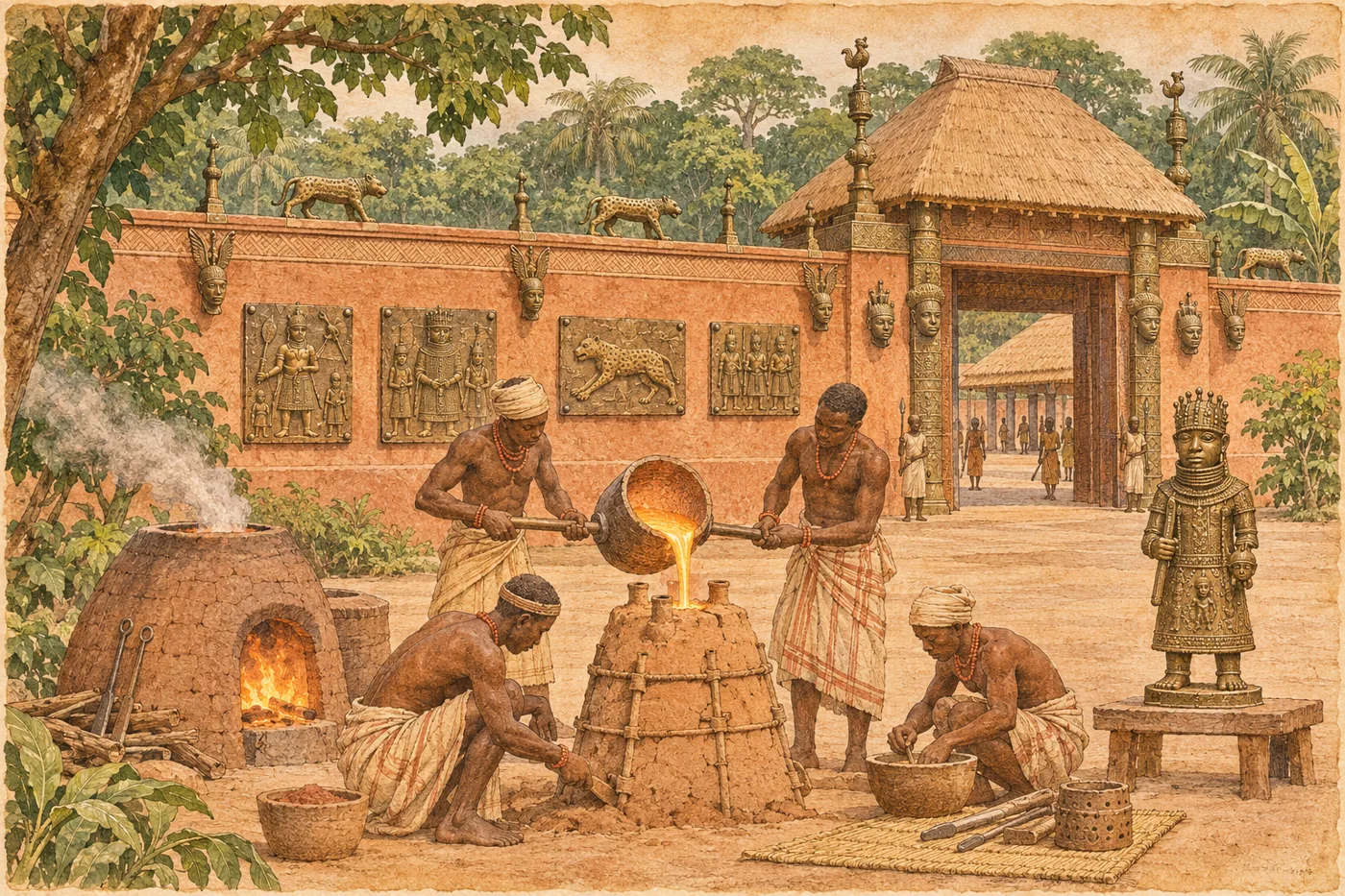
Why were the forest kingdoms of West Africa able to create such magnificent metal artworks?
From the grasslands south of the Sahara, as you go further south, tropical forests spread out. In what is now southern Nigeria, there was the Edo people's Kingdom of Benin. Its capital was Benin City. The king was called the 'Oba.' Note that this is a different place from the present-day Republic of Benin.
The Kingdom of Benin is said to have been established around the 13th century. In the 15th century, Oba Ewuare the Great (reigned mid-15th century) is said to have organized the capital and expanded the kingdom. The city was laid out with wide roads and large earthen ramparts, and Portuguese who arrived at the end of the 15th century are said to have been amazed by its grandeur.
What is known worldwide as Benin art is the brass and bronze relief plaques and memorial heads of kings. They decorated the palace walls and served to convey the king's history and rituals. Craftsmen are said to have belonged to specialized guilds serving the king.
To the west was the Kingdom of Dahomey, in what is now southern Benin. Its capital was Abomey. It arose in the 17th century, engaged with European traders, and built a strong military. This kingdom's army included female warriors called 'Agojie' (or 'Mino'), whom Europeans called 'Amazons.'
Dahomey was also deeply involved in the Atlantic slave trade. From the time of King Gezo (reigned c. 1818–1858), palm oil exports began to grow from the 1830s and are said to have offered an alternative to the slave trade (though slave exports continued until around 1863). Then, in 1892–94, Dahomey lost a war with France and was incorporated into French colonial territory.
Benin also faced a major turning point in 1897. A British punitive expedition burned the palace and took away thousands of artworks. These were housed in museums in London and elsewhere in Europe and America. Benin's bronze art thus became known to the world, but the treatment of the taken objects remains under debate today.
Mini timeline
- c. 13th centuryThe Kingdom of Benin is said to have been established.
- Late 15th centuryPortuguese reach Benin.
- 17th centuryThe Kingdom of Dahomey arises.
- 1894Dahomey is conquered by France.
- 1897British forces attack Benin City.
People in this chapter
He is remembered as the king who organized the capital and expanded the kingdom.
A king who strengthened the nation in the first half of the 19th century and is said to have begun a shift away from dependence on the slave trade.
Meanwhile, elsewhere
Connection to Japan
Portuguese ships arrived in Benin at the end of the 15th century, and in 1543 they also brought firearms to Japan. The same nation's ships encountered two distant lands.
Why it still matters
In Nigeria, where Benin City lies, a king still exists and traditional ceremonies continue. The Republic of Benin changed its name from Dahomey in 1975 to its current name.
Perspectives differ
- Founding date of the Kingdom of Benin
- The notion of 'around the 13th century' is based on oral tradition; archaeological research suggests the city may have developed even earlier.
- Bronze material source
- Some analyses indicate that metal bracelets brought from Europe were melted down as raw material. Research on the provenance of materials continues today.
- Repatriation of artworks
- There is ongoing debate between those who argue the taken artworks should be returned to their original location and those who believe they are better off in museums accessible to people worldwide.
- Dahomey's female warriors
- 'Amazon' is a term used by the French. There are various theories about their numbers and actual roles, and some aspects are told in a legendary manner.
Facts checked (5, verified by AI on the web)
- Confirmed Ewuare the Great reigned in the mid-15th century World History Encyclopedia: Kingdom of Benin
Ewuare's reign is given as 1440–1473, which falls in the mid-15th century. - Confirmed The 1897 British expedition burned the palace and took thousands of artworks British Museum「Benin Bronzes」
About 1,200 troops were in the expedition. Holdings in Europe and America are said to be about 2,400 pieces, or several thousand. As of 2023, ownership of some pieces has been transferred to the Oba, and their treatment is still under debate. - Confirmed Dahomey lost the war with France in 1892–94 EBSCO Research Starters: Dahomey-French Wars
The Second Franco-Dahomean War began in 1892, and the series of wars lasted from November 1889 to January 1894. King Behanzin surrendered in 1894. - Confirmed King Gezo's reign was 1818–1858 Robin Law, Dahomey and the Ending of the Trans-Atlantic Slave Trade (Fontes Historiae Africanae, 序論)
PDF text read and confirmed. Gezo ascended via coup in 1818, reigned until his death in 1858. Origin of the female warrior corps not confirmed in this source; claim limited to reign years. - Corrected & confirmed A shift from the slave trade to palm oil began under King Gezo Robin Law, Dahomey and the Ending of the Trans-Atlantic Slave Trade (Fontes Historiae Africanae, 序論)
PDF text read and confirmed. Palm oil trade emerged as an alternative from the 1830s, but remained secondary before the 1850s; Atlantic slave exports continued until 1863. Accepted a treaty abolishing the slave trade under British pressure in 1852. The text's wording 'there were also moves' is appropriate, but 'shifted focus' is too strong; a weaker proposal is presented.
Sources
World History Encyclopedia: Kingdom of Benin
British Museum「Benin Bronzes」
EBSCO Research Starters: Dahomey-French Wars
Robin Law, Dahomey and the Ending of the Trans-Atlantic Slave Trade (Fontes Historiae Africanae)
* AI-drafted and cross-checked; human review is in progress. Status: