The Mali Empire and Mansa Musa — Pilgrimage Laden with Gold
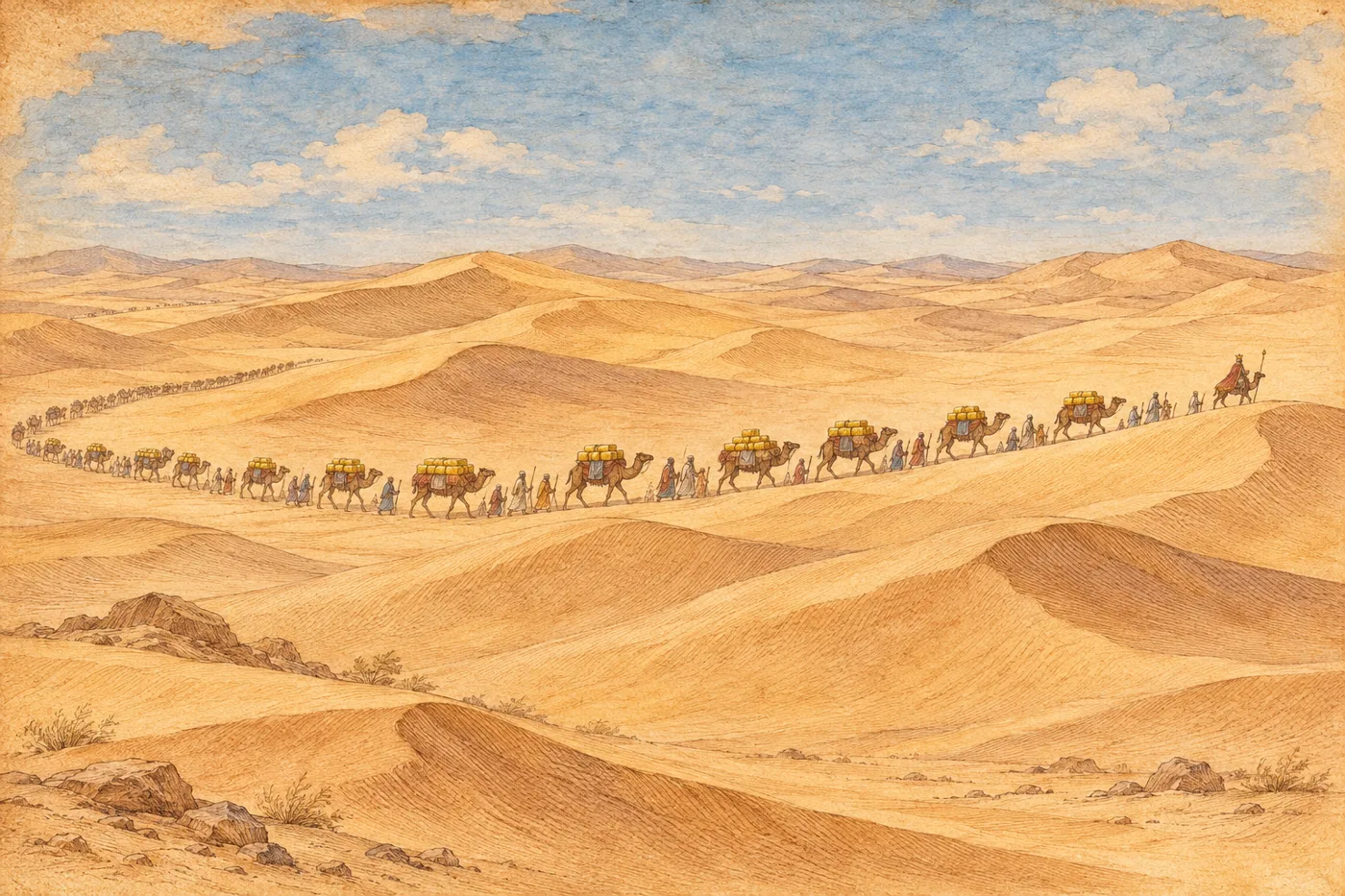
Why is it said that the journey of one king could shift the price of gold even in the Mediterranean?
After the Ghana Empire of the previous chapter, the Mali Empire rose to great prominence in this region. According to tradition, around 1235 a young man named Sundiata Keita defeated the king of a country called Sosso and founded the empire. His story has been passed down not in writing but through the songs of storytellers called 'griots' over many generations.
The Mali Empire spread mainly around the Niger River basin. The river was a vital artery for transport and agriculture, located between the gold-producing regions in the south and the trans-Saharan trade routes in the north. Like the Ghana Empire, it gained great wealth from the gold and salt trade.
The ruler of this empire in the early 14th century was Mansa Musa (Mansa means 'king'). He was a Muslim, and around 1324 he set out on a pilgrimage to Mecca. According to reports, he was accompanied by several thousand to tens of thousands of attendants and a vast amount of gold. It is said that during his stay in Cairo, he gave away gold so generously that its value fell for years.
After returning from his pilgrimage, Mansa Musa brought back scholars and architects. Among them is said to have been Abu Ishaq al-Sahili, a poet and architect of Andalusian origin. Mosques and centers of learning were built in Timbuktu and Gao, fostering a new hub of Islamic scholarship south of the Sahara.
The Catalan Atlas, created in Europe in 1375, depicts a 'King of Mali' seated with a gold nugget. Ibn Battuta, who visited Mali in 1352–53, praised the people for upholding the law and ensuring safe travel. The name of Mali had spread as far as Europe and the Middle East.
By the 15th century, the power of the Mali Empire declined due to succession disputes and the rise of neighboring states. Eventually, the Songhai people gained strength farther east along the Niger River. The next stage is the desert port city of Timbuktu.
Mini timeline
- c. 1235Sundiata is said to have founded the Mali Empire (Battle of Kirina)
- c. 1324Mansa Musa sets out on pilgrimage to Mecca
- 1352–53Ibn Battuta visits Mali
- 1375The Catalan Atlas depicts the 'King of Mali'
- 15th centuryThe Mali Empire weakens
People in this chapter
The hero of the epic 'Sundiata,' still passed down through the recitations of griots.
Known for his pilgrimage and generosity, he is regarded as a king who supported Islamic learning and trade.
Meanwhile, elsewhere
Connection to Japan
Japan was near the end of the Kamakura period. After Mansa Musa set out on his pilgrimage in 1324, the Kamakura shogunate fell in 1333.
Why it still matters
Timbuktu was registered as a World Heritage site in 1988. In West Africa, the griot tradition continues today in music and storytelling.
Perspectives differ
- Mansa Musa's wealth
- He is sometimes called the 'richest person in history,' but it is difficult to convert ancient quantities of gold into modern money, and some point out that such comparisons are inherently flawed. Figures like 'hundreds of billions of dollars' found online often lack solid evidence.
- Scale and impact of the pilgrimage
- The number of attendants and the duration of the drop in gold value are based mainly on later hearsay records, and may contain exaggerations.
- Reign dates
- His reign is often given as c. 1312–1337, but there are theories with a discrepancy of a few years.
- Is the 'Sundiata' historical?
- It is an oral epic, and it is considered difficult to separate historical fact from fictional elements. There are also various theories about the location of the Mali Empire's capital, Niani.
Facts checked (5, verified by AI on the web)
- Confirmed Sundiata won the Battle of Kirina and founded the Mali Empire around 1235 Britannica「Sundiata Keita」
The Battle of Kirina is dated to around 1235 (approximate year); his death is said to have been in 1255 - Confirmed Mansa Musa's pilgrimage to Mecca was around 1324 World History Encyclopedia「Mansa Musa I」
He is said to have arrived near Cairo in July of that year. The number of attendants varies greatly among sources (the text says 'several thousand to tens of thousands') - Corrected & confirmed The pilgrimage caused the value of gold in Cairo to fall World History Encyclopedia「Mansa Musa I」
There are records that the gold dinar dropped about 20% against silver, but some reconsideration regards this as an exaggeration. Consistent with the text (which says 'it is said') - Confirmed Ibn Battuta visited Mali in 1352–53 World History Encyclopedia: Mali Empire
WHE: Ibn Battuta's visit was around 1352. King Suleyman's reign was 1341–1360. The Metropolitan Museum's timeline gives a stay of about one year. He is said to have praised the safety and order. - Confirmed The 1375 Catalan Atlas depicts the 'King of Mali' holding a gold nugget British Library: African kings on medieval and Renaissance maps
British Library: The Catalan Atlas (c. 1375, by Abraham Cresques) shows Mansa Musa on a throne holding a round gold object (possibly an orb, coin, or nugget). The map reflects later reputation rather than a contemporary portrait.
Sources
Britannica「Sundiata Keita」
World History Encyclopedia「Mansa Musa I」
World History Encyclopedia: Mali Empire
British Library: African kings on medieval and Renaissance maps
* AI-drafted and cross-checked; human review is in progress. Status: