The Slave Trade — People Carried Across the Atlantic
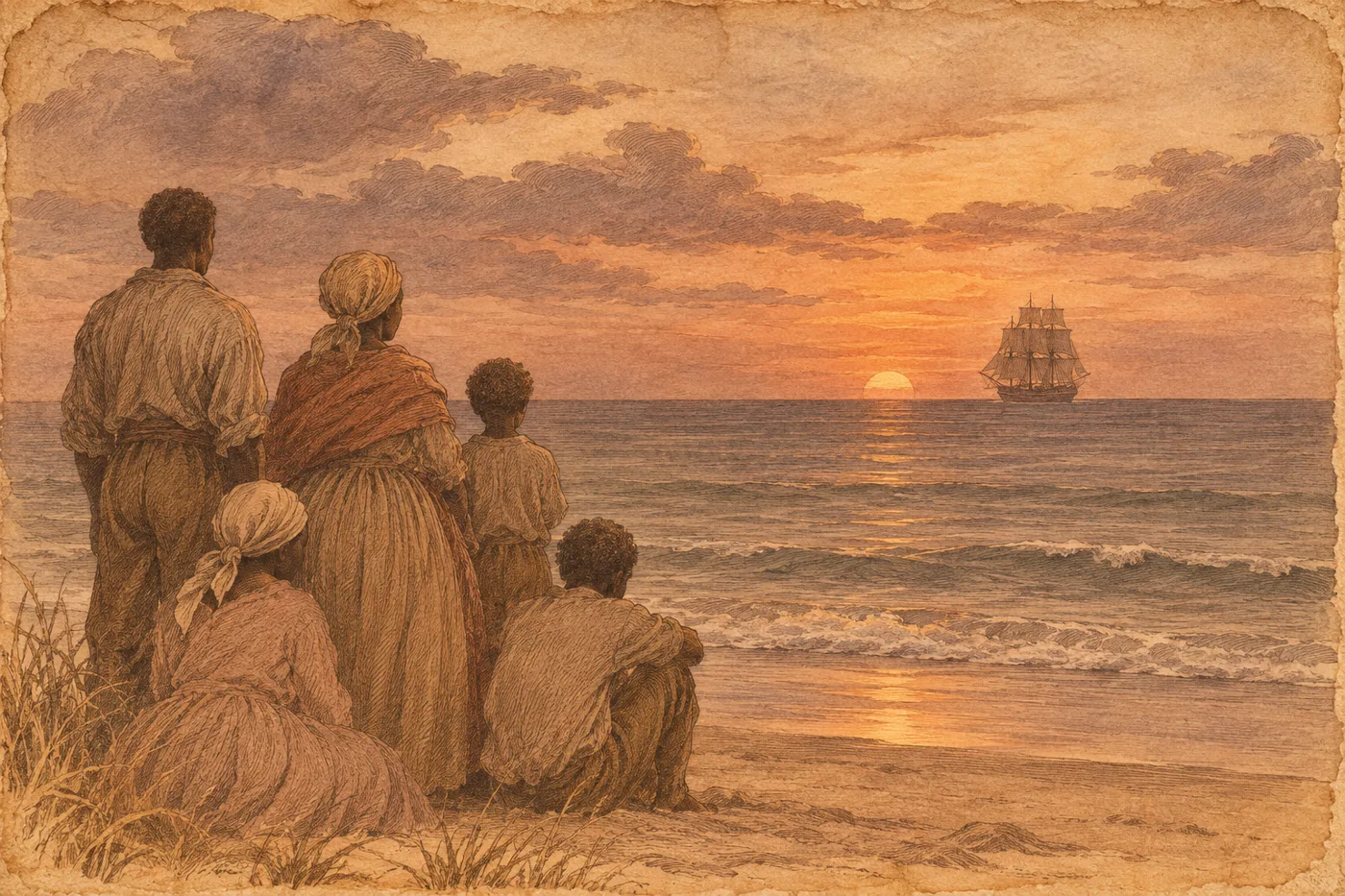
Why, for several centuries, were so many people taken across the Atlantic?
Around 1441, Portuguese sailors took people from the coast of West Africa to Europe. This is regarded as one of the beginnings of what later became the Atlantic slave trade. In the 16th century, plantations and mines in the Americas — especially for sugarcane, and later tobacco and cotton — demanded huge numbers of laborers.
Between the 16th and 19th centuries, an estimated 12.5 million people were shipped from Africa. Of these, about 10 million or so are thought to have arrived in the Americas. The majority went to Brazil and the Caribbean islands; only a few percent went to North America.
The transatlantic 'Middle Passage' lasted weeks or months and was brutal. Ships were cramped and unsanitary, and many died from disease or violence. Those who survived were forced into unfree lives on American plantations.
European traders gave guns, cloth, and metal goods to African coastal kingdoms, then loaded sugar and other goods in the Americas for the return voyage. This triangular route is called the 'triangular trade.' On the African side, coastal kingdoms and merchants also took part in the trade. Many societies were drawn into warfare and instability amid these power dynamics.
People did not simply submit. There were revolts aboard ships, escapes from plantations, and efforts to preserve distinct cultures and beliefs. In 1791, a large-scale uprising began in Haiti, leading to independence in 1804. In Europe, movements to abolish the slave trade also spread.
Britain banned the slave trade in 1807 and decided to abolish slavery in 1833. Slavery ended in the United States in 1865 and in Brazil in 1888. Yet the scars remain in many societies today, in the form of discrimination and poverty.
Mini timeline
- around 1441Portuguese take people from the West African coast
- 16th–19th centuriesAtlantic slave trade reaches its peak
- 1791–1804Haitian Revolution
- 1807Britain bans the slave trade
- 1888Brazil abolishes slavery
People in this chapter
After buying his freedom, he wrote a memoir (1789) that influenced the abolition movement.
He led an uprising of enslaved people, paving the way for Haiti's independence.
Meanwhile, elsewhere
Connection to Japan
The Netherlands, a European country that traded with Japan during the Edo period, was also deeply involved in the Atlantic slave trade.
Why it still matters
Senegal’s Gorée Island is registered as a World Heritage site, a place that conveys the memory of the slave trade. However, the number of people sent from the island is debated among researchers.
Perspectives differ
- Population estimates
- The figure of about 12.5 million is an estimate based on ship records, but there is a range among researchers, and it is thought that some people were never recorded.
- African involvement
- It is seen neither as 'Europeans unilaterally took people away' nor 'Africans sold them,' but as a movement within various power dynamics. Researchers place different emphases on this point.
- Slavery and the Industrial Revolution
- There is a theory that profits from the slave trade funded Britain's Industrial Revolution. The extent of the impact continues to be debated.
- Equiano’s birthplace
- His autobiography says he was born in West Africa, but in recent years a document suggesting he was born in South Carolina has been found, sparking debate.
- Reasons for abolition
- Some emphasize the power of humanitarian movements, others the changing economic conditions. It is thought that neither alone can fully explain it.
Facts checked (5, verified by AI on the web)
- Corrected & confirmed Around 1441, Portuguese took people from the West African coast Lowcountry Digital History Initiative (College of Charleston): Pope Nicolas V and the Portuguese Slave Trade
In 1441, Antão Gonçalves raided near Cape Blanc, capturing a small number (fewer than 10). Some sources place the location near Rio de Oro, and the number varies among sources. It is widely seen as the beginning of the Atlantic slave trade, but some view it as an extension of older Mediterranean practices. - Confirmed About 12.5 million shipped, about 10 million arrived Slave Voyages(Trans-Atlantic Slave Trade Database)に基づく解説(History News Network ほか)
Approximately 12.5 million were embarked between 1525 and 1866, and about 10.7 million arrived. - Confirmed Only a few percent went to North America History News Network
About 388,000 (approx. 3.6%) arrived directly in North America. Some tables from the same dataset give about 445,000, showing variation depending on counting methods. - Confirmed Britain banned the slave trade in 1807 and decided to abolish slavery in 1833 The National Archives (UK): The 1833 Abolition of Slavery Act and compensation claims
The 1833 act was passed in August, came into force on 1 August 1834, turning enslaved people into apprentices and compensating owners. Also notes the 1807 Slave Trade Act (exact passage date unconfirmed). - Confirmed Haiti independence in 1804, US in 1865, Brazil in 1888 米国立公園局(NPS)作成 Historical Fact Sheet on the Abolition of Slavery Worldwide(ウィルソンセンター掲載PDF)
Haiti independence on 1 January 1804; US 13th Amendment ratified 6 December 1865; Brazil slavery ended 13 May 1888 per timelines. For Haiti, independence is recorded; abolition itself is simultaneous with independence.
Sources
Lowcountry Digital History Initiative (College of Charleston): Pope Nicolas V and the Portuguese Slave Trade
History News Network「How many Africans were taken to the US」
The National Archives (UK): The 1833 Abolition of Slavery Act and compensation claims
米国立公園局(NPS)作成 Historical Fact Sheet on the Abolition of Slavery Worldwide(ウィルソンセンター掲載PDF)
* AI-drafted and cross-checked; human review is in progress. Status: