Greece — The 'Power to Think' Born from City-States
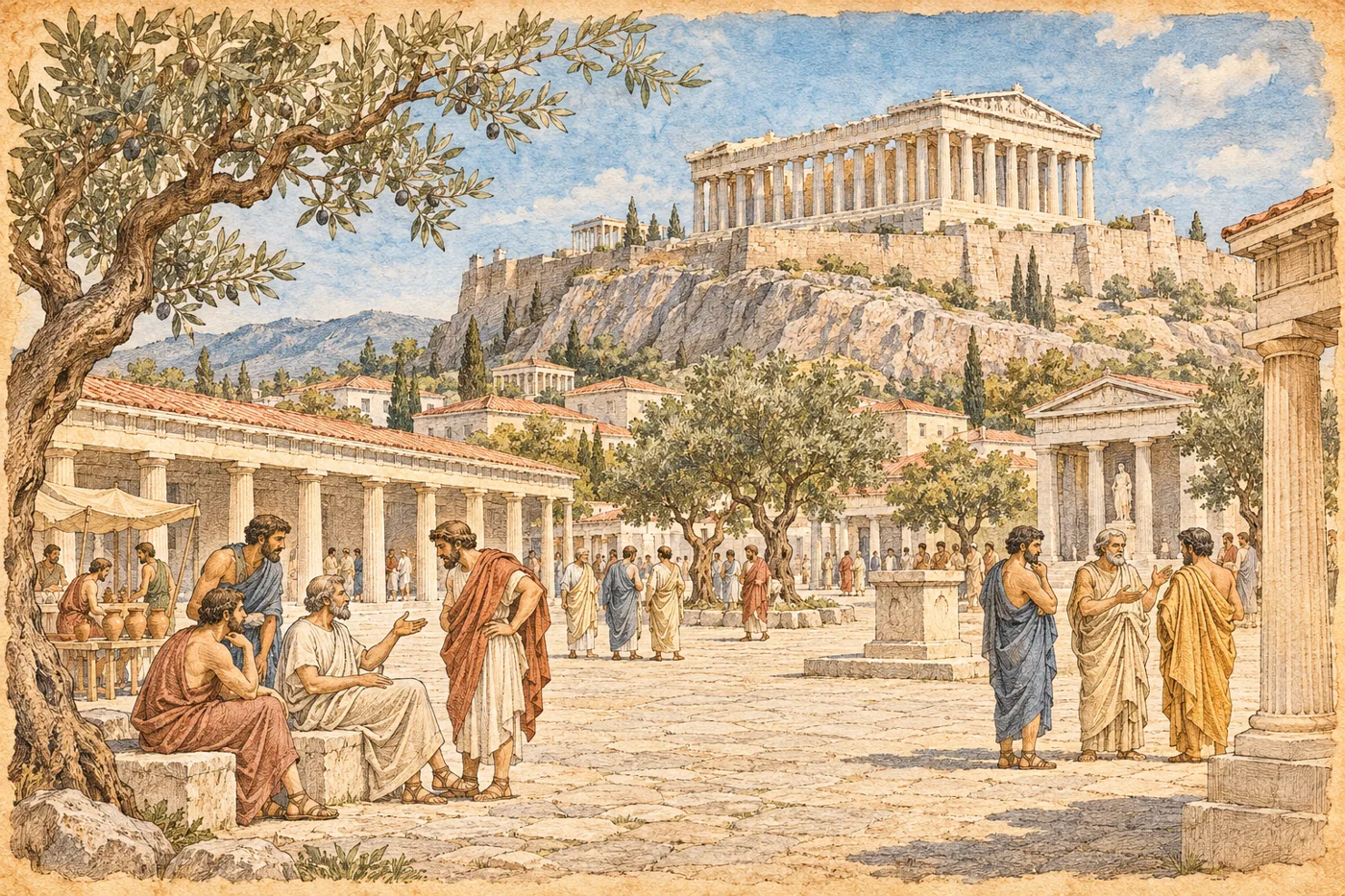
How did democracy and philosophy emerge from a collection of small city-states?
Greece is mountainous with small, fragmented plains. As a result, it did not become a single large country; instead, small city-states (poleis) emerged along coasts and valleys, starting around the 8th century BC. There were many poleis, with Athens and Sparta being the most famous. The people spoke the same language, worshipped the same gods, and held athletic festivals at Olympia every four years (the first is said to have been held in 776 BC).
In the poleis, citizens gathered in plazas (agora) and on hills to discuss important state matters. Athens, in particular, through reforms in the late 6th century BC such as those of Cleisthenes (around 508 BC), developed a 'democracy' where citizens voted directly on policy in popular assemblies and selected many officials by lottery. This system reached its peak under the leadership of Pericles in the 5th century BC.
However, this 'democracy' had limitations. Only adult male citizens could participate in politics. Women, foreigners, and the many slaves could not. It is thought that citizens were only a small fraction of the population. Even so, the idea of 'deciding together through discussion' had a profound impact on later civilizations.
As people began to debate, questions arose: 'What is the world made of?' and 'What is the right way to live?' Socrates constantly questioned people in the agora, emphasizing the importance of thinking. These inquiries were passed on to his student Plato, and then to Plato's student Aristotle, forming the foundation of later scholarship.
Athens gained power by repelling the large Persian army in the Persian Wars (early 5th century BC) and built structures that still stand today, such as the Parthenon. However, it lost momentum after being defeated by its rival Sparta in the Peloponnesian War (431–404 BC). Conflicts among the poleis weakened Greece.
Eventually, the emerging northern state of Macedon grew powerful. Its prince, Alexander the Great, defeated Persia and advanced east, spreading Greek culture as far as Egypt and near India. This became Hellenistic culture. The ideas born from small city-states traveled to the wider world.
Mini timeline
- c. 8th century BCCity-states (poleis) emerge throughout Greece
- c. 508 BCCleisthenes' reforms in Athens lay the foundation for democracy
- Early 5th century BCPersian Wars; Athens gains power
- 431 BCPeloponnesian War begins (ends 404 BC)
- 323 BCAlexander the Great dies
People in this chapter
Known for leading Athens during the height of its democracy and for advancing the construction of the Parthenon.
He advocated for thinking through dialogue with people, but was later sentenced to death at a trial.
Meanwhile, elsewhere
Connection to Japan
Japan was transitioning from the Jōmon period to the Yayoi period (the exact timing is debated).
Why it still matters
The word 'democracy' comes from the Greek 'dēmos' (people) and 'kratos' (power). Many familiar words today, such as philosophy (from 'philosophia'), Olympics, and academy (from Plato's school 'Akadēmeia'), originate here.
Perspectives differ
- Who were 'the people' in the democracy?
- In Athenian democracy, only adult male citizens could participate; women, slaves, and foreigners were excluded. Estimates of the proportion of citizens in the population vary among scholars. Whether it can truly be called 'democracy' is debated based on modern standards.
- Year of the first Olympic Games
- The year 776 BC is based on later records and tradition; some believe the actual start was earlier.
- Image of Sparta
- Sparta is famous as a 'state of strict military education,' but much of this image was idealized in writings by later Greeks and Romans, and it has been pointed out that it differs from reality.
- Socrates' trial
- Socrates was sentenced to death for 'not believing in the city's gods' and 'corrupting the youth,' but there are multiple interpretations, including the view that there were political motives.
- Perspective on the Persian Wars
- Much of the account of the wars relies on Greek sources (e.g., Herodotus), and the Persian perspective may differ.
Facts checked (5, verified by AI on the web)
- Confirmed The first Olympic festival was in 776 BC (traditional earliest recorded date) Britannica: Ancient Greek civilization – The Olympic Games
The date 776 BC was calculated by later scholars like Hippias. The phrase 'is said to' is appropriate. - Confirmed Cleisthenes' reforms were around 508 BC (also given as 508/507 BC) and formed the foundation of democracy Britannica: Cleisthenes of Athens
The date is given as 508/507 BC with some variation. The text's 'around 508 BC' is reasonable. - Confirmed The Peloponnesian War began in 431 BC and Athens surrendered in 404 BC Britannica: Peloponnesian War
- Confirmed The Parthenon was built under Pericles' leadership (construction began in 447 BC) Britannica: Acropolis of Athens
Construction began in 447 BC, the building was completed in 438 BC, and the decorations were finished by 432 BC. - Confirmed Socrates was sentenced to death at his trial in 399 BC Britannica: Socrates
Sources
Britannica: Ancient Greek civilization – The Olympic Games
Britannica: Cleisthenes of Athens
Britannica: Peloponnesian War
Britannica: Acropolis of Athens
Britannica: Socrates
* AI-drafted and cross-checked; human review is in progress. Status: