Rome — How a small city became the empire that surrounded the Mediterranean
Why was one city on the Italian peninsula able to rule the entire Mediterranean?
Around the middle of the Italian peninsula, on the banks of the Tiber River, the city of Rome was born. Legend says it was founded in 753 BC by Romulus, one of twin brothers raised by a she-wolf. At first it was ruled by kings, but around the end of the 6th century BC (traditionally 509 BC) the kings were driven out, and it became a republic.
In the Roman Republic, the Senate, made up of leading citizens, discussed matters of state, while two annually elected consuls led the country. This system kept power from concentrating in one person. Rome often granted citizenship or allied rights to those it defeated, increasing its allies as it unified the Italian peninsula.
The next opponent was Carthage, a maritime power in North Africa. The Punic Wars (264–146 BC) lasted over a century. The Carthaginian general Hannibal even crossed the Alps with elephants and dealt the Romans a major defeat. But in the end Rome prevailed, and Carthage was destroyed in 146 BC. That same year, Greece also came under Roman control.
As territory expanded, the gap between rich and poor widened, causing internal conflict. There were slave revolts, such as the one led by Spartacus (73–71 BC). Caesar, who had conquered Gaul (roughly modern-day France), seized dictatorial power but was assassinated in 44 BC. His adopted heir Octavian emerged victorious from the ensuing civil war.
In 27 BC, Octavian received the title Augustus and became effectively the first emperor (the Principate). For about 200 years afterward, large-scale warfare was rare — a period called the Pax Romana (Roman Peace). Under Emperor Trajan in the 2nd century, the empire reached its greatest extent (around 117 AD).
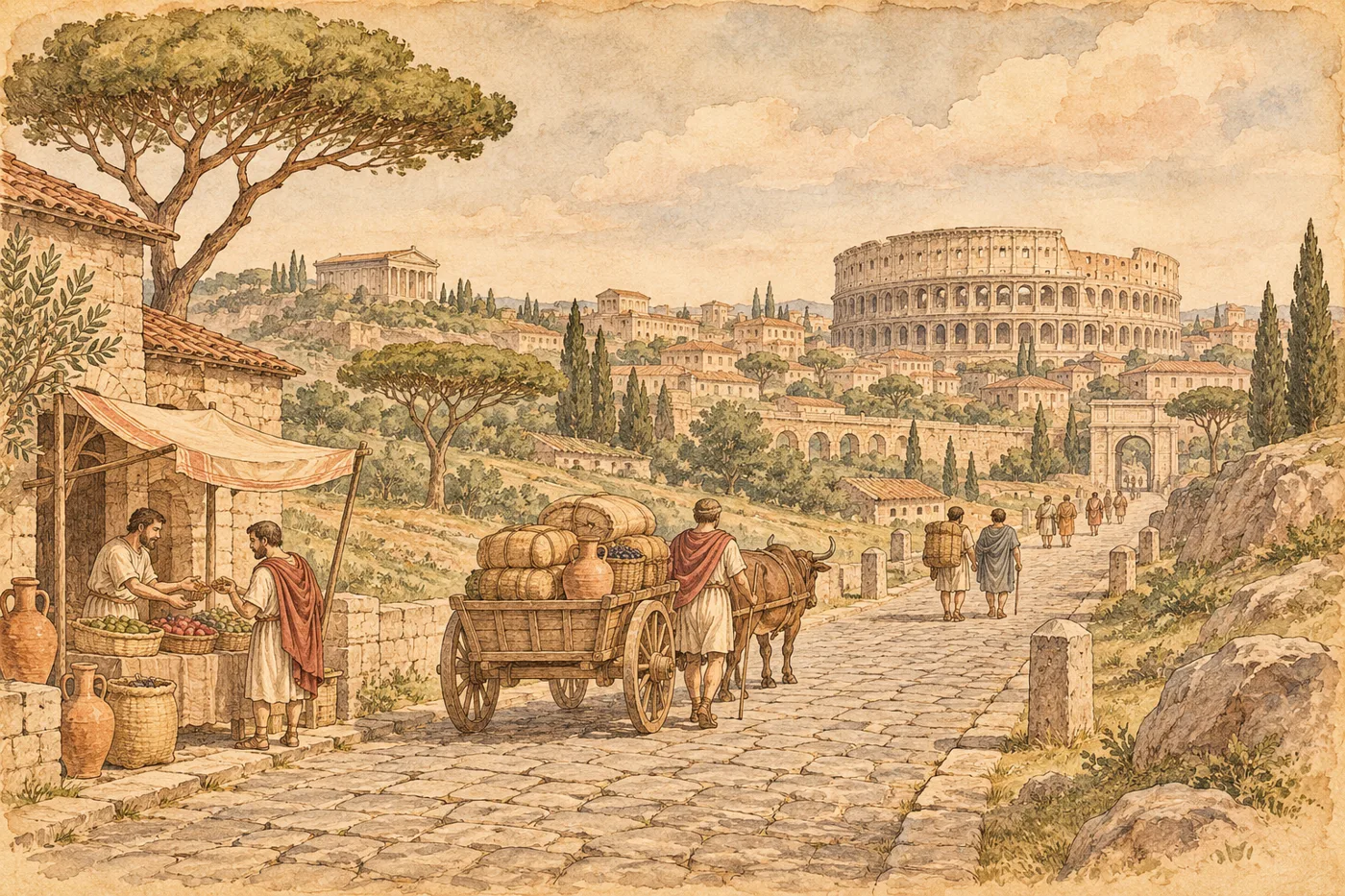
The Romans built roads, aqueducts, and great structures like the Colosseum (opened in 80 AD), and they codified laws. As the saying goes, 'All roads lead to Rome' — the road network connected the whole empire. However, this prosperity rested on the labor of many slaves and the burden on conquered peoples.
Mini timeline
- 753 BCLegendary founding of Rome by Romulus
- 146 BCCarthage destroyed (end of the Punic Wars)
- 44 BCCaesar assassinated
- 27 BCAugustus receives his title; imperial rule begins
- c. 117 ADEmpire reaches its greatest extent under Trajan
People in this chapter
He gained power by conquering Gaul. Although assassinated, his name later became the root of words meaning 'emperor'.
While preserving the form of the Republic, he created a system where one man effectively ruled the state.
Meanwhile, elsewhere
Connection to Japan
Japan was in the Yayoi period. According to the *Book of the Later Han*, the king of the Wa state of Na received a seal from the Later Han in 57 AD.
Why it still matters
July (named after Julius Caesar) and August (after Augustus) still bear their names. Latin, the ancestor of many European languages, as well as ideas about law and architecture, were inherited from Rome.
Perspectives differ
- Founding legend
- The story of Romulus is a legend. The actual city is thought to have grown from small settlements gradually merging. The details of the transition from monarchy to republic are also unclear.
- Proportion of slaves
- There are few sources on what percentage of the Roman Empire's population were slaves, and estimates vary widely.
- How to see the 'Roman Peace'
- For people within the empire it was a time of stability, but from the perspective of the conquered, it was an era of domination and taxation. Both sides are part of history.
- When the Republic ended
- Scholars differ on whether to mark the end with Caesar's dictatorship or with Augustus's accession.
- Hannibal's forces
- Ancient records differ on the number of troops and elephants that crossed the Alps, so the exact figures are unknown.
Facts checked (4, verified by AI on the web)
- Confirmed The Republic was traditionally founded in 509 BC (the expulsion of the last king, Tarquin) Britannica: Roman Republic
Modern scholarship is skeptical of the traditional details. The text says 'traditionally,' which is appropriate. - Confirmed The Punic Wars lasted from 264 to 146 BC; Carthage fell in 146 BC Britannica: Punic Wars
- Confirmed The empire reached its greatest extent around 117 AD under Trajan Britannica: Trajan
- Corrected & confirmed The Colosseum was completed in 80 AD Britannica: Colosseum
Text corrected: opened in 80 AD (under Titus); completed in 82 AD (under Domitian), so changed to 'opened in 80 AD'.
Sources
Britannica: Roman Republic
Britannica: Punic Wars
Britannica: Trajan
Britannica: Colosseum
* AI-drafted and cross-checked; human review is in progress. Status: