The Persian Wars and Alexander — An Age When East and West Met
How did the wars between Greece and Persia later connect the eastern and western worlds?
The Persian Wars were a conflict between the vast Persian Empire and the city-states of Greece. In 490 BC, the Greek forces, led by Athens, repelled an army sent by Darius I on the plain of Marathon. From the Greek perspective, this was an event where a small city defeated a great power. For the Persian side, however, it may have been just a minor stumble on the distant western edge of their empire.
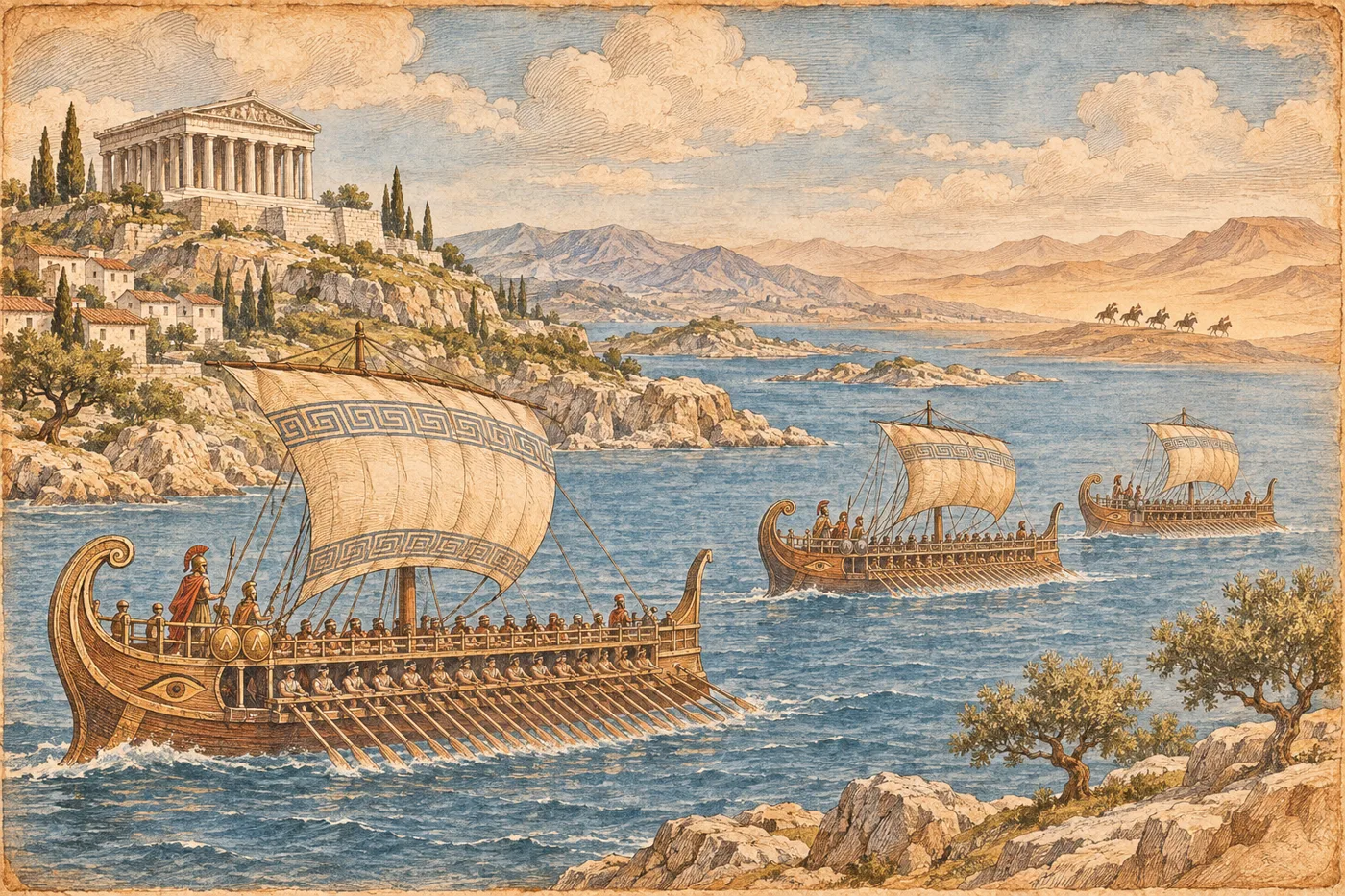
In 480 BC, Darius's son Xerxes I attacked again. In September of that year, at the Battle of Salamis, the strategy of Themistocles paid off, and the Greek fleet won. The Persian ships suffered heavy losses in this battle, and the king withdrew to Asia for the time being. The following year, at the Battle of Plataea, the Persian invasion of the Greek mainland is said to have ended (though the war itself continued until the peace treaty of 449 BC). For the Greeks, it was long celebrated as a fight to preserve their freedom.
The main source for this war is the Histories by Herodotus, a Greek. Many of the figures for ships and soldiers are thought to be inflated. Almost no comprehensive accounts of the war left by the Persian side have been found. We are seeing the image of the losing side through the narrative of the winners. Keeping that in mind makes this story much richer.
About 150 years later, in 334 BC, the young king of Macedon, Alexander, crossed into Asia Minor. He won successive victories at the Granicus, Issus, and Gaugamela, and destroyed the Persian Empire. In Egypt, he is said to have founded Alexandria, which later became a city of learning. He advanced further east, reaching the gateway to India, but his weary soldiers refused to go on, and he turned back.
In June 323 BC, Alexander died of a fever in Babylon at the age of 32. When asked to whom he left his empire, he is said to have replied, 'To the strongest,' and his empire was divided after conflicts among his generals. This led to the Ptolemaic Kingdom in Egypt, the Seleucid Empire in West Asia, and others. The period from this point until around 30 BC is usually called the Hellenistic Age. The death of one king drastically redrew the map of the world.
In the Hellenistic world, Greek language and ideas blended with local traditions. Alexandria and Antioch became centers of learning and culture, and the famous Library of Alexandria was built. Further east, from around the 1st century AD, Gandharan art flourished, and it is often explained that artistic styles derived from Greek traditions influenced the making of Buddhist statues.
Mini timeline
- 490 BCAt the Battle of Marathon, the Greek forces led by Athens repel the Persian army.
- 480 BCAt the naval Battle of Salamis, the Greek fleet wins.
- 479 BCAt the Battle of Plataea, the Greek side wins, ending the Persian invasion of the Greek mainland (the fighting continued afterward; a peace is said to have been made around 449 BC, though its existence is debated).
- 334 BCAlexander crosses into Asia Minor and begins his eastern campaign.
- 331 BCAfter founding Alexandria in Egypt, he wins the Battle of Gaugamela (the Persian Empire falls the following year, 330 BC).
- 323 BCAlexander dies in Babylon, and his empire is divided.
- 30 BCPtolemaic Egypt falls (the year after the Battle of Actium in 31 BC), marking the conventional end of the Hellenistic period.
People in this chapter
The king who sent an army to Marathon.
He is said to have devised the strategy for the Battle of Salamis.
He campaigned eastward from 334 BC and overthrew the Persian Empire.
Meanwhile, elsewhere
Connection to Japan
In Japan, this corresponds to the late Jōmon to Yayoi periods, when rice-paddy farming spread across the land and metal tools began to be used.
Why it still matters
Alexandria still thrives as Egypt's second-largest city. Gandharan Buddha statues can be seen in museums around the world. The name Marathon lives on in modern long-distance running.
Perspectives differ
- Heavy reliance on Greek sources
- The narrative of the Persian Wars relies heavily on Greek sources like Herodotus. While Herodotus is called the 'Father of History,' he has been criticized since ancient times for embellishing stories; at the same time, in recent years some parts of his account have been corroborated by archaeology. The numbers of troops and ships are especially disputed.
- Evaluating Alexander
- There is a view of him as a hero who spread culture, and a view of him as a conqueror who brought war to many cities and peoples. It is impossible to decide which is correct, and evaluations differ by era and standpoint.
- How far did Greek influence reach?
- It is widely noted that Gandharan Buddha statues display Greek-style features, but scholars differ on the strength and route of that influence.
Facts checked (10, verified by AI on the web)
- Confirmed In September 490 BC, the Greek forces led by Athens repelled the Persian invasion at Marathon. World History Encyclopedia: Battle of Marathon(事典)
Confirmed in encyclopedia entries. Details of tradition and casualty numbers are not on that page. - Confirmed At the Battle of Salamis in September 480 BC, the Greeks won, Xerxes withdrew, and the Persian ambition ended at Plataea in 479 BC. World History Encyclopedia: Battle of Salamis(事典)
Confirmed in encyclopedia. Herodotus's ship numbers are considered exaggerated, and the same page notes there is no consensus among researchers. - Corrected & confirmed The main source is Herodotus, with exaggerated numbers, and almost no continuous Persian records remain. World History Encyclopedia: Herodotus(事典)
Criticism that Herodotus is not impartial and contains exaggerations and errors is confirmed. The point that 'no Persian battle records have been found' is not on that page and is unverified. The text uses the cautious phrase 'almost.' - Confirmed In 334 BC, he crossed into Asia Minor, won at Granicus, Issus, and Gaugamela, founded Alexandria in Egypt, and in India his soldiers refused to advance. World History Encyclopedia: Alexander the Great(事典)
Confirmed in encyclopedia. The encyclopedia describes the site of the mutiny in India as the Beas River. - Confirmed He died in Babylon in June 323 BC at age 32, and his empire was divided into the Ptolemaic and Seleucid kingdoms, etc. World History Encyclopedia: Alexander the Great(事典)
Confirmed in encyclopedia. The same page notes that the cause of death is disputed. 'To the strongest' is treated as 'reportedly,' so the text uses 'is said to.' - Confirmed The Hellenistic period is from 323 BC to 31 BC. The Library of Alexandria and Antioch were cultural centers. World History Encyclopedia: Hellenistic Period(事典)
Confirmed in encyclopedia. - Corrected & confirmed Gandharan art flourished from around the 1st century BC and was influenced by Greek traditions. World History Encyclopedia: Gandhara(事典)
Confirmed in encyclopedia. However, that page does not mention debates about the strength of Greek influence. The text uses 'it is often said.' - Unverified In Japan's Yayoi period, rice farming spread and metal tools began to be used (from around the 4th century BC). World History Encyclopedia: Hellenistic Period(事典)
No description found on the relevant WHE page, or page inaccessible. - Unverified Around the 5th century BC, ironworking spread in West Africa / The Maurya Empire and King Ashoka's patronage of Buddhism / China's Warring States period. World History Encyclopedia: Alexander the Great(事典)
No description found on the relevant WHE page, or page inaccessible. - Unverified The name Marathon survives in long-distance running. World History Encyclopedia: Battle of Marathon(事典)
No description found on the relevant WHE page, or page inaccessible.
Sources
World History Encyclopedia: Battle of Marathon(事典)
World History Encyclopedia: Battle of Salamis(事典)
World History Encyclopedia: Alexander the Great(事典)
World History Encyclopedia: Gandhara(事典)
World History Encyclopedia: Hellenistic Period(事典)
World History Encyclopedia: Herodotus(事典)
* AI-drafted and cross-checked; human review is in progress. Status: