The Renaissance and Reformation — Rediscovering Humanity and Questioning the Church
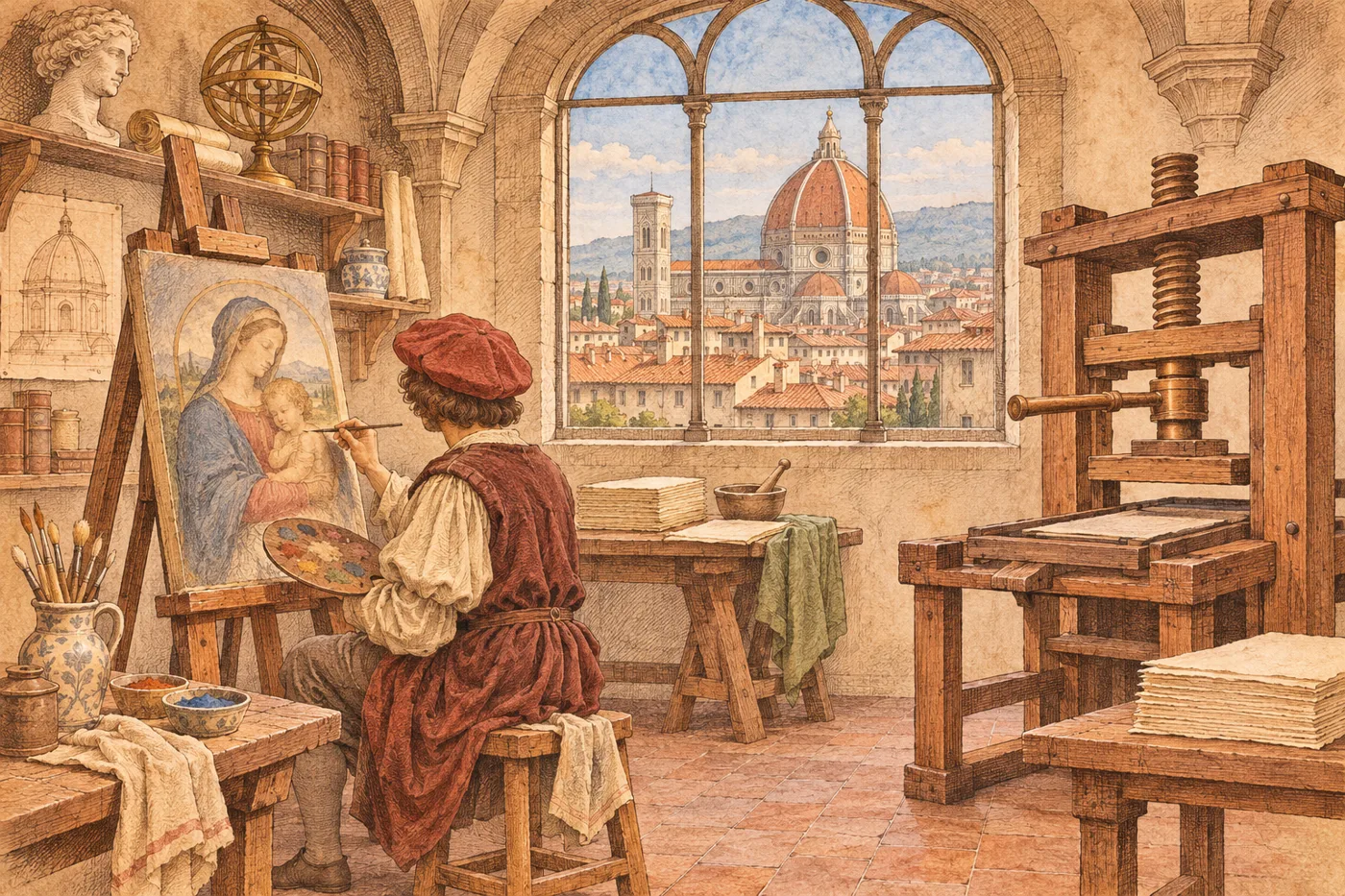
Why did European views on 'humanity' and 'faith' change so dramatically?
In the 14th century, a new movement arose in Italian cities that had endured the chaos of the plague and other crises. In wealthy commercial centers like Venice and Florence, powerful families such as the Medici bankers supported artists and scholars. People revisited ancient Greek and Roman culture and re-examined 'what it means to be human.' This was the Renaissance ('rebirth').
In art, Leonardo da Vinci, Michelangelo, and Raphael flourished. They used perspective to create depth, studied human anatomy, and vividly depicted the human form. Around the mid-15th century, Germany's Gutenberg is said to have made movable-type printing practical. Books could be produced cheaply and in quantity, and knowledge spread rapidly.
That printing technology accelerated another major movement. In 1517, German theologian Martin Luther published a document questioning the church's sale of indulgences (the Ninety-five Theses). 'People are saved by faith.' 'What matters is the Bible.' Luther's ideas spread across the country via printed materials.
Luther translated the Bible into German so anyone could read it. Later, Calvin pushed forward another reform in Geneva, Switzerland. In England, King Henry VIII broke with the pope and established the Church of England with himself as its head (1534). These reformists became known as 'Protestants,' and the split with the Roman Catholic Church became decisive.
The Catholic side also worked to rebuild (the Counter-Reformation). The Jesuits focused on education and overseas missions. But differences in faith became tied to political conflicts. In France, religious wars continued from 1562. In Germany, the Thirty Years' War began in 1618, drawing in many European countries.
The war ended with the Peace of Westphalia in 1648. The idea that each state had the right to determine its own religion and politics was clearly established. The focus on humanity and the conflicts over faith both pushed Europe into the next era.
Mini timeline
- 14th centuryThe Renaissance begins in Italian cities
- c. 1450Gutenberg is said to have made movable-type printing practical
- 1517Luther publishes his criticisms of indulgences
- 1534The Church of England is established
- 1648The Peace of Westphalia ends the Thirty Years' War
People in this chapter
In addition to painting, he observed the human body, water, and machines, leaving behind voluminous notebooks.
He translated the Bible into German, and his German is said to have greatly influenced the later development of standard German.
Meanwhile, elsewhere
Connection to Japan
Japan was in the Sengoku (Warring States) period. In 1543, guns were introduced, and in 1549, the Jesuit Francis Xavier came to spread Christianity.
Why it still matters
'Protestant' is said to originate from the 'protest' issued by the reformists at the 1529 Imperial Diet. Da Vinci's works continue to draw crowds in museums around the world.
Perspectives differ
- Was the Renaissance a 'break from the Middle Ages'?
- Previously, it was often seen as moving from a 'dark Middle Ages to a bright modern era,' but now the emphasis is on how medieval scholarship and culture formed its foundation.
- The story of nailing the Ninety-five Theses to the door
- The famous story of Luther nailing the document to a church door is considered a later tradition, and whether it actually happened is debated. That the document was published is certain.
- The inventor of printing
- Before Gutenberg, movable type (including metal type) existed in East Asia (China and Korea). It is accurate to understand Gutenberg as the figure who made it practical in Europe.
- The Westphalian system
- The 1648 treaty is sometimes described as the 'starting point of the modern international order,' but some point out that this is a later idealization.
- The casualties of the Thirty Years' War
- The population of the German region is said to have dropped by 20–30%, but there were large regional differences and estimates vary.
Facts checked (4, verified by AI on the web)
- Confirmed Gutenberg’s movable-type printing was made practical around 1440–1450 (the Bible was completed around 1455). Britannica: Gutenberg Bible
The text saying 'around the mid-15th century … is said to' is appropriate. There were earlier examples of movable type in China and Korea. - Confirmed In 1517, Luther criticized indulgences with the Ninety-five Theses. Britannica: Ninety-five Theses
Sent to Archbishop Albrecht on October 31. The 'nailing to the door' story is a tradition. The text says 'published,' which is appropriate. - Confirmed In 1534, Henry VIII became the head of the Church of England. Britannica: Reformation
- Confirmed The Peace of Westphalia in 1648 ended the Thirty Years' War. Britannica: Reformation
Sources
Britannica: Gutenberg Bible
Britannica: Ninety-five Theses
Britannica: Reformation
* AI-drafted and cross-checked; human review is in progress. Status: