Crusades, Cities, and Plague — The Height of the Middle Ages and the Black Death
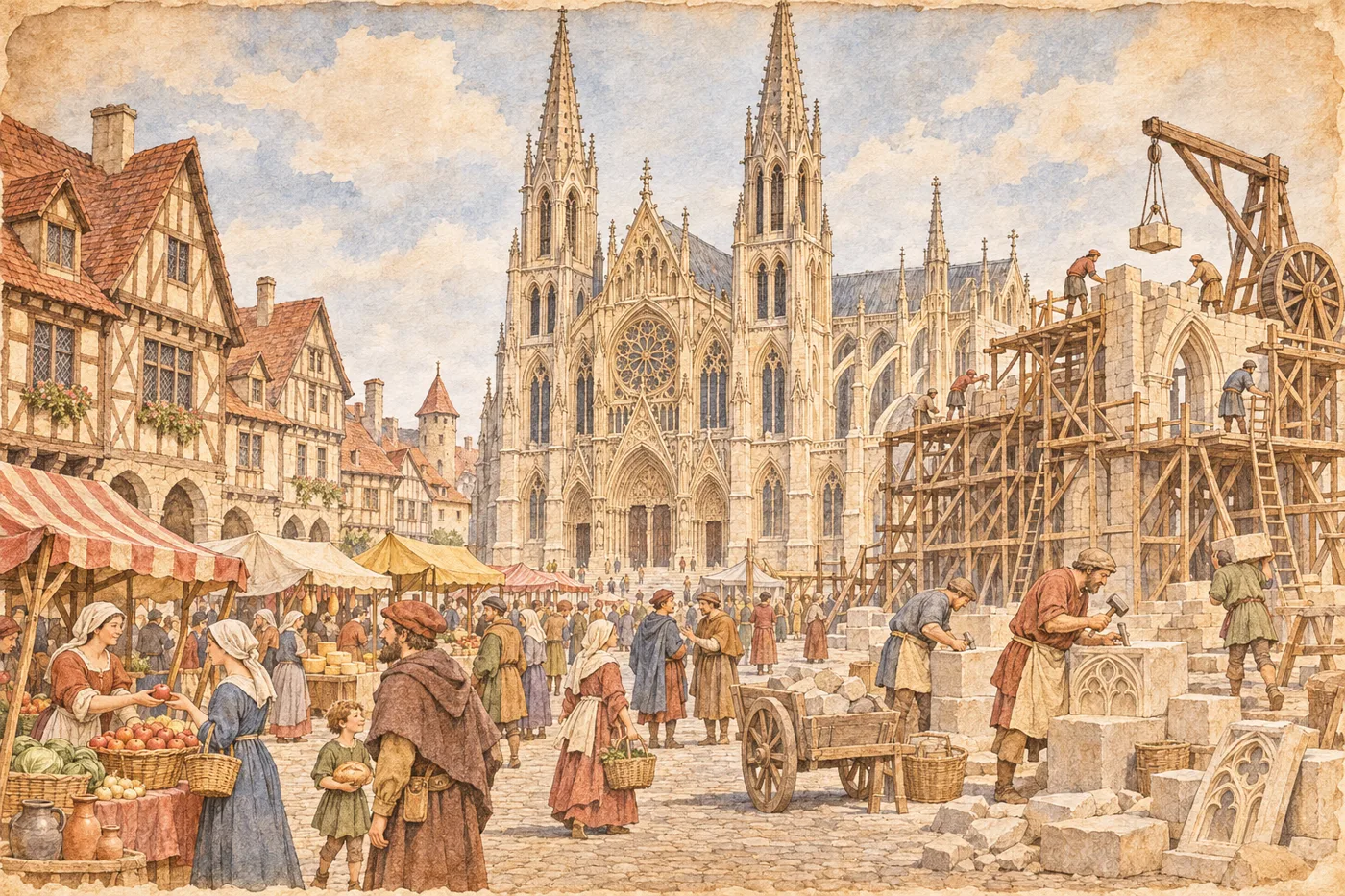
Why did a single disease drastically change a flourishing Europe?
From around the 11th century, life in Western Europe began to prosper. Advances in farming tools and techniques increased wheat harvests, and the population grew. Cities developed as places to buy and sell surplus crops and goods. Merchants and craftsmen formed trade associations (guilds), and some cities gained self-governing rights from their lords.
The Crusades, which began in 1096 (we looked at the Eastern side in the Islamic world chapter), also greatly changed Europe. Increased contact with the Eastern Mediterranean allowed Italian cities like Venice and Genoa to thrive on maritime trade. Knowledge and goods from outside Europe flowed in, broadening horizons a little.
Learning also flourished in the cities. Universities emerged in Bologna, Paris, Oxford, and elsewhere as associations of teachers and students. Meanwhile, soaring Gothic cathedrals were built across the region. Around this time, in 1215, the Magna Carta was sealed in England, giving rise to the idea that even the king's power had limits.
But a great trial came in the 14th century. Around 1347, ships arriving from the Black Sea region reached the Mediterranean island of Sicily. The plague—later called the Black Death—spread from there. Within a few years, it swept across all of Europe, and is thought to have killed a third of the population, or even more in some places.
People didn't know the cause and were terrified. In the resulting panic, blame was placed on Jews and others, leading to persecution and massacres in many areas. Because the workforce had shrunk, the remaining peasants and craftsmen found their position relatively strengthened. Movements to free serfs bound to their lords spread. Trust in the Church was also shaken.
Meanwhile, France and England were locked in a long war (the Hundred Years' War), which began in 1337. In 1429, a peasant girl named Joan of Arc led the French army to lift the Siege of Orléans, but she was later captured and executed in 1431. The war ended in 1453. That same year, in the East, Constantinople fell.
Mini timeline
- 1096The First Crusade departs
- 1215The Magna Carta is sealed in England
- 1337The Hundred Years' War begins (ends in 1453)
- c. 1347The plague begins to spread to Europe via a Mediterranean island
- 1429Joan of Arc liberates Orléans
People in this chapter
She said she 'heard the voice of God,' led the French army to victory, but was later executed as a heretic. She was later exonerated and made a saint.
He wrote the 'Decameron,' a story of people who fled to the outskirts of the city to escape the plague, conveying life at the time.
Meanwhile, elsewhere
Connection to Japan
In Japan, this period spanned the Kamakura to Muromachi periods. It saw the Mongol (Yuan) invasions (1274 and 1281) and the fall of the Kamakura shogunate (1333).
Why it still matters
The word 'quarantine' comes from the Italian for 'forty days,' originating from the practice of keeping ships in port for 40 days during the plague era. Institutions like universities and parliaments were also born in this period.
Perspectives differ
- Number of plague deaths
- Mortality rates varied greatly by region. It is said that around 30% of the population died, and in some places, the figure may have been even higher. Exact numbers are unknown.
- Cause of the plague
- Recent analysis of human remains strongly suggests Yersinia pestis was the main cause, but there is debate over how it spread and whether other factors were involved.
- Persecution of Jews
- Based on the false rumor blaming Jews for the plague, massacres occurred in many places. Some popes and others tried to stop it, but with limited effect.
- The image of Joan of Arc
- There are various interpretations of what her experience of hearing 'voices' was. In later France, she was also used as a national symbol.
Facts checked (4, verified by AI on the web)
- Confirmed The plague is said to have arrived in Messina, Sicily, by ship in 1347 Britannica: Black Death
- Confirmed It is thought that about a third of Europe's population died (regional differences are large) Britannica: Black Death – Students
Estimates range from one-quarter to one-half. The main text's 'between a third and, in some places, even more' is appropriate. - Confirmed The Hundred Years' War lasted from 1337 to 1453. Joan of Arc liberated Orléans in 1429 and was executed in 1431 Britannica: Joan of Arc
Records differ on whether her entry into Orléans was April 29 or 30. Her rehabilitation was in 1456 and canonization in 1920. - Confirmed The First Crusade departed in 1096 World History Encyclopedia(事典): First Crusade
Encyclopedia states: Proclaimed at Clermont in 1095, departure date set for August 15, 1096, People's Crusade reached Constantinople in early summer 1096. Consistent with the text's departure in 1096 (council in 1095).
Sources
Britannica: Black Death
Britannica: Black Death – Students
Britannica: Joan of Arc
World History Encyclopedia(事典): First Crusade
* AI-drafted and cross-checked; human review is in progress. Status: