The Age of Exploration — Europe sets sail, the world connects
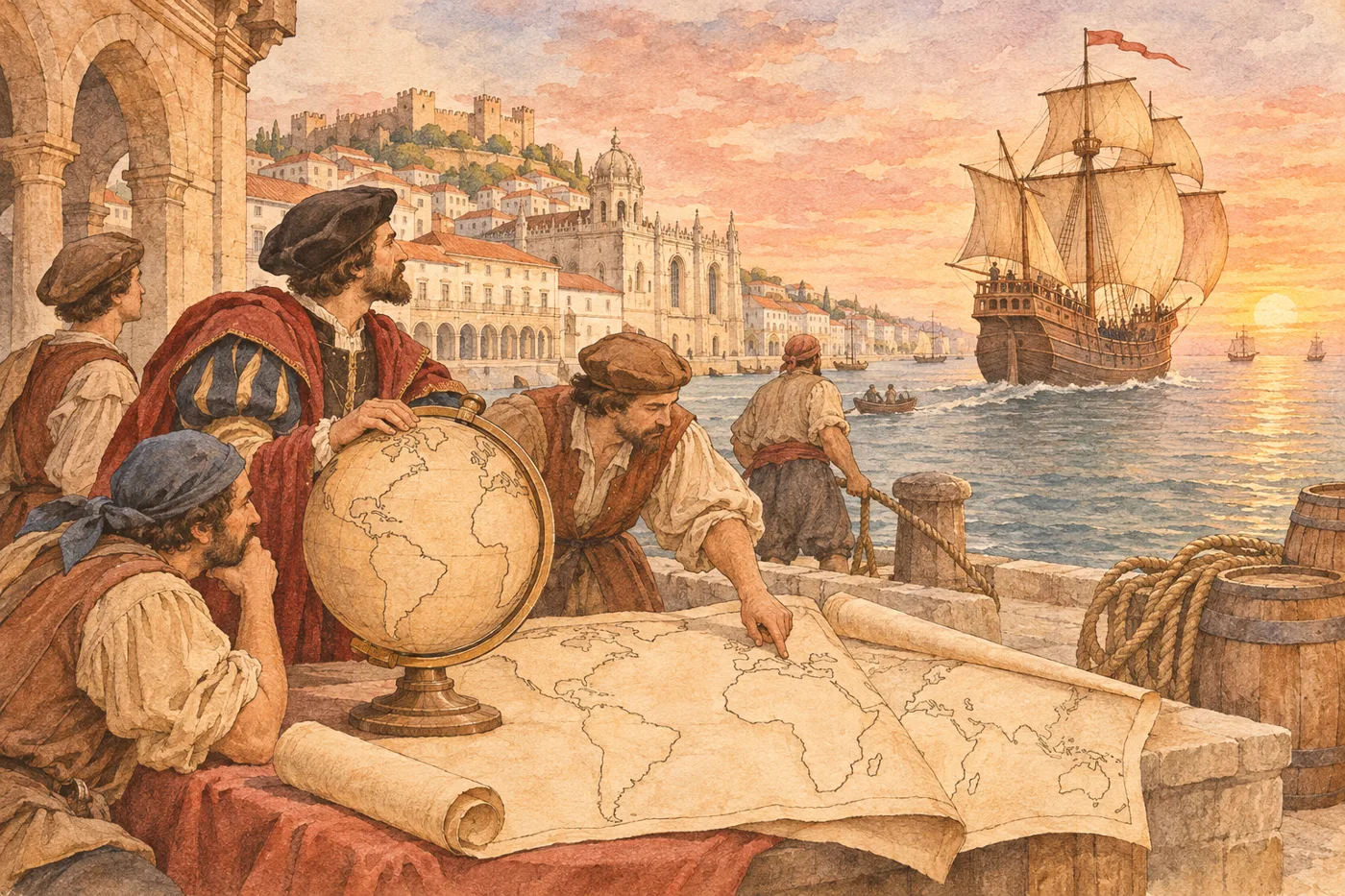
Why did European ships suddenly head out into the vast oceans all at once?
In the 15th century, Europeans sought Asian spices (such as pepper), silk, and gold. Trade with Asia passed through the eastern Mediterranean, giving middlemen strong control and keeping prices high. They wanted more direct access — and to spread Christianity. These desires drove people to the sea.
Portugal, facing the Atlantic, led the way. Starting with the capture of Ceuta in 1415, they gradually pushed south along Africa's west coast, with Dias reaching the Cape of Good Hope in 1488. In 1498, Vasco da Gama rounded Africa and arrived at Calicut in India.
Spain, meanwhile, headed west. In 1492, Columbus — a Genoese — set sail with support from Queen Isabella of Spain (the Kingdom of Castile) and reached an island in what is now the Caribbean. He thought it was part of India, but it was actually a continent unknown to Europeans. Of course, many people already lived there.
To avoid conflict between the two countries, the Treaty of Tordesillas in 1494 drew a line dividing the world in two. Magellan's fleet, which departed in 1519, completed a circumnavigation of the globe (Magellan himself died in the Philippines). That the Earth is round was thus confirmed in practice.
The voyages connected more than just routes. Potatoes, corn, tomatoes, and chili peppers came from the Americas; wheat, horses, and cattle came from the Old World, transforming global food. But diseases like smallpox brought from Europe are thought to have greatly reduced the indigenous population of the Americas depending on the region.
Spain shipped vast quantities of silver from mines like Potosí to Europe and Asia. The Americas, Europe, Asia, and Africa were now linked by the sea — an era that brought wealth and convenience, but also cast the heavy shadows of conquest and the slave trade across the world.
Mini timeline
- 1415Portugal captures Ceuta
- 1488Dias reaches the Cape of Good Hope
- 1492Columbus crosses the Atlantic and reaches an island in the Caribbean
- 1498Da Gama reaches Calicut in India
- 1519–1522Magellan's fleet completes a circumnavigation of the globe
People in this chapter
Believing he could reach Asia by sailing west, he set out and opened a sea route between the Americas and Europe. His legacy remains contested.
He reached India by rounding Africa. In the Indian Ocean, a network of Arab and Indian merchants was already well established.
Meanwhile, elsewhere
Connection to Japan
Japan was in the Sengoku (Warring States) period. In 1543, a ship carrying Portuguese people is said to have arrived at Tanegashima, introducing firearms. Afterward, the Nanban trade began.
Why it still matters
Many foods now common on tables around the world — potatoes, corn, tomatoes, chili peppers, and more — crossed the oceans during this era. Japanese words like 'pan' (bread), 'kasutera' (sponge cake), and 'tempura' are also said to come from Portuguese.
Perspectives differ
- The word 'discovery'
- For Europeans, it was the 'discovery of a New World,' but indigenous peoples already lived there. On this site, we sometimes use 'arrival' or 'encounter' instead.
- Evaluating Columbus
- There are views that praise his navigational achievements and views that criticize him for beginning the conquest and enslavement that followed; debate continues today.
- Was Columbus first?
- Archaeological research has confirmed that around the year 1000, Vikings reached Newfoundland on the east coast of North America — earlier than Columbus.
- Decline of indigenous populations
- Estimates of population decline due to disease, warfare, and forced labor vary widely; some regions are said to have lost from tens of percent to as much as 90% of their people.
- Motives for exploration
- The explanation that 'the Ottoman Empire blocked trade routes' is widely known, but some point out that this is an oversimplification.
Facts checked (4, verified by AI on the web)
- Confirmed Portugal captures Ceuta in 1415 Britannica: Timeline of European Colonization of Africa
- Confirmed Dias reaches the Cape of Good Hope in 1488 Britannica: Bartolomeu Dias summary
- Confirmed da Gama arrives in Calicut, India in 1498 Britannica: Vasco da Gama – Students
Arrived May 20. - Confirmed Treaty of Tordesillas 1494 / Magellan's fleet departs 1519, completes circumnavigation 1522 Britannica: Ferdinand Magellan
Magellan died in the Philippines in 1521. The circumnavigation was a fleet achievement completed by del Cano.
Sources
Britannica: Timeline of European Colonization of Africa
Britannica: Bartolomeu Dias summary
Britannica: Vasco da Gama – Students
Britannica: Ferdinand Magellan
* AI-drafted and cross-checked; human review is in progress. Status: