Civic Revolutions and Enlightenment — From 'The King's Nation' to 'The People's Nation'
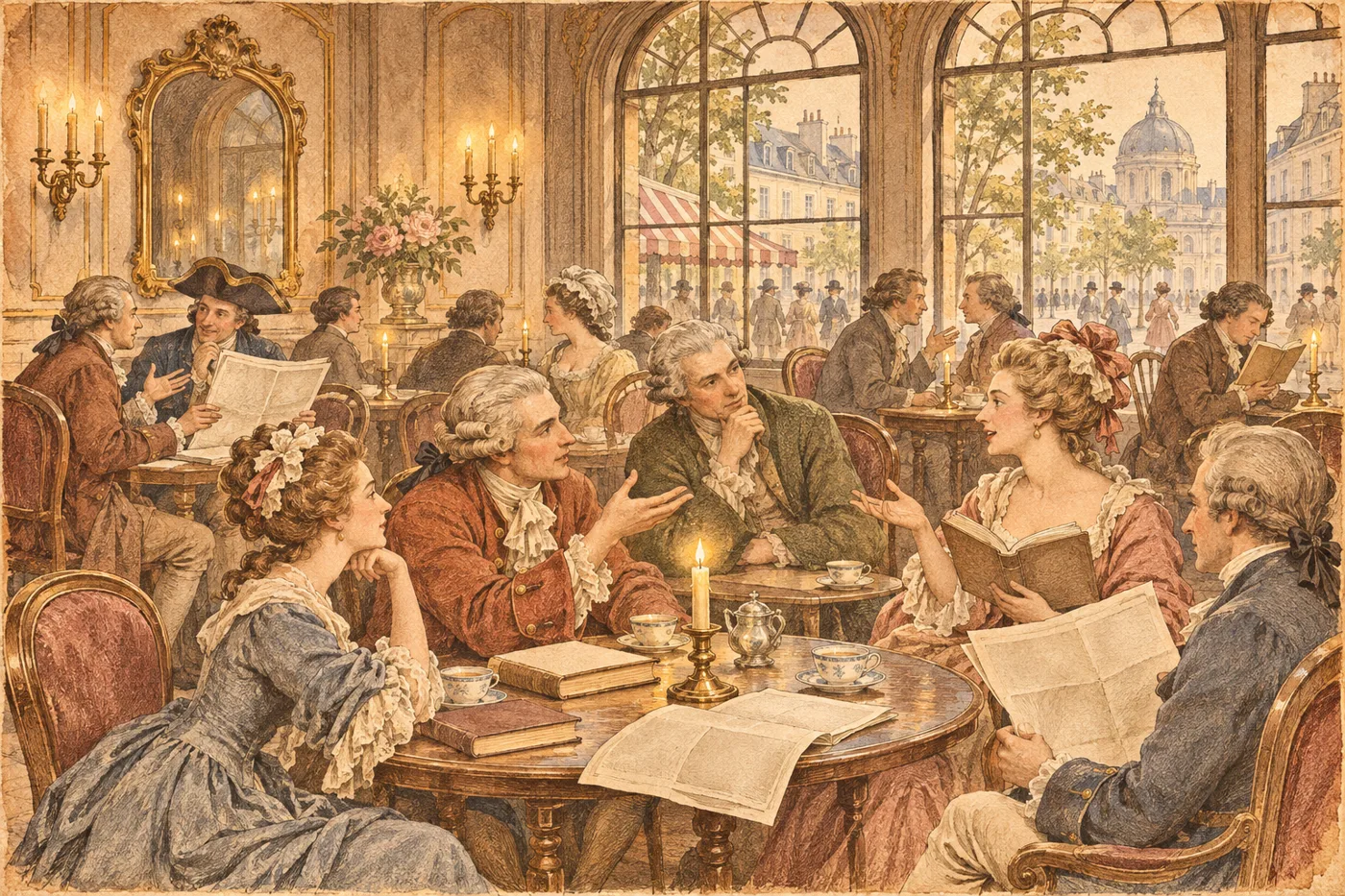
Why did people begin to question the idea that 'the king decides'?
In 17th-century Europe, more countries adopted 'absolute monarchy,' where the king ruled alone. France's Louis XIV (reigned 1643–1715) built a lavish palace at Versailles and was called the Sun King. The famous quote 'L'État, c'est moi' (I am the state) is said to be a later invention.
Meanwhile, in England, conflict between Parliament and the king deepened, leading to civil war in 1642. In 1649, King Charles I was executed. Then, in the Glorious Revolution of 1688–89, Parliament established the Bill of Rights, limiting the king's power. The idea that 'the king is also under the law' took root here.
Around the same time, Enlightenment ideas spread across Europe, holding that 'humans can think with reason.' Locke argued that governments are formed by the consent of the people; Montesquieu proposed dividing power into three branches (separation of powers); and Rousseau asserted that the will of the people is the foundation of the state.
These ideas crossed the Atlantic. In 1776, Britain's North American colonies declared independence. Then, in 1789, revolution broke out in France. Sparked by the storming of the Bastille on July 14, the revolution spread, abolishing privileges based on birth and issuing the Declaration of the Rights of Man and of the Citizen.
However, the revolution did not follow a straight path. In 1793, King Louis XVI was executed, and revolutionary leaders carried out the 'Reign of Terror,' executing opponents one after another. Eventually, the military leader Napoleon seized power and became emperor in 1804. He conquered much of Europe, spreading revolutionary ideas, but was defeated at Waterloo in 1815.
Yet the revolution that championed 'liberty' and 'equality' had limits. Those recognized as 'citizens' with rights were mainly men; women and slaves were often excluded. Some people pointed out this contradiction. In Haiti in the Caribbean, slaves rose up and won independence in 1804.
Mini timeline
- 1649King Charles I of England is executed
- 1689The Bill of Rights is established in England
- 1776American Declaration of Independence
- 1789French Revolution begins (Declaration of the Rights of Man and of the Citizen)
- 1815Napoleon is defeated at Waterloo
People in this chapter
He advocated that sovereignty lies with the people, and is said to have greatly influenced the ideas of the French Revolution.
Through the Napoleonic Code, he spread ideas like equality before the law and systematized the achievements of the revolution, while also ruling in a dictatorial manner.
Meanwhile, elsewhere
Connection to Japan
Japan was in the Edo period. Around the time of the French Revolution, in 1792, the Russian envoy Laxman arrived in Nemuro.
Why it still matters
In France, July 14 is still celebrated as Revolution Day (Bastille Day). The separation of powers, human rights concepts, and the metric system (established during the Revolution) have been passed down to systems around the world.
Perspectives differ
- "L'État, c'est moi" (I am the state)
- Famous as a quote from Louis XIV, but there is no solid evidence he said it; the prevailing view is that it is a later invention.
- Evaluation of the French Revolution
- Some emphasize its significance in spreading human rights and equality, while others stress the sacrifices of the Reign of Terror and wars. Evaluations remain divided today. Estimates of the number of victims also vary.
- Did Enlightenment thought cause the revolution?
- Scholars differ on whether ideas caused the revolution, or whether financial crisis and social grievances came first and ideas were used as a tool. The emphasis varies among researchers.
- Evaluation of Napoleon
- Views are split between seeing him as an heir of the revolution or as a dictator and conqueror, differing by country and by individual.
- The scope of 'citizens'
- Even after the Declaration of the Rights of Man, the rights of women, slaves, and propertyless people were restricted. Olympe de Gouges wrote the 'Declaration of the Rights of Woman' (1791), but she was later executed.
Facts checked (4, verified by AI on the web)
- Confirmed Louis XIV reigned from 1643 to 1715 Britannica: Absolutism
- Unverified "L'État, c'est moi" is considered a later invention Britannica: Absolutism
Britannica returns 403; source text supporting the 'invention' theory could not be read. - Confirmed Charles I executed in 1649 / Bill of Rights in 1689 Britannica: Charles I
- Confirmed Haiti declared independence on January 1, 1804 Britannica: Haitian Revolution
Sources
Britannica: Absolutism
Britannica: Charles I
Britannica: Haitian Revolution
* AI-drafted and cross-checked; human review is in progress. Status: