The Industrial Revolution — Steam and factories changed everyday life
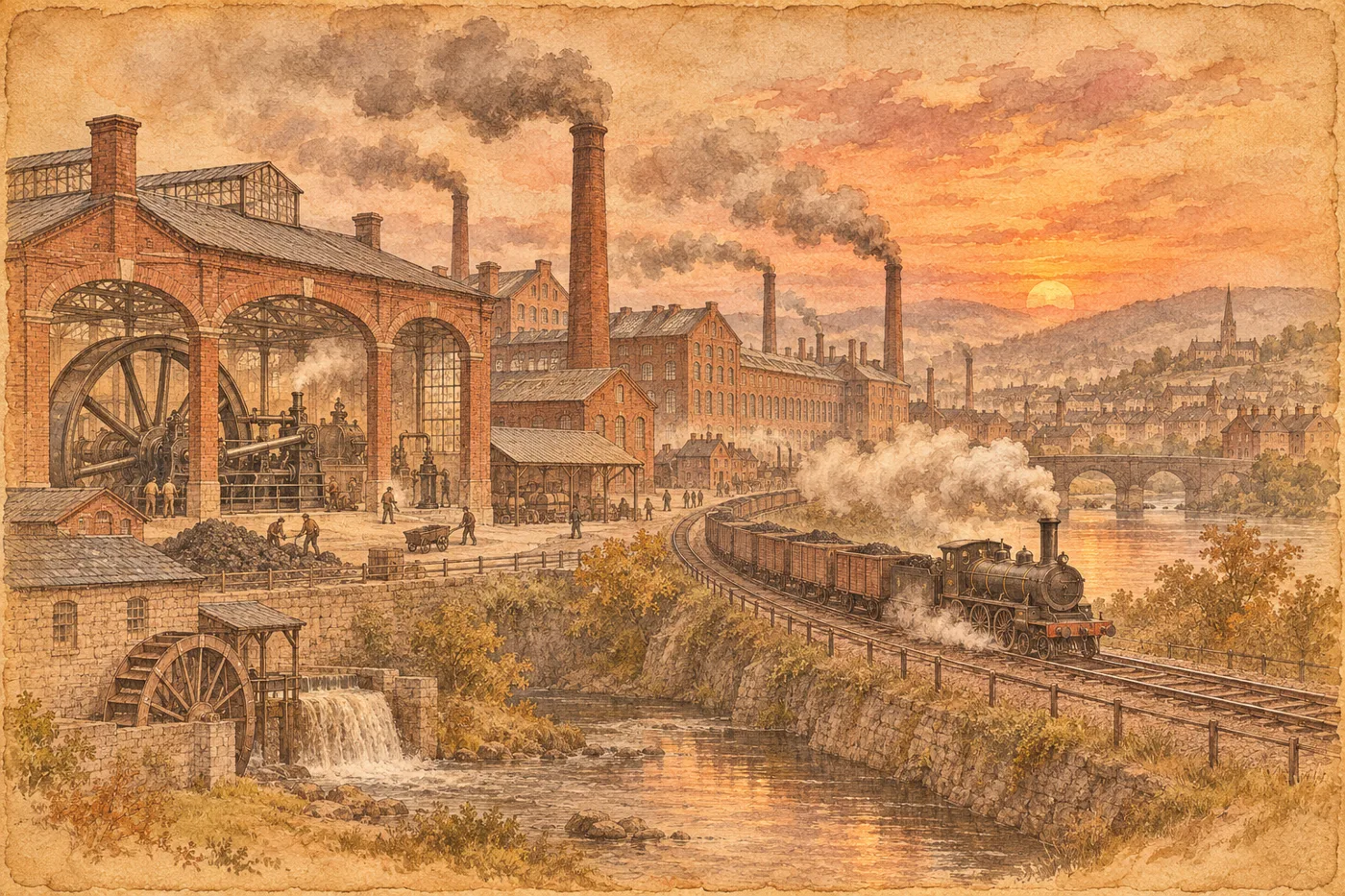
Why did the 'age of machines' begin in 18th-century England?
In the late 18th century, a movement began in Britain that would upend people's lives: the Industrial Revolution. One trigger was cotton textiles. Cotton cloth originally imported from India was light, durable, and hugely popular. The British, wanting to produce it themselves, invented one spinning and weaving machine after another.
The power to run machines also evolved. James Watt greatly improved the steam engine (patented in 1769), using coal to generate strong power. This meant factories could now also be built in places without running water. Iron-making technology also advanced.
Steam power also transformed transportation. In 1825, the world's first steam railway (a public railway) using Stephenson's steam locomotive began operation, and in 1830, Liverpool and Manchester were connected by rail. Steamships also appeared, moving people and goods at unprecedented speed.
In factories, large numbers of people began working fixed hours. Many moved from the countryside to cities, and places like Manchester grew rapidly. But working conditions were harsh: long hours, low wages, and child labor were common. The sky darkened with smoke, and cities became unsanitary.
People raised their voices against these problems. The Luddite movement (around 1811–17), which destroyed machines believed to steal jobs, the formation of labor unions, and the Factory Acts limiting working hours all emerged. In 1848, Marx and Engels published the Communist Manifesto, criticizing capitalism.
The Industrial Revolution spread to Belgium, France, Germany, the United States, and Japan. Factories needed raw materials and markets, so the great powers expanded into Asia and Africa. Steam, iron, and coal reshaped the world's landscape and power relations.
Mini timeline
- 1769Watt patents his improved steam engine
- 1825First steam locomotive railway begins operation
- 1830Liverpool–Manchester railway opens
- 1833Factory Act enacted in Britain
- 1851Great Exhibition in London
People in this chapter
Greatly improved the steam engine, opening the way for its use as a power source in factories and railways.
Worked on practical steam locomotives and contributed to the development of the world's first major steam railway.
Meanwhile, elsewhere
Connection to Japan
Japan transitioned from the end of the Edo period into the Meiji era. After Perry's arrival in 1853 and the Meiji Restoration in 1868, Japan's industries rapidly modernized as well.
Why it still matters
To operate railways, local times across regions had to be synchronized, leading to the creation of standard time. Also, the large-scale use of fossil fuels like coal is often cited as the historical starting point of today's climate change.
Perspectives differ
- Can it be called a 'revolution'?
- The prevailing view today is that it was a gradual change over a long period, rather than a sudden upheaval. The term 'Industrial Revolution' itself became common only later.
- Why Britain?
- Various factors are cited: coal and iron resources, capital, colonial markets, political stability, and a culture open to experimentation. Which factor is emphasized varies among researchers.
- Did living standards improve?
- There are views that in the long run living standards rose, and other views that at least for the first few decades, workers' lives were harsh.
- Relationship with colonies
- The impact of the Industrial Revolution on other regions—such as the supply of cotton (grown under slavery) and the decline of India's textile industry—is also an important point of debate.
Facts checked (5, verified by AI on the web)
- Confirmed Watt's patent of 1769 (separate condenser) Britannica: Watt steam engine
- Corrected & confirmed 1825 Stockton–Darlington railway (steam locomotive), 1830 Liverpool–Manchester railway opened Britannica: Stockton & Darlington Railway
Text correction: The 1825 railway is more accurately described as 'the world's first public railway using a steam locomotive' rather than 'first commercial railway' (regular passenger service began in 1833; horses were also used initially). - Confirmed 1833 Factory Act (limited child labor in textile mills) Britannica: Factory Act
- Confirmed Luddite movement around 1811–1816 Britannica: Factory Act
Sources vary between 1811–16 and 1811–17. The text's 'around' is appropriate. - Confirmed 1851 Great Exhibition in London (Crystal Palace) Britannica: Great Exhibition of 1851
Sources
Britannica: Watt steam engine
Britannica: Stockton & Darlington Railway
Britannica: Liverpool and Manchester Railway
Britannica: Factory Act
Britannica: Great Exhibition of 1851
* AI-drafted and cross-checked; human review is in progress. Status: