The Great Irish Famine — The Island Where the Potato Disappeared
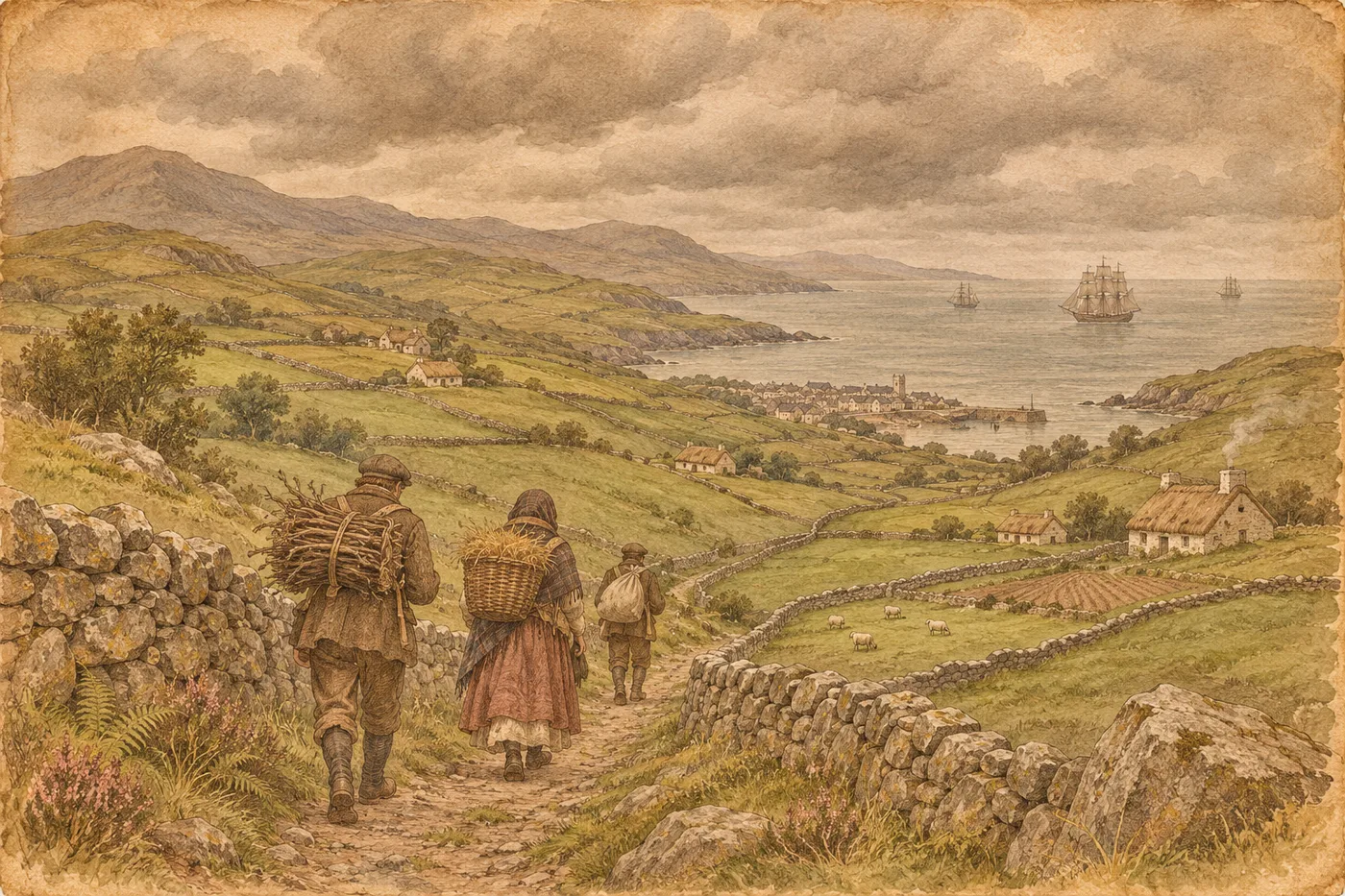
Why did a single crop disease become an event that dramatically changed the island's population?
In 1840s Ireland, especially among the poor, the potato was the main food. A small plot could yield a large harvest, which helped support a growing population. Then around September 1845, a disease called potato blight appeared on the island, and crops in the fields began to turn black and rot. This was the beginning of the Great Famine.
In 1845, damage was still only partial across the island. But by 1846, the blight had spread to nearly the entire country. The number of families with no reserves grew, and in winter, deaths from starvation and associated diseases (such as typhus) rose sharply. In 1847, although the blight itself weakened, the harvest plummeted due to a shortage of seed potatoes, and in 1848 the blight raged again. Poor harvests continued until 1849; the crop only began to recover around 1850.
At the time, Ireland was part of the United Kingdom, and relief policy was decided by the government in London. From autumn 1845 into 1846, Prime Minister Peel's government imported maize (Indian corn), started public works to provide jobs, and set up relief committees. From 1846, Prime Minister Russell's government took over, and by around March 1847, over 700,000 people are said to have been employed in public works. Later, relief was switched to free soup kitchens (1847), and by summer, about 3 million people are said to have received meals there.
However, the soup kitchens were closed in the summer and autumn of 1847, and relief costs were shifted to local poor law unions funded by local taxes. Workhouses overflowed, and over 200,000 people are said to have died inside them. More than 500,000 people are said to have been evicted for failing to pay rent. Whether these responses were adequate remains debated to this day.
The population fell from about 8.2 million in 1841 (some studies suggest the actual figure was slightly higher due to undercounting) to about 6.55 million in 1851. Many researchers estimate at least around 1 million deaths, with estimates ranging from 800,000 to about 1.4 million depending on the method. In addition, many people left the island; over 1 million are said to have arrived at North American ports between 1846 and 1851.
The emigrant journey was not easy. People died on ships and at quarantine stations such as Grosse Isle in Canada. Nevertheless, large immigrant communities grew in America; over 900,000 are said to have arrived in New York between 1845 and 1855. Ireland's population continued to decline for a long time afterward, reaching about 4.5 million around 1901. The famine changed the island's way of life, family structures, and its connections with the rest of the world.
Mini timeline
- c. September 1845Potato blight appears on the island
- 1846Blight spreads to nearly the entire country; Russell government takes over relief
- 1847Soup kitchens established; closed in summer and autumn. Poor Law amendment shifts the financial burden to local areas
- 1848Blight returns, worsening the disaster
- 1846–51Over 1 million people said to have arrived at North American ports
- 1851Census records population at about 6.55 million
People in this chapter
He led the government that imported maize (Indian corn) and set up local relief committees in the first year of the blight.
He was in charge of the practical administration of relief. Seen as an able organizer, but his strong emphasis on cost-cutting leads to divided assessments.
Meanwhile, elsewhere
Connection to Japan
The year 1845 was late in Japan's Edo period, corresponding to Kōka 2. Perry's arrival (1853) came about eight years later.
Why it still matters
The population of the island of Ireland fell from about 8.2 million in 1841 to about 4.5 million in 1901. Emigrants and their descendants built large communities in America and elsewhere, and the memory of the famine continues to be passed down both on the island and abroad.
Perspectives differ
- Number of deaths
- British government records from the time are incomplete, and the 1851 census is thought to have undercounted. Death estimates range from around 800,000 to over 1 million, and some views, including the reduction in births due to the famine, put the total population loss at about 1.4 million or more.
- Assessment of the British government's response
- Some argue that policies to keep costs down and avoid free food handouts, which were thought to encourage idleness, made relief inadequate. On the other hand, some view the response as a major relief effort given the constraints of the time; scholars' assessments are divided.
- Differences by region and class
- The impact is described as falling most heavily on the west and south of the island, and on the poorest people. Research into the reasons for regional differences continues.
- How to view food exports
- Opinions differ on how to evaluate the fact that foodstuffs such as grain were being exported from the island even during the famine. No figures are cited here.
- Counting the number of emigrants
- The number of people arriving at North American ports and the total number leaving the island vary by source. It is also difficult to distinguish 'famine emigrants' from those who had been emigrating before.
Facts checked (7, verified by AI on the web)
- Confirmed Potato blight appeared on the island around August 1845 and spread to nearly the entire country in 1846 PRONI: Education Leaflet 3 - The Great Irish Famine
Confirmed by reading the PDF text. Late August 1845, total in 1846, recovery of harvest in 1850. - Confirmed Population fell from about 8.2 million in 1841 to about 6.55 million in 1851 RTÉ: 'Greatest ravages': the 1851 census and famine mortality
1841 census 8,175,124, 1851 6.55 million. The article notes some recent studies suggest the 1841 figure was an undercount. PRONI gives 8.2 million to 6.6 million. - Corrected & confirmed Deaths were at least around 1 million (estimates range from 800,000 to about 1.4 million) RTÉ: 'Greatest ravages': the 1851 census and famine mortality
RTÉ says 'at least 1 million' is majority view, including birth reduction about 1.4 million. Wilde estimated about 1.36 million deaths 1841–51. PRONI gives about 800,000 (1845–50). Written with a range in the text. - Confirmed Over 1 million people arrived at North American ports in 1846–51 / Over 900,000 arrived in New York in 1845–55 PRONI: Education Leaflet 3 - The Great Irish Famine
PRONI says over 1 million to North America 1846–51. New York over 900,000 from RTÉ article. PRONI elsewhere writes 'a further 2 million emigrated', showing variation. - Confirmed Over 700,000 in public works in March 1847; about 3 million received soup kitchen rations in summer. Relief shifted to local burden in 1847 RTÉ: The Great Irish Famine
Confirmed by reading the text. Soup kitchens closed late August–September 1847. Over 200,000 deaths in workhouses, over 500,000 evictions also noted. - Confirmed In April 1849, Lord Clarendon criticized the government's indifference and warned of a 'policy of extermination' RTÉ: The Great Irish Famine
Only the fact of criticism was used, avoiding direct quotation or evaluation of the phrase. - Confirmed Foodstuffs such as grain were being exported from the island during the famine History Ireland: food exports from Ireland during the Famine
Text states: During the famine years, considerable food left the island; in 1847 alone about 4,000 ships carried food to major British ports. Official statistics may be understated. Whether exports were the main cause of increased deaths is debated; some argue that even keeping all food would not have compensated for the blight. The text's treatment as 'views differ' is appropriate.
Sources
PRONI(北アイルランド公文書館): Education Leaflet 3 - The Great Irish Famine
RTÉ(アイルランド公共放送): The Great Irish Famine
RTÉ(アイルランド公共放送): 'Greatest ravages': the 1851 census and famine mortality
RTÉ(アイルランド公共放送): The truth about Trevelyan
History Ireland: food exports from Ireland during the Famine
* AI-drafted and cross-checked; human review is in progress. Status: