Peter the Great — The Tsar Who Looked West
Why did Russia's tsar decide to radically reshape his own country?
In 1547, Ivan IV (the Terrible) was crowned, becoming the first to take the title 'Tsar.' Russia subdued Kazan in the east (1552) and expanded across Siberia toward the Pacific in the 17th century. In 1613, the Romanov dynasty began, ending a long period of turmoil.
In 1682, Peter I ascended the throne as a boy (he later ruled alone). From a young age, he took a strong interest in Western European technology and navigation, visiting the foreign quarter in the outskirts of Moscow.
From 1697 to 1698, Peter traveled through Western Europe incognito with a grand embassy; he is said to have worked in a shipyard in the Netherlands. After returning home, he tried to change customs: he had nobles' beards shaved, introduced Western-style clothing, and in 1700 made January 1 the start of the new year. He created a standing army and navy, and set up government offices and schools.
Russia lacked a port that did not freeze in winter. Peter fought Sweden for access to the Baltic Sea (the Great Northern War, 1700–1721). Though defeated at first, he won the Battle of Poltava in 1709 and made peace in 1721, gaining the Baltic coastline.
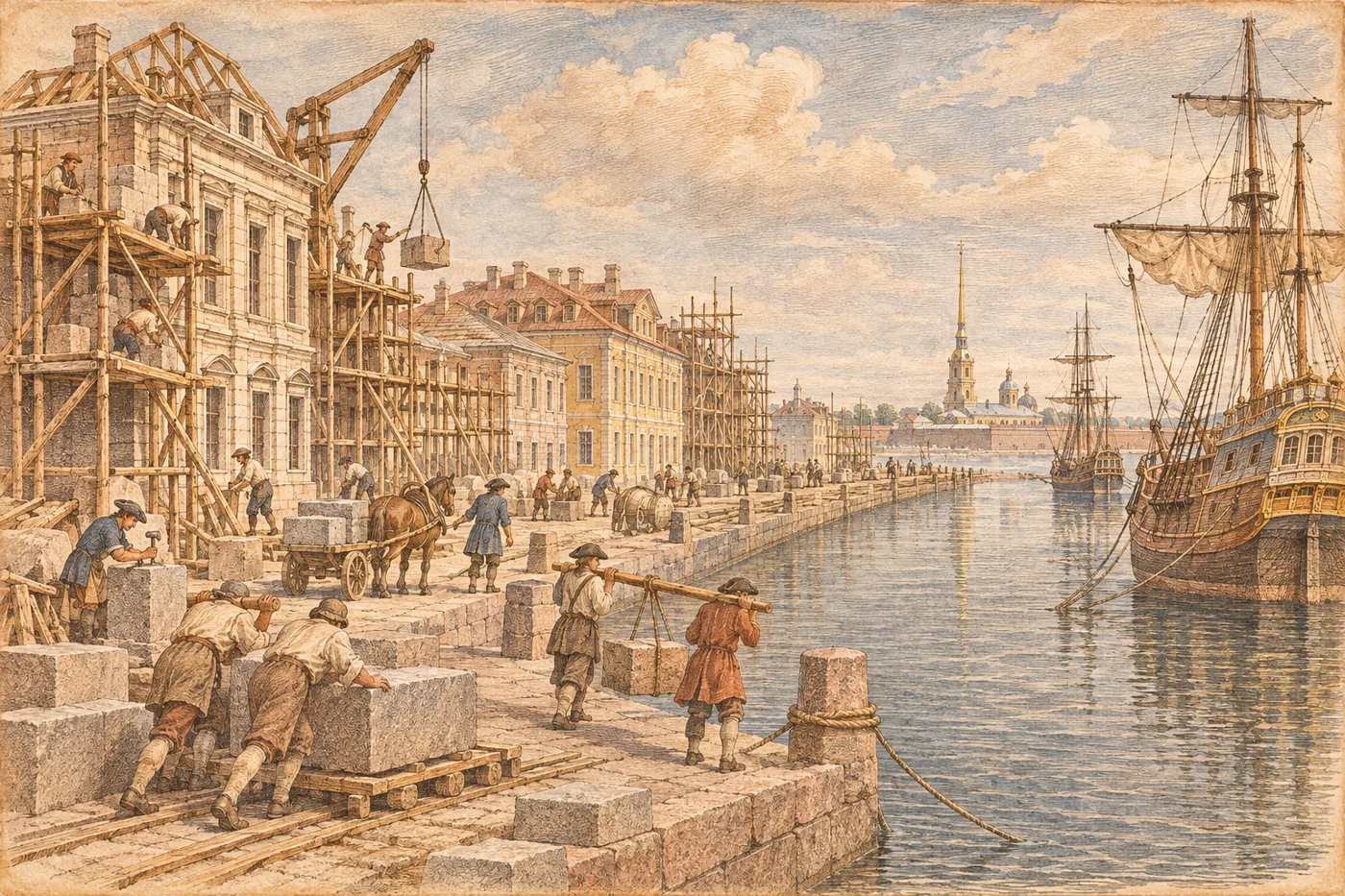
In 1703, he began building a new capital, Saint Petersburg, on marshland at the mouth of the Neva River (it became the capital in 1712). This city, called a 'window to the West,' was built by conscripting many peasants. In 1721, Peter accepted the title 'Emperor (Imperator),' and Russia became an empire.
The reforms came at a cost. Heavy taxes, military service, and the burden on serfs (peasants bound to landowners) are said to have grown even heavier. Western-style culture spread among the nobility, but a great gap opened between them and the common people. This vast empire would confront France's Napoleon in the 19th century.
Mini timeline
- 1547Ivan IV takes the title of Tsar
- 1613Romanov dynasty begins
- 1697-98Peter tours Western Europe
- 1703Construction of Saint Petersburg begins
- 1709Battle of Poltava
- 1721Great Northern War ends; Russian Empire proclaimed
People in this chapter
Called 'the Great,' he transformed Russia into a major power through military, administrative, and cultural reforms.
Greatly expanded Russia's territory. In the latter half of his reign, he was also known for harsh rule.
Meanwhile, elsewhere
Connection to Japan
Japan was in the Edo period. It is said that a Japanese castaway named Denbei met Peter in 1702, and later taught Japanese in Moscow. A Japanese language school was ordered established in 1705 and later moved to St. Petersburg.
Why it still matters
The historic center of Saint Petersburg is a UNESCO World Heritage site. The city, crisscrossed by canals, is known as the 'Venice of the North.'
Perspectives differ
- Assessment of the Reforms
- There are views of Peter as the 'father of modernization,' and views that he simply accelerated reforms already underway in the preceding period.
- Human Cost of Building St. Petersburg
- It is said that many people died during the construction, but the exact numbers are uncertain.
- The Battle of Poltava and Ukraine
- The Ukrainian Cossack hetman Mazepa sided with Sweden in this battle. In Russian history he is portrayed as a 'traitor,' while in Ukraine he is regarded as a leader who sought independence; assessments are sharply divided.
- Strengthening of Serfdom
- It is thought that the funding and manpower for Peter's reforms were supported by the burden on serfs. Assessment varies depending on whether one emphasizes the 'light' or the 'shadow' of the reforms.
Facts checked (5, verified by AI on the web)
- Confirmed Ivan IV crowned as first tsar in 1547, Kazan in 1552, Romanov dynasty in 1613 SUNY World History(Lumen Learning): Ivan the Terrible
Lumen (SUNY material) records the 1547 coronation (first use of the title) and the 1552 fall of Kazan; EBSCO Research Starters notes the 1613 election of Mikhail Romanov and the start of the new dynasty. - Confirmed Grand Embassy to Western Europe in 1697–98 World History Encyclopedia: The Grand Embassy of Peter the Great
March 1697 to August 1698. Its main goal was to expand the anti-Ottoman alliance, which was unsuccessful. - Confirmed New Year moved to January 1 in 1700 Slavic Review(Cambridge): Calendar Reform under Peter the Great
A journal article notes the calendar reform introduced January 1, 1700, and notes in a footnote that the previous New Year had been September 1 (the Julian calendar itself was retained; the article notes it would be inaccurate to say the Julian calendar was adopted at this time). - Confirmed Great Northern War (1700–21), Battle of Poltava 1709, Peace 1721 World History Encyclopedia: Great Northern War
The Treaty of Nystad was signed on August 30, 1721 (Old Style). - Confirmed St. Petersburg founded 1703, capital in 1712, imperial title in 1721 World History Encyclopedia: Peter the Great
The capital was moved in 1712 (it returned to Moscow in 1728 and became the capital again in 1732). The imperial title was adopted on October 22 (Old Style) = November 2 (New Style), 1721.
Sources
SUNY World History(Lumen Learning): Ivan the Terrible
World History Encyclopedia: The Grand Embassy of Peter the Great
Slavic Review(Cambridge): Calendar Reform under Peter the Great
World History Encyclopedia: Great Northern War
World History Encyclopedia: Peter the Great
EBSCO Research Starters: Election of Michael Romanov as Czar
* AI-drafted and cross-checked; human review is in progress. Status: