The Fall of Constantinople — The Day a Thousand-Year Capital Ended
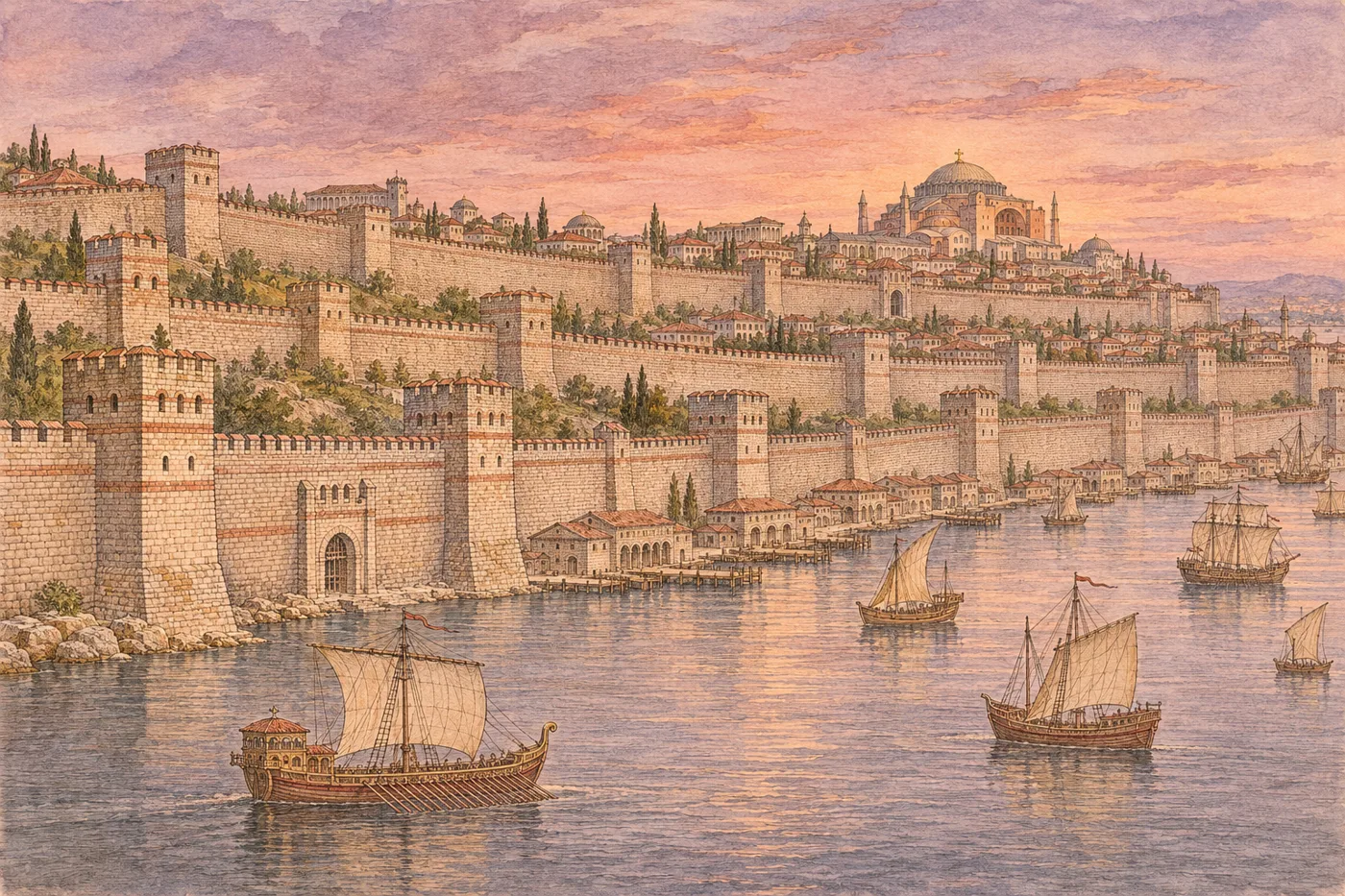
Why did a city that had lasted over a thousand years fall after a siege of barely two months?
In 1453, the Eastern Roman (Byzantine) capital of Constantinople was besieged by the army of the Ottoman Empire. By this time, the empire's territory is said to have shrunk to little more than the area around the capital, apart from parts of the Peloponnese and a few other holdings. The young sultan Mehmed II, who had ascended the throne again in 1451, was about 21 years old. The emperor relied on the massive walls built in the 5th century to defend the city.
The key defensive point was the land wall completed under Theodosius II. It stretched about 6.5 kilometers, with an inner wall some 5 meters thick and 12 meters high, and is said to have had 96 projecting towers. The city fell to the Fourth Crusade in 1204 from the sea side, but the great land wall is said never to have been breached by force until 1453. But now a new weapon would challenge these very walls — the city's greatest hope of defense.
That weapon was the cannon. A Hungarian engineer named Urban first tried to serve the Byzantine side, but the emperor could not pay his fee. It is said he went to Mehmed, who offered him four times the amount he had asked. The largest cannon was about 9 meters long and could fire a shot of some 500 kilograms over 1.5 kilometers, but could only be fired a few times a day.
The siege began in early April. Recent studies estimate the Ottoman army at about 60,000 to 80,000 men. The defenders numbered fewer than 5,000 Byzantine soldiers, and even with about 2,000 foreign troops from Genoa and elsewhere, the total was only around 7,000. Genoese soldiers also joined them, and a commander named Giovanni Giustiniani aided in the defense. On April 20, four ships in total — three Genoese vessels and one imperial transport — broke through the blockade and made it in. But aid from the West was meager.
An all-out assault began at dawn on May 29. Emperor Constantine XI is said to have fought to the last and died near the Gate of St. Romanus. He is said to have removed his insignia, and his body was never identified. Later a legend arose that he sleeps, encased in marble, and will one day return. After the fall, plunder was allowed by the custom of the time; thousands were killed and tens of thousands carried off as slaves (one encyclopedia gives about 4,000 killed and over 50,000 enslaved). It is said that once inside the city, Mehmed forbade the destruction of buildings and soon put a stop to the looting.
How this event is seen depends on one's perspective. From the Byzantine side, it was the end of the Roman tradition. From the Ottoman side, it was a starting point in which the city became the capital of a new empire. Mehmed ordered Hagia Sophia to be turned into a mosque, and the Orthodox community is also said to have been allowed to continue under Patriarch Gennadius II. Both perspectives have been presented on the basis of historical sources.
Mini timeline
- c. 413The Theodosian land walls are built, then reinforced in 447
- 1204The Fourth Crusade enters the city
- 1451Mehmed II ascends the throne again
- April 6, 1453The Ottoman attack begins
- April 20, 1453Three Genoese ships and one imperial transport break through the blockade and make it in
- May 29, 1453The city falls in an all-out assault; Emperor Constantine XI is said to have been killed in battle
People in this chapter
He ascended the throne again in 1451 and came to be called 'the Conqueror.' After the fall, he made the city the Ottoman capital.
He reigned from 1449 and is said to have personally led the city's defense.
He is said to have cast the cannons and helped in the assault on the walls.
He is said to have joined the command of the defending forces.
Meanwhile, elsewhere
Connection to Japan
In Japan, 1453 corresponded to the second year of the Kyotoku era, during the Muromachi shogunate. Not long after, in 1467, the Onin War would begin.
Why it still matters
The city is now known as Istanbul, and parts of the Theodosian Walls are said to remain. Its history has been passed down in different words in countries such as Greece and Turkey.
Perspectives differ
- Is 1453 an appropriate cutoff for the 'end of the Middle Ages'?
- While many textbook accounts mark 1453 as the end of the Middle Ages, historical eras cannot be neatly divided by a single day, and other years such as 1492 are also proposed. Here it is treated as 'one of the dividing points.'
- The Byzantine vs. Ottoman perspective
- On the Byzantine and Christian side, it has been described as the end of the Roman tradition. On the Ottoman side, it is described as the turning point when the empire gained its capital. This book does not judge which is correct.
- The city's name and the status of Hagia Sophia
- The city later came to be called Istanbul. There is a range of explanations for when this name became established. Hagia Sophia was turned into a mosque after the fall, became a museum in the 20th century, and was made a mosque again in 2020. No definitive judgment is made here on the debates over how to evaluate this.
- Was the cannon the decisive factor?
- Many accounts emphasize the cannon as the key to victory, while others place more weight on the disparity in troop numbers and the scarcity of Western aid. Figures also vary between sources.
Facts checked (8, verified by AI on the web)
- Confirmed The siege began in April, final assault at dawn on May 29. Ottoman forces about 60,000–80,000, defenders fewer than 5,000, Genoese ships arrived on April 20. World History Encyclopedia(事典): 1453: The Fall of Constantinople
Confirmed in the encyclopedia text. The start of the attack is recorded as April 6. Troop numbers differ between older sources and recent estimates. - Confirmed Urban's cannon (about 9m long, 500kg shot, about 7 times a day) and the story of four times the pay. World History Encyclopedia(事典): 1453: The Fall of Constantinople
Confirmed in the encyclopedia text. Includes traditions. - Confirmed Theodosian Walls (completed 439, land wall about 6.5km, inner wall thickness about 5m, height about 12m, 96 towers), unbreached until 1204. World History Encyclopedia(事典): 1453: The Fall of Constantinople
Confirmed in the encyclopedia text. - Confirmed Constantine XI is said to have died near the Gate of St. Romanus, body unidentified, with a legend of marble. World History Encyclopedia(事典): 1453: The Fall of Constantinople
Confirmed in the encyclopedia text. Circumstances of death are not certain. - Confirmed Mehmed II enthroned in 1451, about 21 at the fall; stopped the looting, turned Hagia Sophia into a mosque, allowed the Orthodox community to continue under Gennadius II. World History Encyclopedia(事典): 1453: The Fall of Constantinople
Confirmed in the encyclopedia text. - Confirmed Giustiniani's participation in the defense. World History Encyclopedia(事典): 1453: The Fall of Constantinople
The encyclopedia says he joined the defense as a Genoese siege expert. His later movements were not confirmed in the text and are not written here. - Unverified The city later called Istanbul / the spread of 1453 as the end of the Middle Ages / other cutoffs such as 1492. World History Encyclopedia(事典): 1453: The Fall of Constantinople
WHE 'Constantinople' only states 'modern-day Istanbul' with no details on renaming. The text read contains no mention of 1453 as the end of the Middle Ages or reference to 1492. - Unverified The Hundred Years' War ended in 1453 / Japan's Kytoku 2 and the Onin War of 1467. World History Encyclopedia(事典)「Hundred Years' War」
Only the end of the Hundred Years' War in 1453 is confirmed in the encyclopedia text. The year 1467 (Ōnin War) remains unverified due to lack of accessible sources.
Sources
World History Encyclopedia(事典): 1453: The Fall of Constantinople
* AI-drafted and cross-checked; human review is in progress. Status: