Poland–Lithuania — A Country That Was Carved Up and Rose Again
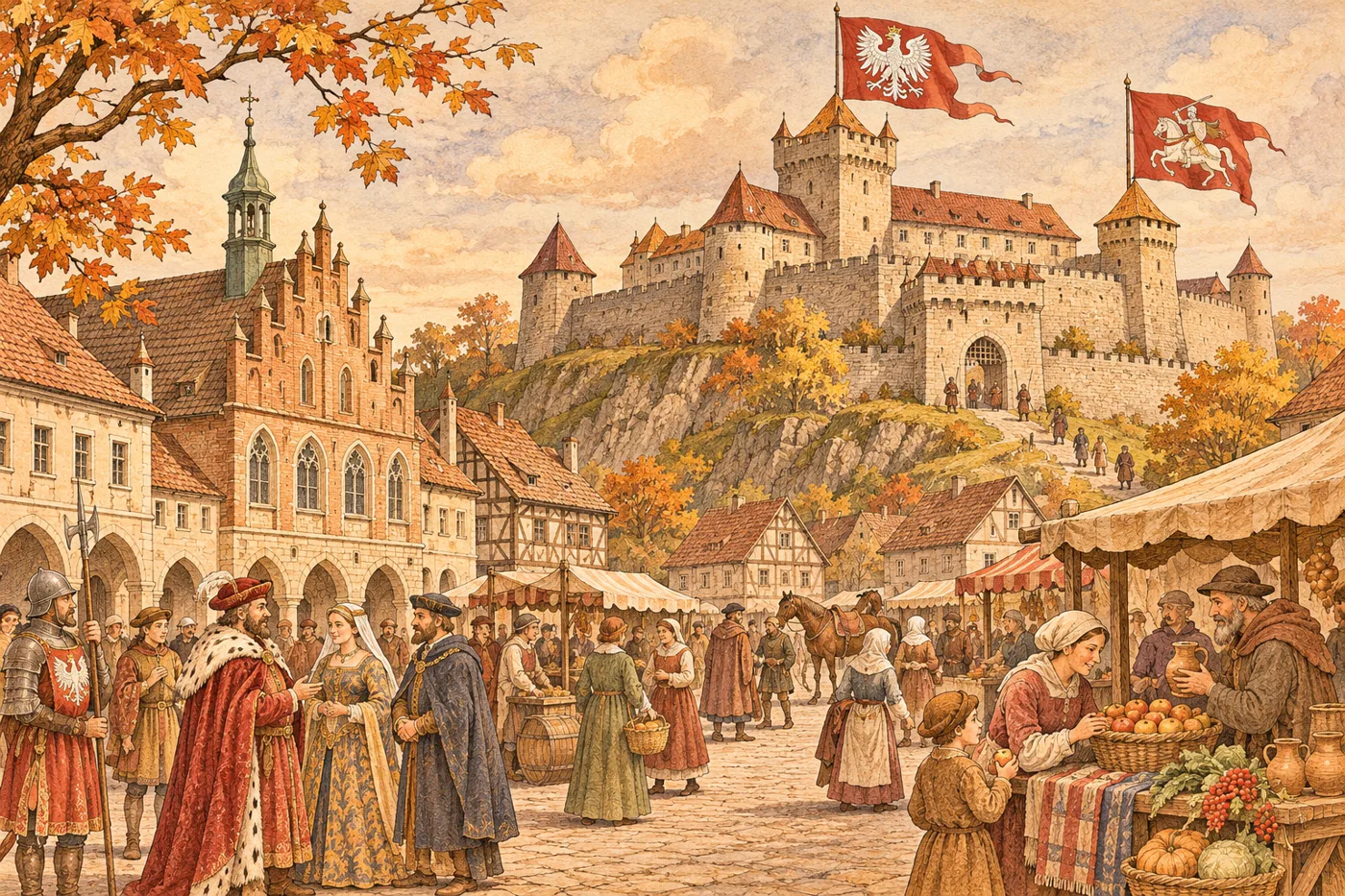
How did a nation that vanished from the map manage to re-emerge more than a hundred years later?
After the Union of Krewo in 1385, in the following year, 1386, Grand Duke Jogaila of Lithuania was baptized, married Queen Jadwiga of Poland, and became King Władysław II Jagiełło of Poland. The backdrop was a common enemy: the Teutonic Knights. In 1410, at the Battle of Grunwald, the armies of both countries defeated the order. The bond between the two nations would endure for over 400 years.
With the Union of Lublin in 1569, the two countries became a single republic. The king was to be elected jointly, and the parliament was to convene jointly. Lithuania, however, kept its own military, treasury, laws, and administrative system. This loose union of states was also called the 'Commonwealth of Both Nations.' It lasted until 1795, respecting the circumstances of each country.
In this state, the nobility (szlachta) made up about 7–10% of the population and elected the king. Parliament operated on the principle of unanimity, and religion was treated with relative tolerance for Europe at the time. Around 1582, it is estimated that one of the largest Jewish communities in the world existed here. The nobility held dominion over the land and the peasants who worked it.
However, in the 18th century, the surrounding great powers grew stronger. The First Partition came in 1772, and on May 3, 1791, a constitution was created that is said to be Europe's first written constitution. Nevertheless, the Second Partition occurred in 1793, and after the Kościuszko Uprising in 1794, the Third Partition in 1795 erased the country from the map. The European powers of the time prioritized their responses to the French Revolution and their own interests, and no country attempted to stop the partitions.
Thereafter, the territory was divided among Russia, Prussia, and Austria. Uprisings also broke out in 1830 and 1863, each time being suppressed. Still, the people preserved their language and culture through 'organic work'—fostering education and the economy—and from towns in Galicia, which had relative autonomy. Cultural centers included Kraków and Lviv.
World War I shook the three empires. About two million Poles fought in the armies of those empires. In November 1918, Józef Piłsudski returned to Warsaw, and after 123 years, an independent country returned to the map. The borders were set in 1921, and about one-third of the population were ethnic minorities. Thus, the long era of partitions came to an end. Independence became a reality amid post-war international negotiations.
Mini timeline
- 1385Poland and Lithuania form a bond (Union of Krewo)
- 1410The Teutonic Knights are defeated at the Battle of Grunwald
- 1569The Union of Lublin creates a republic
- 1791The Constitution of May 3 is established
- 1795The country disappears in the Third Partition
- 1918Independence is restored
People in this chapter
Baptized in 1386, he married Queen Jadwiga and became King of Poland.
Having participated in the American Revolutionary War, he led the 1794 uprising. He was defeated by Russian forces but is still regarded as a national hero.
Meanwhile, elsewhere
Connection to Japan
The Union of Lublin in 1569 came the year after Oda Nobunaga entered Kyoto with Ashikaga Yoshiaki, during Japan's Sengoku period.
Why it still matters
Constitution Day on May 3 is one of Poland's most cherished holidays. Lithuania and Poland now walk their own paths, and their views of shared history still differ in places.
Perspectives differ
- Nature of the Union of Krewo
- There are views that see the 1385 agreement as an incorporation into Poland, and views that see it as the beginning of an equal partnership. The emphasis differs between the Polish and Lithuanian sides, and there are multiple theories.
- Process of the Union of Lublin
- During the negotiations, it was announced that part of Lithuania's territory had been annexed to Poland. Whether this is seen as pressure or a realistic compromise divides opinions.
- Assessment of the Noble Republic
- While some see it as a system protecting noble freedoms, others view the unanimity principle and elective monarchy as weakening the state. Which aspect is weighted more heavily varies among researchers.
- Causes of the Partitions
- There are explanations that emphasize the ambitions of the surrounding great powers, and those that emphasize internal conflicts and institutional weaknesses. The view that both factors overlapped is said to be common.
- Assessment of the May 3 Constitution
- It is sometimes called 'Europe's first written constitution,' though definitions of what counts as 'first' vary. It is also said that it was not fully implemented.
Facts checked (5, verified by AI on the web)
- Confirmed In 1385 Poland and Lithuania formed a bond, and in 1410 they defeated the Teutonic Knights at Grunwald Library of Congress, Poland: A Country Study(online edition): The Jagiellon Era, 1385-1572
Confirmed: the Union of Krewo in 1385, the marriage of Jadwiga and Jogaila, the common enemy being the Knights, and the victory in 1410. The characterization of the union is treated as a point of debate. - Confirmed Union of Lublin on July 1, 1569: shared king and parliament, Lithuania retained its military, currency, treasury, and laws Encyclopedia.com(事典): Lublin, Union of (1569)
Confirmed by Encyclopedia.com. Also noted that annexation of some territories was declared during negotiations. - Confirmed Nobility made up 7–10% of the population; Jews estimated at 150,000 around 1582 Library of Congress, Poland: A Country Study(online edition): The Golden Age of the Sixteenth Century
Both from the same source. The Jewish population is an 'estimate.' The phrase 'one of the largest in the world' follows the source's wording. - Confirmed Three partitions in 1772, 1793, and 1795, and the Constitution of May 3, 1791 Library of Congress, Poland: A Country Study(online edition): The Three Partitions, 1764-95
The source calls the May 3 constitution 'Europe's first written constitution,' but the text uses 'is said to be' and includes it as a debate point. The Kościuszko Uprising is dated 1794. - Confirmed Piłsudski returned in November 1918 and restored independence; borders finalized in 1921; ethnic minorities were about one-third of the population Library of Congress, Poland: A Country Study(online edition): World War I / Interwar Poland
Chapter 13 records 'November 1918,' '123 years gone from the map,' 'about 2 million Poles fought in the armies of three empires, with 450,000 dead.' Borders (1921) and about one-third ethnic minorities are from Chapter 14. A specific date (November 11) is unconfirmed, so it is not included in the text.
Sources
Library of Congress, Poland: A Country Study(online edition): The Jagiellon Era, 1385-1572
Library of Congress, Poland: A Country Study(online edition): The Golden Age of the Sixteenth Century
Library of Congress, Poland: A Country Study(online edition): The Three Partitions, 1764-95
Library of Congress, Poland: A Country Study(online edition): Partitioned Poland
Library of Congress, Poland: A Country Study(online edition): World War I / Interwar Poland
Encyclopedia.com(事典): Lublin, Union of (1569)
* AI-drafted and cross-checked; human review is in progress. Status: