Conquest — A Handful of Soldiers and an Invisible Enemy
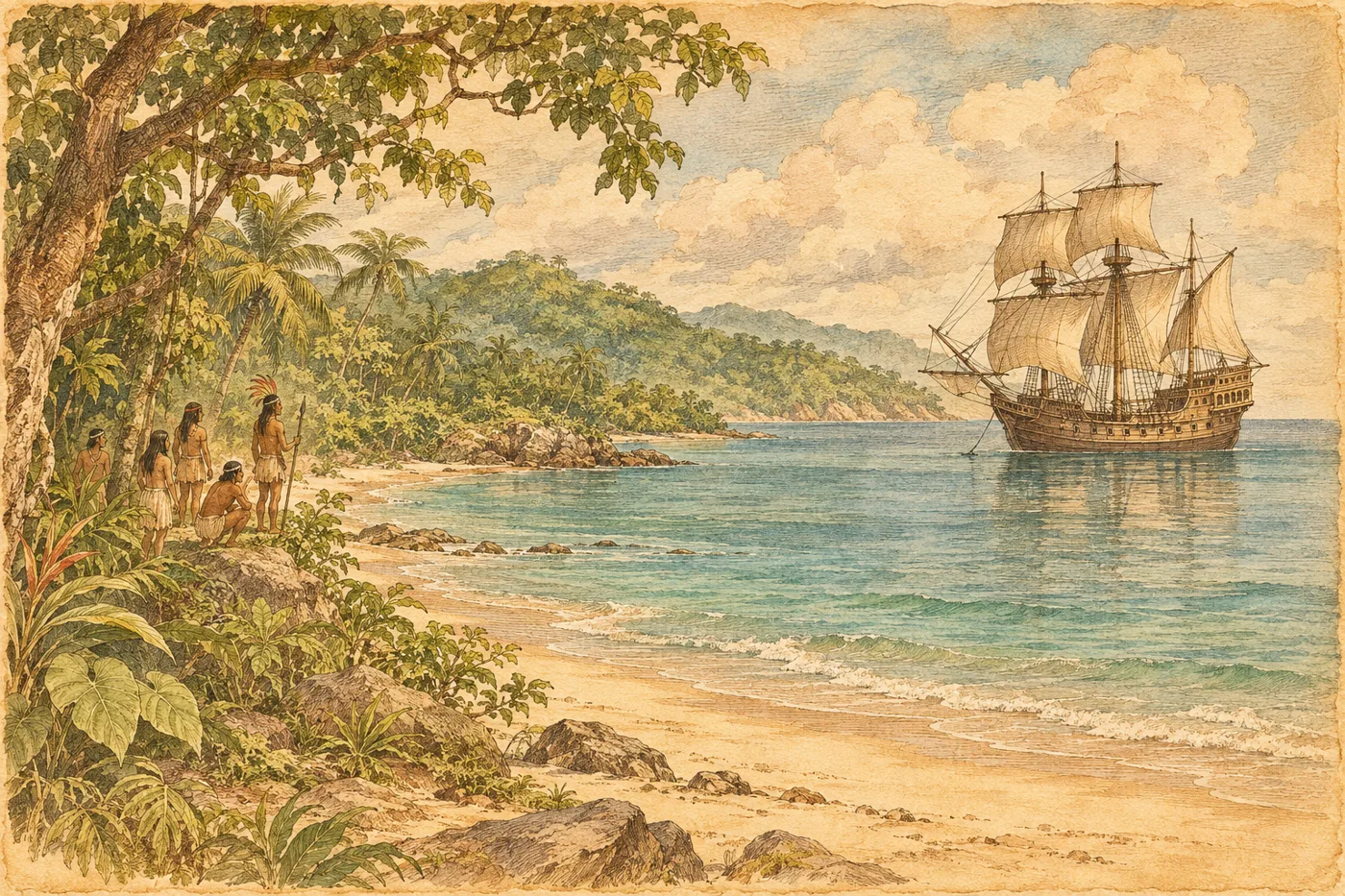
Why were a few hundred Spaniards able to topple vast empires?
In 1492, Christopher Columbus, an Italian-born explorer, crossed the Atlantic with the support of the Spanish queen and landed on an island in the Caribbean. He was convinced he had reached India. To Europeans, this was the "discovery of a New World," but millions of people were already living there.
In 1519, the Spanish conquistador Hernán Cortés landed on the coast of Mexico with about 500 soldiers. With the help of an interpreter, Malinche (Doña Marina), he formed alliances with peoples who opposed the Aztecs, especially the Tlaxcalans. Thus, Cortés’s army—swelled by tens of thousands of indigenous allies—marched toward Tenochtitlan.
In 1520, smallpox broke out in the capital. The peoples of the Americas had no immunity to this disease brought by Europeans. In 1521, Tenochtitlan fell, and the Aztec Empire came to an end.
In South America, in 1532, Francisco Pizarro captured the Inca emperor Atahualpa at Cajamarca with about 170 soldiers. The Inca Empire had been shaken by an epidemic, thought to have spread from the Europeans (smallpox is the leading view, though debated), and by a civil war over the throne. Atahualpa was executed in 1533.
After the conquest, the Spanish crown established the encomienda system, granting conquistadors control over land and the indigenous people living on it. In exchange for receiving Christian instruction, the indigenous people were required to work, but in practice, they were subjected to harsh forced labor. The indigenous population is said to have declined drastically in some regions.
The priest Bartolomé de las Casas fiercely criticized this treatment. A debate in 1550–51 discussed how indigenous people should be treated. Nonetheless, the last Inca stronghold (Vilcabamba) was destroyed in 1572. The European conquest transformed the indigenous world, but indigenous peoples have continued to live on to this day.
Mini timeline
- 1492Columbus lands on an island in the Caribbean
- 1519Cortés lands in Mexico
- 1521The Aztec capital Tenochtitlan falls
- 1532Pizarro captures Inca emperor Atahualpa
- 1572The last Inca of Vilcabamba is executed
People in this chapter
Having witnessed the treatment of indigenous peoples, he appealed to the Spanish crown to protect them.
She interpreted between indigenous languages and Spanish. Her later reputation remains deeply divided, even in Mexico.
Meanwhile, elsewhere
Connection to Japan
Japan was in the Sengoku period. In 1543, firearms arrived, and in 1549, the Spanish Jesuit missionary (from Navarre) Francis Xavier came to Japan.
Why it still matters
Much of Mexico’s population is mestizo, of both indigenous and Spanish descent. Mexico City was built on the ruins of the Aztec capital, and temple remains still lie beneath the ground. Over 60 indigenous languages are still spoken in Mexico today.
Perspectives differ
- Why were they able to conquer with so few?
- Various factors are cited: diseases like smallpox, indigenous allied forces, civil war, differences in weapons, horses, and information. Scholars disagree on which was most important.
- Decline of the indigenous population
- Estimates of the pre-conquest population and the scale of the decline vary widely. Some studies suggest that the majority of the population was lost in some regions, but exact numbers are unknown.
- The term 'discovery'
- From a European perspective, it was a 'discovery,' but since people were already living there, some call it an 'arrival' or 'encounter.'
- The Spanish 'Black Legend'
- It has been pointed out that propaganda painting Spain in a negative light, using Las Casas's criticisms, spread in other European countries. However, the brutality of the facts themselves is widely acknowledged.
Facts checked (5, verified by AI on the web)
- Confirmed Cortés landed in Mexico with about 500 men in 1519, smallpox hit in 1520, Tenochtitlan fell in 1521 World History Encyclopedia: The Fall of Tenochtitlan(事典)
Checked in encyclopedia text: landing in March 1519 with about 500 men, smallpox epidemic in 1520, fall of Tenochtitlan on August 13, 1521. Troop numbers are given as 400–550, depending on the source. - Confirmed Pizarro captured Atahualpa with about 170 men in 1532, executed in 1533 World History Encyclopedia: Pizarro & the Fall of the Inca Empire
Troop numbers range from 163–168 depending on the source. Execution was in July–August 1533. - Confirmed Vilcabamba was destroyed in 1572 World History Encyclopedia: Pizarro & the Fall of the Inca Empire
In June 1572, the last Inca (Túpac Amaru) was captured and executed in Cusco. - Corrected & confirmed The Valladolid debate of 1550–51 History on Trial (Lehigh University): The Literature of Justification - New Spain
According to a Lehigh University article, the debate took place in 1550, and the judges were divided, reaching no overall conclusion (some sources count it as 1550–51). - Confirmed Las Casas lived 1484–1566 Library of Congress: Casas, Bartolome de, 1484-1566
Confirmed via Library of Congress authority record: 1484–1566.
Sources
World History Encyclopedia: The Fall of Tenochtitlan(事典)
World History Encyclopedia: Pizarro & the Fall of the Inca Empire
History on Trial (Lehigh University): The Literature of Justification - New Spain
Library of Congress: Casas, Bartolome de, 1484-1566
* AI-drafted and cross-checked; human review is in progress. Status: