The Columbian Exchange — How Potatoes and Maize Changed the World
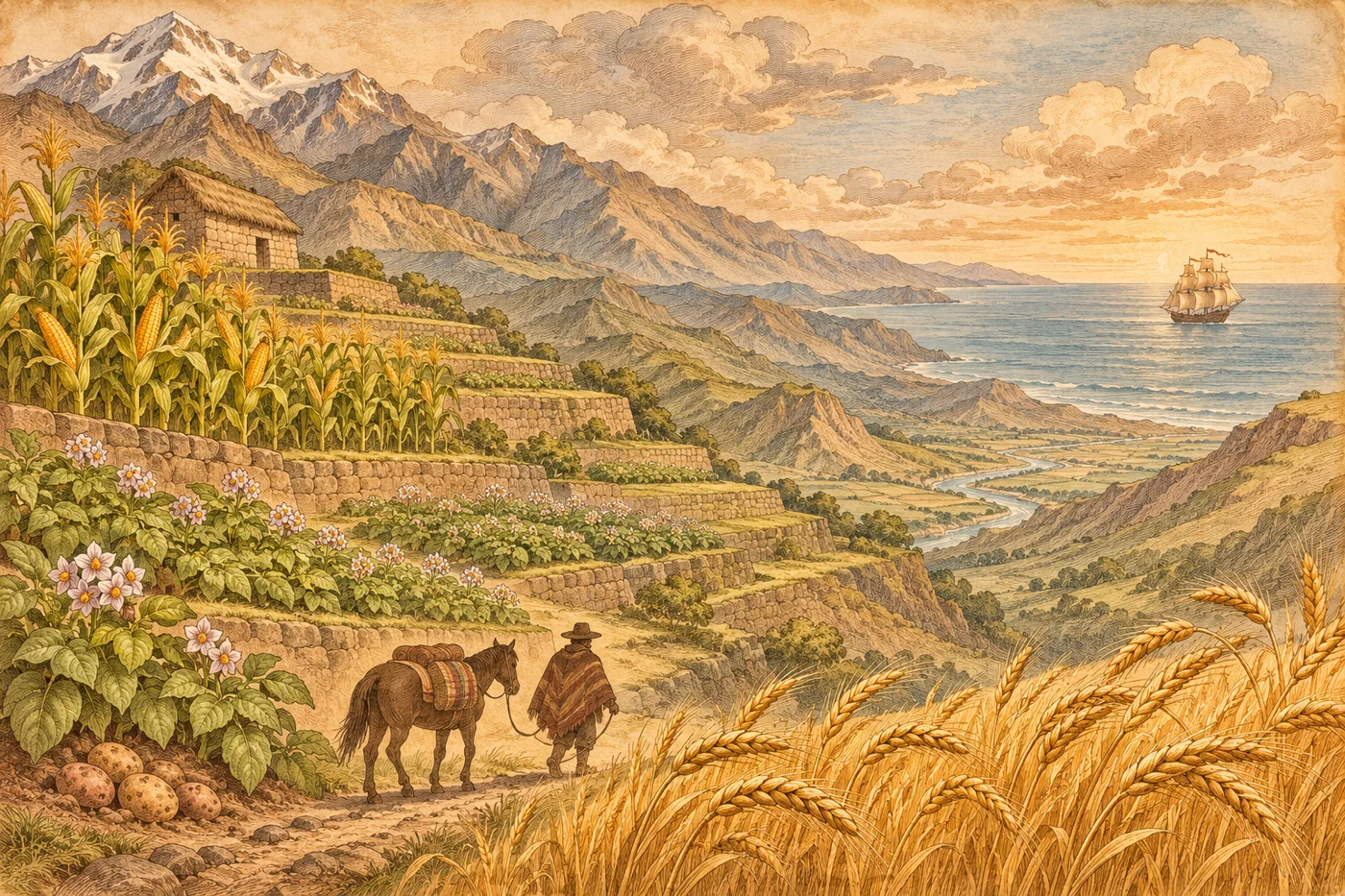
How did crops from the Americas spread to dinner tables around the world?
On October 12, 1492, Columbus's ships reached an island in the Bahamas. After this voyage, crops, animals, and even diseases began to move back and forth across the Atlantic. This movement became known as the 'Columbian Exchange,' a term coined by historian Alfred Crosby in 1972. Let's start by looking at food.
From the Americas, crops such as maize, potatoes, common beans, peanuts, tomatoes, cacao, chili peppers, and tobacco crossed to the Old World. Cacao is said to have reached Spain in 1528. Conversely, wheat, grapes, olives, sugarcane, rice, and other crops were brought to the Americas. Today's Italian tomato sauce and European chocolate exist thanks to this great movement.
The movement of animals was also significant. Large domesticated animals were scarce in the Americas, where kept animals were limited to species such as llamas, alpacas, turkeys, guinea pigs, and dogs. Horses, cattle, sheep, goats, pigs, and chickens were introduced. Horses changed the way of life for Indigenous peoples, cattle ranching spread in regions such as Mexico by the mid-16th century, and cattle were brought to Florida in 1565. Meat, milk, hides, and pack animals transformed daily life and the landscape.
It is thought that the new crops also affected population. Potatoes, which grow in cold, poor soil, and maize, which is easy to cultivate over large areas, are said to have helped increase food supplies in Europe, Asia, and Africa. However, the speed of their spread and their impact on population varied by region, and estimates differ among studies. The perspective here is that when food changes, people's lives and the bustle of towns change as well.
On the other hand, indigenous peoples of the Americas suffered a great tragedy. They had no immunity to Old World diseases such as smallpox, measles, and influenza. Smallpox is said to have reached the Caribbean islands in 1518 and mainland Mexico in 1520. With disease compounded by war, enslavement, and food shortages, the population in some regions is estimated to have declined by 50 to 90 percent. Estimates of the 1492 population itself vary widely, and no definitive figure exists.
Furthermore, as many people from Africa were enslaved and brought to the Americas, diseases such as malaria and yellow fever also spread. It must not be forgotten that behind the word 'exchange' lies a history of people stripped of their lives and freedom.
Mini timeline
- 1492Columbus reaches an island in the Bahamas.
- 1495The first report of syphilis is said to have been made in Naples.
- 1518–1520Smallpox spreads from the Caribbean to mainland Mexico; Cortés enters Tenochtitlan in 1519.
- 1528Cacao is said to have reached Spain.
- c. 1565Cattle are brought to Florida, following their introduction to Mexico.
- 16th–19th centuriesAn estimated 12.5 million Africans were forced onto slave ships to cross the Atlantic; the total number of victims is even higher when deaths during capture and other losses are included.
People in this chapter
Sailing west from Spain in 1492, he reached an island in the Bahamas. His actions and legacy remain subjects of debate today.
He is known for authoring the 1972 book The Columbian Exchange and popularizing the term.
Meanwhile, elsewhere
Connection to Japan
In Japan, 1492 corresponds to the first year of the Meiō era, in the late Muromachi period. Potatoes are said to have arrived aboard Dutch ships in the late 16th or early 17th century, while sweet potatoes are famously associated with Aoki Konyō, who advanced their study in 1735 after the Kyōhō famine.
Why it still matters
At the same time, historical perspectives that consider what was lost in the name of 'exchange' are deepening.
Perspectives differ
- Estimates of the Indigenous Population
- Estimates of the 1492 population range from several million to over 100 million depending on the study, and the rate of decline varies from 50 to 90 percent; figures differ greatly depending on researchers' stances and methods.
- The Name 'Columbian Exchange'
- This name has been criticized for centering history on Columbus. Some argue that 'exchange' sounds mutually beneficial, obscuring violence, plunder, and enslavement. Nevertheless, it remains widely used as a scholarly term.
- Causes of Population Decline
- While disease is often cited as the main cause, some researchers emphasize the impact of war, forced labor, land loss, and food shortages. Opinions are divided on which factor should be regarded as central.
- Origin of Syphilis
- One theory holds that it was brought back from the Americas, while another holds that it already existed in Europe without being distinguished as a separate disease; no consensus has been reached.
Facts checked (9, verified by AI on the web)
- Confirmed Columbus reached the Bahamas on October 12, 1492; Crosby coined the term 'Columbian Exchange' in 1972. World History Encyclopedia(事典): Columbian Exchange
Confirmed in encyclopedia. - Confirmed From the Americas to the Old World: maize, potatoes, beans, tomatoes, cacao, chili peppers, tobacco. From the Old World to the Americas: wheat, grapes, olives, sugarcane, rice. Cacao reached Spain in 1528. World History Encyclopedia(事典): Columbian Exchange
Confirmed in encyclopedia. - Confirmed The Americas originally had dogs, alpacas, etc.; horses, cattle, sheep, goats, pigs, and chickens were introduced. Cattle ranching spread to Mexico and Florida by 1565. World History Encyclopedia(事典): Columbian Exchange
Confirmed in encyclopedia. The point about horses changing indigenous lifestyles is not in the encyclopedia; it was written as a general observation. - Corrected & confirmed Old World diseases (smallpox, measles, influenza) devastated indigenous populations. Smallpox reached the Caribbean in 1518 and Mexico in 1520. Population decline estimated at 50–90%. テキサス大学オースティン校(授業資料): The Columbian Exchange: Disease & the Environment
The encyclopedia states 'up to 90%' or '90% by 1650.' A university lecture source gives a range of 50–90% over the first few centuries; the text adopts this range. The 1492 population of North America (north of Mexico) is estimated at 2–18 million, with a common estimate of about 7 million. - Confirmed Syphilis was first reported in Naples in 1495. Two theories exist: American origin or pre-existing in Europe. World History Encyclopedia(事典): Columbian Exchange
Confirmed in encyclopedia (both theories mentioned). - Confirmed 12 to 20 million Africans were taken across the Atlantic from the 16th to the 19th centuries; malaria and yellow fever were also introduced. World History Encyclopedia(事典): Columbian Exchange
Confirmed in encyclopedia. Numbers are estimates and vary by study. - Unverified Criticism of the name 'Columbian Exchange' and the word 'exchange'. World History Encyclopedia(事典): Columbian Exchange
Unverified. Re-reading World History Encyclopedia shows no criticism of the term itself, only that 'research has expanded to include people and culture.' University source (UT Austin) also does not mention the term. Critical essays found (e.g., NIU) were not opened. The text's weak phrasing 'sometimes criticized' remains, but the source is marked as unverified. - Unverified Potatoes and maize increased populations in various regions. World History Encyclopedia(事典): Columbian Exchange
Partially confirmed. Encyclopedia states 'potatoes led to European population growth,' but no mention of maize and population, or in Asia/Africa. Only potato (Europe) confirmed; rest unverified. The text's 'is thought' can remain. - Unverified Introduction to Japan (potatoes via Dutch ships in early Edo period; sweet potatoes studied by Aoki Konyō in 1735); 1492 corresponds to the first year of the Meiō era. 東京都健康安全研究センター: Knowledge about potatoes
Partially confirmed. Tokyo page states 'Potatoes were brought to Japan via Dutch ship from Jakarta in 1601'; 'Dutch ship' confirmed. For sweet potatoes, nippon.com states Aoki Konyō wrote 'Banshoko' and submitted it to the shogunate during the Kyōhō famine (1732), and the shogun ordered trials, but the year 1735 is not found. 1492 = Meiō 1 also unverified in sources.
Sources
World History Encyclopedia(事典): Columbian Exchange
テキサス大学オースティン校(授業資料): The Columbian Exchange: Disease & the Environment
東京都健康安全研究センター: Knowledge about potatoes
nippon.com: Satsumaimo: From Food Shortage Essential to Sweet Treat
* AI-drafted and cross-checked; human review is in progress. Status: