Brazil — A Big Country That Speaks Portuguese
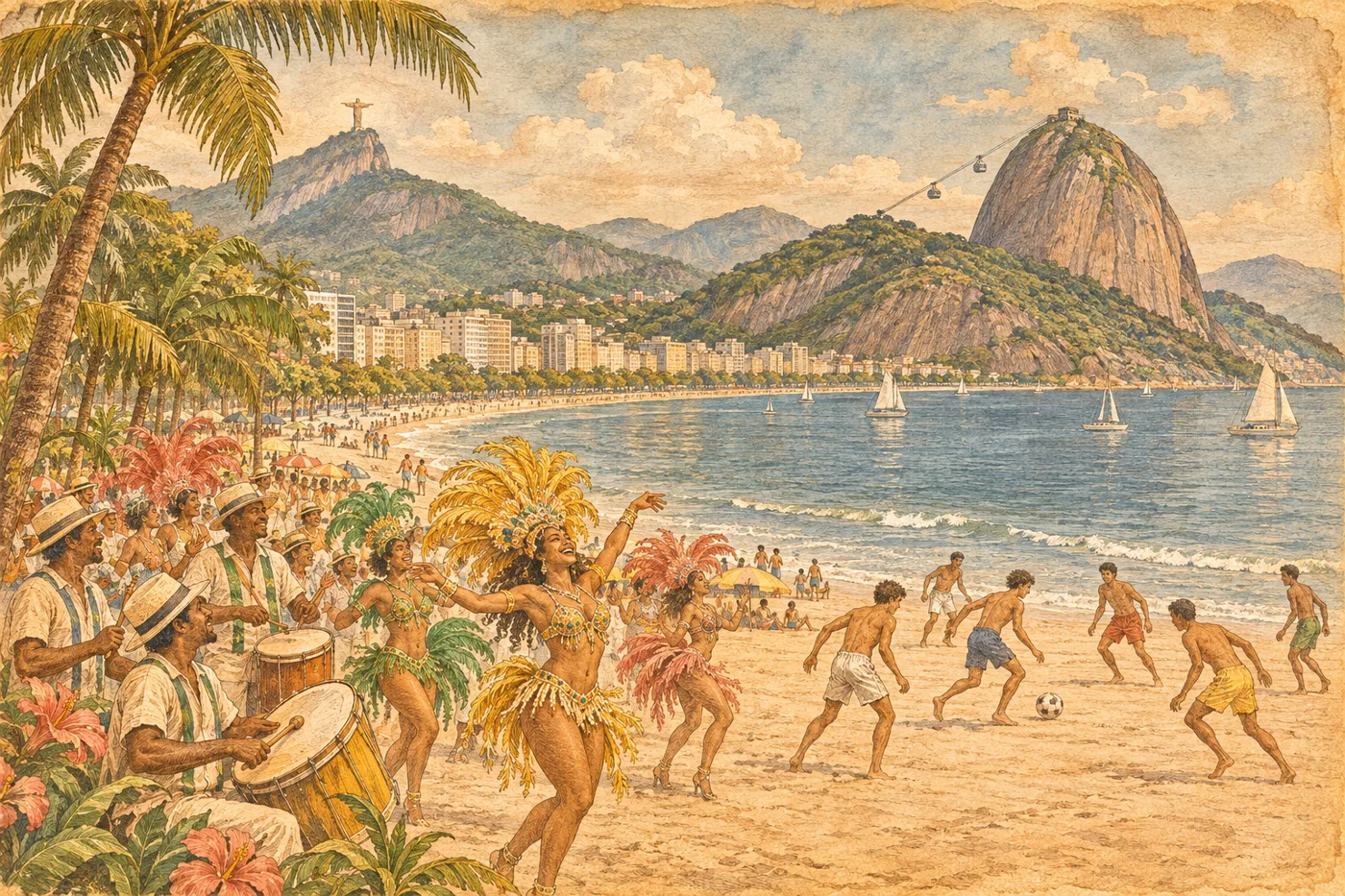
In South America, where most countries speak Spanish, why is Brazil a Portuguese-speaking country?
In April 1500, a fleet led by the Portuguese nobleman Cabral arrived at the coast of present-day Brazil. It is said to have happened either because they took a route that swung far west across the Atlantic on the way to India, or because they were blown off course by the wind. Many indigenous people were already living on this land. The country's name is said to come from the tree 'pau-brasil', from which a red dye was obtained.
Under the 1494 Treaty of Tordesillas, Portugal and Spain agreed that a north–south line in the Atlantic would divide their spheres: east of the line for Portugal, west for Spain. The eastern tip of Brazil fell on the Portuguese side of this line. Later, Portuguese-descended people pushed inland, and a large territory was recognized as theirs. This is the background to why Brazil became a country with a different language from its neighbors.
From the mid-16th century, large sugarcane plantations spread along the northeastern coast. Indigenous people were also forced to work, but later many people were brought from Africa as slaves. In the Atlantic slave trade, more than 4 million people are said to have arrived in Brazil, making it the largest destination in the Americas. The deep African influence on Brazil's language, food, and music has its roots in this history.
Around the end of the 17th century, gold was discovered in the inland region of Minas Gerais, and later diamonds were also found, ushering in a 'golden age'. People moved inland, and towns sprang up. In 1808, the Portuguese royal family, fleeing Napoleon's army, moved to Rio de Janeiro. It was a rare event in history for a European royal court to move its capital to a colony.
After the royal family returned to Portugal, the prince who remained, Pedro, declared independence on September 7, 1822, and later became emperor of the Empire of Brazil. Brazil thus began as a monarchy, and the imperial system lasted a long time. Slavery continued after independence and was only abolished in 1888 by the 'Golden Law'. It is said to have been the latest abolition in the Americas. The following year, 1889, Brazil became a republic.
From the late 19th century, labor was needed for coffee plantations, and immigrants came from many parts of the world: Italy, Germany, Portugal, and also Japan. Japanese immigration began with the Kasato Maru in 1908. These peoples mingled, and samba, bossa nova, and soccer came to represent the country. In the World Cup, Brazil won five times by 2002. Today it is the largest country in Latin America, with a population of about 200 million.
Mini timeline
- 1500Cabral's fleet arrives
- mid-16th century–Sugar production spreads in the northeast
- c. late 17th centuryGold found in Minas Gerais
- 1822Pedro declares independence; the Empire begins
- 1888Slavery abolished
People in this chapter
He led a fleet heading for India and arrived at the coast of Brazil.
Born as a prince of the Portuguese royal family, he declared independence in 1822.
Meanwhile, elsewhere
Connection to Japan
When Cabral reached Brazil in 1500, Japan was entering the Sengoku (Warring States) period. Later, in 1908, Japanese immigrants crossed to Brazil aboard the Kasato Maru, and today people of Japanese descent form a large community.
Why it still matters
Brazil is one of the world's largest countries by area, with a population of about 200 million. Its official language is Portuguese, and people of many different roots live there. The annual Carnival and soccer are widely known both at home and abroad.
Perspectives differ
- Was Cabral's arrival accidental?
- The common explanation is that he was blown off course and arrived by chance on the way to India. On the other hand, there are also theories that he was on a route that deliberately swung far west, or that Portugal already knew of this land; nothing is certain. There is also a theory that the Spanish navigator Pinzón arrived a few months earlier.
- The number of people brought over
- The number of Africans who arrived in Brazil is often put at about 4 to 5 million, but estimates vary depending on how records are counted.
- How should the 1888 abolition of slavery be viewed?
- Some views emphasize the signing by Princess Isabel. Others emphasize the resistance of enslaved people themselves and the power of the abolitionist movement. Scholars debate this from various perspectives.
- The origins of samba
- It is said to be based on the music of African-descended people, with the traditions of Bahia in the northeast later developing into urban music in Rio de Janeiro. However, there are various theories about when and where it was born.
Facts checked (8, verified by AI on the web)
- Confirmed On April 22, 1500, Cabral's fleet reached Brazil and claimed it for Portugal as lying east of the Tordesillas line Marinha de Portugal: chegada ao Brasil (22 de abril de 1500)
Most sources give the arrival date as April 22, 1500. The explanation that they were blown off course has weak sourcing; the text adjusts to 'said to be either because of the route or because of the wind'. - Confirmed On September 7, 1822, Pedro declared independence, and was later (October 12) acclaimed as emperor Hérodote: 7 septembre - 12 octobre 1822
Text states declaration of independence on September 7 at the Ipiranga River, proclaimed Constitutional Emperor Pedro I on October 12, and crowned on December 1. Britannica unread (403). - Confirmed Slavery was abolished on May 13, 1888, by the Golden Law (signed by Princess Isabel) Hérodote: 13 mai 1888
Abolition: May 13, 1888. The claim that this was the latest in the Americas is a common view, but the text says 'is said to be' as no explicit source was confirmed for this specific phrasing. - Confirmed In 1908, the Kasato Maru carried Japanese immigrants to Santos, Brazil (driven by labor shortages on coffee plantations) JICA: History of Cooperation between Latin America and Japan - Brazil
Kasato Maru arrived in Santos on June 18, 1908, carrying 781 immigrants (JICA). - Corrected & confirmed More than 4 million enslaved Africans arrived in Brazil, the largest number in the Americas Hérodote: 13 mai 1888
Sources range from 'over 4 million' to 'over 5 million'. Text uses 'more than 4 million'; the debates section notes the range. The point about being the largest destination is consistent across multiple sources. - Confirmed Brazil's large inland territory was later recognized through advances beyond the treaty line and subsequent agreements Arquivo Nacional (Brasil): Tratado de Madri (1750)
The 1750 Treaty of Madrid, based on the principle of uti possidetis (effective occupation), recognized Portuguese America in a shape very close to Brazil's current borders (Brazilian National Archives). - Confirmed Gold was discovered in the late 17th century in the Minas Gerais region Brown University Library: Five Centuries of Change, Gold Discovered
The bandeirantes found gold in Minas Gerais in the 1690s, and Vila Rica was founded in 1698. - Confirmed Five World Cup wins (up to 2002) FIFA: Brazil at the FIFA World Cup, team profile and history
Wins in 1958, 1962, 1970, 1994, and 2002 (FIFA).
Sources
Britannica: Pedro I
Marinha de Portugal: chegada ao Brasil (22 de abril de 1500)
JICA: History of Cooperation between Latin America and Japan - Brazil
Hérodote: 13 mai 1888
Arquivo Nacional (Brasil): Tratado de Madri (1750)
Brown University Library: Five Centuries of Change, Gold Discovered
FIFA: Brazil at the FIFA World Cup, team profile and history
* AI-drafted and cross-checked; human review is in progress. Status: