Silver and Colonies — The Silver Road That Circled the World
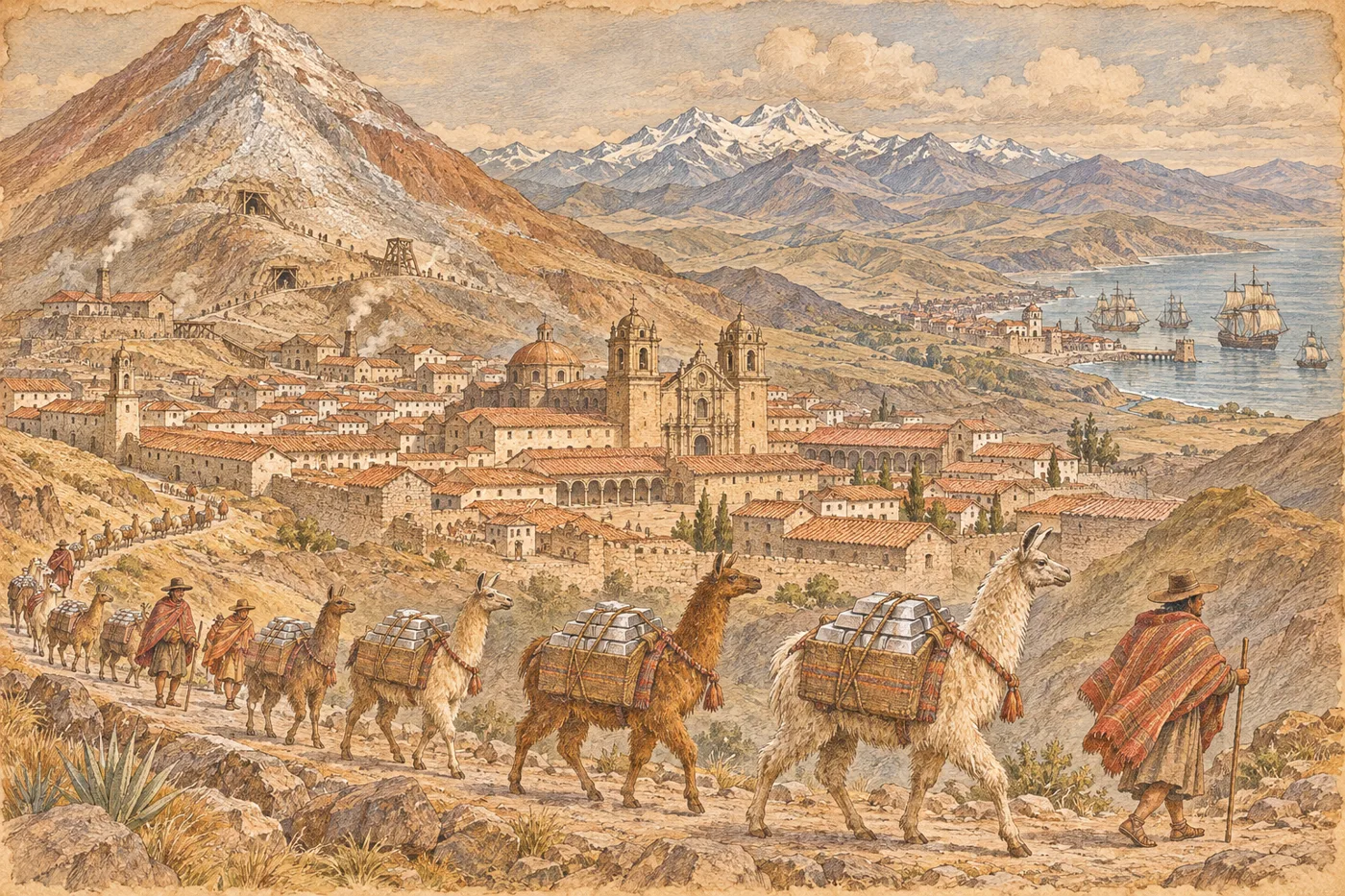
Why did silver mined in the Andes drive the global economy?
In 1545, a huge silver vein was discovered at Potosí, in present-day Bolivia. A town sprang up at the foot of a mountain over 4,000 meters high, quickly becoming one of the largest cities in the world. A silver mine was also discovered at Zacatecas in Mexico in 1546.
The work of mining silver was brutal. In the Viceroyalty of Peru, a system called the 'mita' was used to conscript indigenous people into the mines, forcing many to work in dangerous tunnels. Later, slaves brought from Africa also came to work on plantations and in mines across the region.
Spain divided Latin America into 'viceroyalties' to govern it: New Spain (1535), centered on Mexico, and Peru (1542). Portugal governed Brazil, where large numbers of slaves worked on sugarcane plantations. It is said that over 4 million slaves were brought to Brazil.
Colonial society had a hierarchy. Those born in Spain were at the top, followed by whites born in the colonies (criollos), with indigenous people, mixed-race people, and those of African descent ranked below them. Even so, people mixed, and new cultures emerged.
Starting in 1565, the 'Manila Galleons' sailed between Acapulco, Mexico, and Manila, the Philippines, and silver was also carried to China. At that time, China's Ming dynasty required taxes to be paid in silver, creating a huge demand.
Thus, the Americas, Europe, Asia, and Africa were connected by a single economy for the first time. Chinese silk and porcelain were carried around the world in exchange for Latin American silver. Yet we must not forget the human suffering under the mita system and slavery that lay behind it.
Mini timeline
- 1545Silver mine discovered at Potosí
- 1546Silver mine discovered at Zacatecas, Mexico
- 1565Manila Galleon trade begins
- 1780Revolt of Túpac Amaru II begins
- Late 18th centuryColonial discontent grows, independence movements begin
People in this chapter
In Mexico, at a time when it was difficult for women to pursue learning, she wrote poetry and philosophy. She was called the 'Phoenix of the New World'.
In 1780, he led a major rebellion against colonial rule but was executed the following year.
Meanwhile, elsewhere
Connection to Japan
Japan, at the time, also produced large amounts of silver at mines like Iwami Ginzan, and is said to have accounted for about a third of the world's silver output (there are various theories).
Why it still matters
The town and mines of Potosí are now a World Heritage Site, and mining continues in Bolivia's mines today. In Spanish, the saying 'worth a Potosí' is said to have emerged.
Perspectives differ
- Death toll from the mita system
- Estimates of the number of people who died in the Potosí mines range widely, from tens of thousands to millions. No exact figure is known.
- Impact of silver inflow on China
- Some theories hold that the massive inflow of silver supported the Ming economy, while others argue it contributed to later economic turmoil. Estimates of the amount that flowed in also differ among researchers.
- Reality of the casta system
- Paintings depicting the colonial 'caste system' are well known, but some argue that actual society was more fluid, with people's status varying according to wealth and region.
- Cause of the 'Price Revolution'
- Whether the rise in prices in 16th-century Europe can be explained solely by the inflow of silver is a matter of debate.
Facts checked (6, verified by AI on the web)
- Confirmed Potosí silver vein discovered in 1545 Library of Congress blog: A short story about Potosí
A Library of Congress blog states 'the discovery of Potosí was in 1545' and that the story of discoverer Diego Gualpa is based on testimony given to Viceroy Toledo. - Corrected & confirmed Zacatecas silver mine discovered in 1546 Mining, the Americas (Encyclopedia.com)
Most sources give 1546; some sources give 1548. - Confirmed Manila Galleons began in 1565 Spanish Silver Fleets (資料)
The route was pioneered in 1565; some view regular sailings as starting after 1571. - Confirmed Over 4 million slaves brought to Brazil Research Indicates that Rio Received Two Million Enslaved Africans (Rio on Watch)
Estimates range from about 4.8 million (landed) to 5.5 million (embarked). - Corrected & confirmed Sor Juana was c. 1648–1695 Sor Juana Inés de la Cruz (Britannica)
Text corrected: Many sources give 1651 as birth year; the 1648 theory is also noted (both listed). - Views differ Túpac Amaru II was c. 1740–1781 Túpac Amaru II (Britannica)
Birth year varies between 1738 and 1742 in sources (the text's 'c.' covers this range). Death year is 1781.
Sources
Library of Congress blog: A short story about Potosí
Mining, the Americas (Encyclopedia.com)
Spanish Silver Fleets (資料)
Research Indicates that Rio Received Two Million Enslaved Africans (Rio on Watch)
Sor Juana Inés de la Cruz (Britannica)
Túpac Amaru II (Britannica)
* AI-drafted and cross-checked; human review is in progress. Status: