The Haitian Revolution — A Country Built by Enslaved People
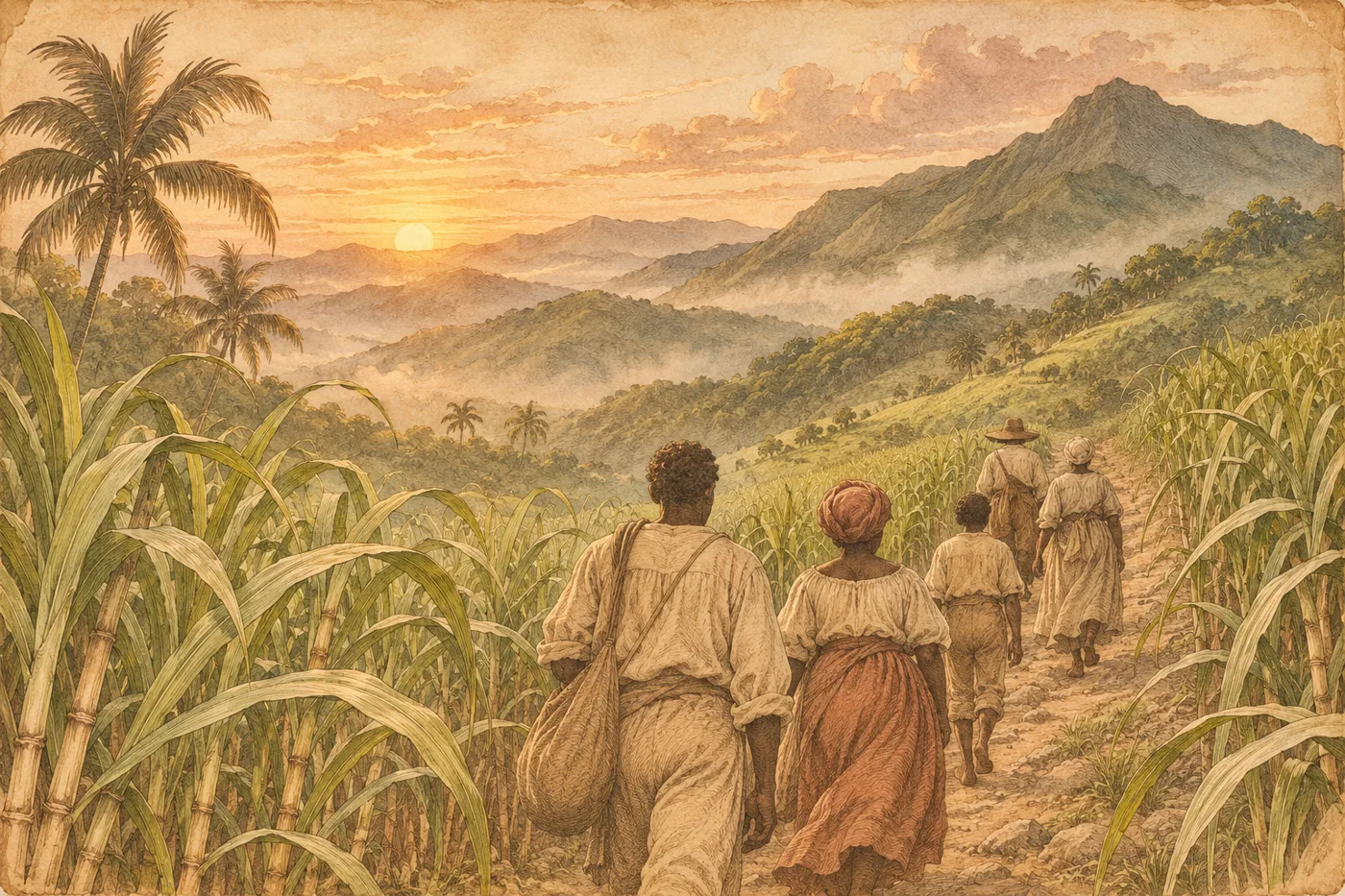
How did enslaved people build their own country?
In the 18th century, the western part of the Caribbean island of Hispaniola was the French colony of Saint-Domingue. Through the cultivation of sugar and coffee, it was considered one of the most profitable colonies in the Americas. That wealth was built on the labor of people brought from Africa and enslaved. The island was rich, but the people who worked there had no freedom.
On August 22, 1791, a major uprising of enslaved people broke out in the northern part of the colony. It is said that a gathering took place beforehand at a place called Bois Caïman. The uprising spread rapidly, and the fighting continued for a long time. One of its leaders was Toussaint Louverture. He too was born into slavery but later gained his freedom.
Toussaint was born around 1743 (some accounts say around 1740) and later became a free man. He joined the uprising, and when France abolished slavery in 1794, he sided with France. He led armies, gained power, and in 1801 created a constitution proclaiming autonomy, becoming governor-general for life. By then, he held de facto control of the island.
In 1802, Napoleon sent his brother-in-law General Leclerc with an army of about 20,000 (some accounts say 25,000) to retake control of the island. Toussaint was captured and sent to France, where he died in April 1803 at Fort de Joux, a prison in eastern France. However, when word reached the island that slavery was being reinstated, the people rose up again.
The war turned against the French, compounded by a yellow fever epidemic, and the French army surrendered in November 1803. On January 1, 1804, Jean-Jacques Dessalines, a former subordinate of Toussaint, and others declared independence, naming the country Haiti. It became the second independent country in the Americas, after the United States. After independence, Dessalines is said to have ordered the execution of remaining whites on the island, and his evaluation remains divided.
Many countries did not recognize Haiti's independence; the United States officially recognized Haiti only in 1862. In 1825, under an ordinance by King Charles X, France recognized Haiti's independence in exchange for reparations to the former colonists: 150 million francs, payable in five installments. This was reduced to 90 million francs in 1838, but it remained a heavy burden. In 2025, French President Macron stated that this decision was unjust and announced the creation of a joint historical commission.
Mini timeline
- August 22, 1791A major uprising of enslaved people breaks out in northern Saint-Domingue
- 1801Toussaint creates a constitution and becomes governor-general for life
- 1802Napoleon's army arrives, and Toussaint is captured
- April 7, 1803Toussaint dies at Fort de Joux in France
- January 1, 1804Haiti declares independence
- 1825France recognizes Haiti's independence in exchange for reparations
People in this chapter
Born into slavery, later gained freedom, led armies, and held de facto control of the island. He died in a French prison in 1803.
Rose from being a subordinate of Toussaint to become the central figure of independence. He is considered the first head of state of Haiti.
Meanwhile, elsewhere
Connection to Japan
1804 corresponds to the late Edo period in Japan, the first year of the Bunka era. That year, the Russian envoy Rezanov arrived in Nagasaki.
Why it still matters
The Haitian Revolution is remembered as an event that resisted slavery and colonial rule. In 2025, the French president stated that the decision on reparations was unjust, and a joint historical commission was established.
Perspectives differ
- Evaluation of Toussaint
- While some view him as a hero who fought against slavery, others criticize him for consolidating his own power and certain later policies, and opinions remain divided.
- Dessalines' execution of whites
- He is said to have ordered the execution of remaining whites after independence. Views differ, with some seeing it as retaliatory violence and others as a measure to protect independence.
- Reparations and poverty
- Among researchers, views differ on how greatly the 1825 reparations affected Haiti's subsequent economy. Many sources attest that repayment continued for a long time, but the completion year varies by source, with accounts citing 1878, the 1880s, or 1947.
- Debate over reparations and restitution
- While Haiti and its supporters demand restitution, France has so far only stated the establishment of a historical commission. Opinions on what should be done vary depending on one's position.
- Numbers of troops and casualties
- The size of the army Napoleon sent is given as about 20,000 or about 25,000 in different sources. Estimates of total war casualties also vary, and this book does not take a definitive position.
Facts checked (6, verified by AI on the web)
- Confirmed On August 22, 1791, a large-scale uprising of enslaved people began in northern Saint-Domingue U.S. Department of State, Office of the Historian: The United States and the Haitian Revolution, 1791-1804
Confirmed by the US State Department's Office of the Historian. The same page notes Saint-Domingue as the most profitable colony from the 1760s onward and Haiti as the second independent country in the Americas. The Bois Caïman gathering is based on the record of a French memorial foundation. - Corrected & confirmed Toussaint was born into slavery, born around 1743, and died on April 7, 1803, at Fort de Joux Fondation pour la mémoire de l'esclavage(フランス): Toussaint Louverture
A memorial foundation gives his birth as May 20, 1743, while the BnF gives around 1740. His death (April 7, 1803, Fort de Joux) is confirmed by both the foundation and the Fondation Napoléon. The text notes alternate birth years with 'around'. - Corrected & confirmed The army Napoleon sent in 1802 numbered about 20,000 Fondation Napoléon: Napoleon, the dark side: Napoleon and Santo Domingo
The Fondation Napoléon states about 20,000, while a memorial foundation says 25,000. The text includes both. The news of the reinstatement of slavery arriving in August and reigniting the revolt, as well as Rochambeau's surrender on November 28, 1803, are also confirmed on the same pages. - Confirmed Independence was declared on January 1, 1804, and Dessalines became the first head of state Bibliothèque nationale de France: Toussaint Louverture: Destiny and Contradictions
The BnF records independence in 1804 and calls Dessalines the 'liberator' who declared independence and the first head of state. A memorial foundation also records the same date. The US State Department notes that Dessalines ordered the execution of remaining whites. - Confirmed An 1825 ordinance set reparations at 150 million francs in five installments, reduced to 90 million francs in 1838 Bibliothèque nationale de France: Haiti's independence debt. The slave as a unit of account (1794-1922)
The BnF records the April 17, 1825 ordinance for 150 million francs in five payments, and renegotiation to 90 million francs (30 payments) in 1838. The completion year of repayment varies by source: the BnF cites 1878 for the independence debt and 1887–88 and 1921–22 for loans, while NBC cites 1947; therefore the text does not take a definitive position. - Confirmed In 2025, President Macron stated the reparations decision was unjust and announced a joint historical commission NBC News(報道): France's president says making Haiti pay for its independence was unjust
Confirmed by an NBC News report on the statement of April 17, 2025. The report notes he did not directly address reparations or restitution. No confirmation from official documents.
Sources
U.S. Department of State, Office of the Historian: The United States and the Haitian Revolution, 1791-1804
Fondation pour la mémoire de l'esclavage(フランス): Toussaint Louverture
Bibliothèque nationale de France: Haiti's independence debt. The slave as a unit of account (1794-1922)
Bibliothèque nationale de France: Toussaint Louverture: Destiny and Contradictions
Fondation Napoléon: Napoleon, the dark side: Napoleon and Santo Domingo
NBC News(報道): France's president says making Haiti pay for its independence was unjust
* AI-drafted and cross-checked; human review is in progress. Status: