The Persian Empire — 'Tolerance' and Roads That United Many Peoples
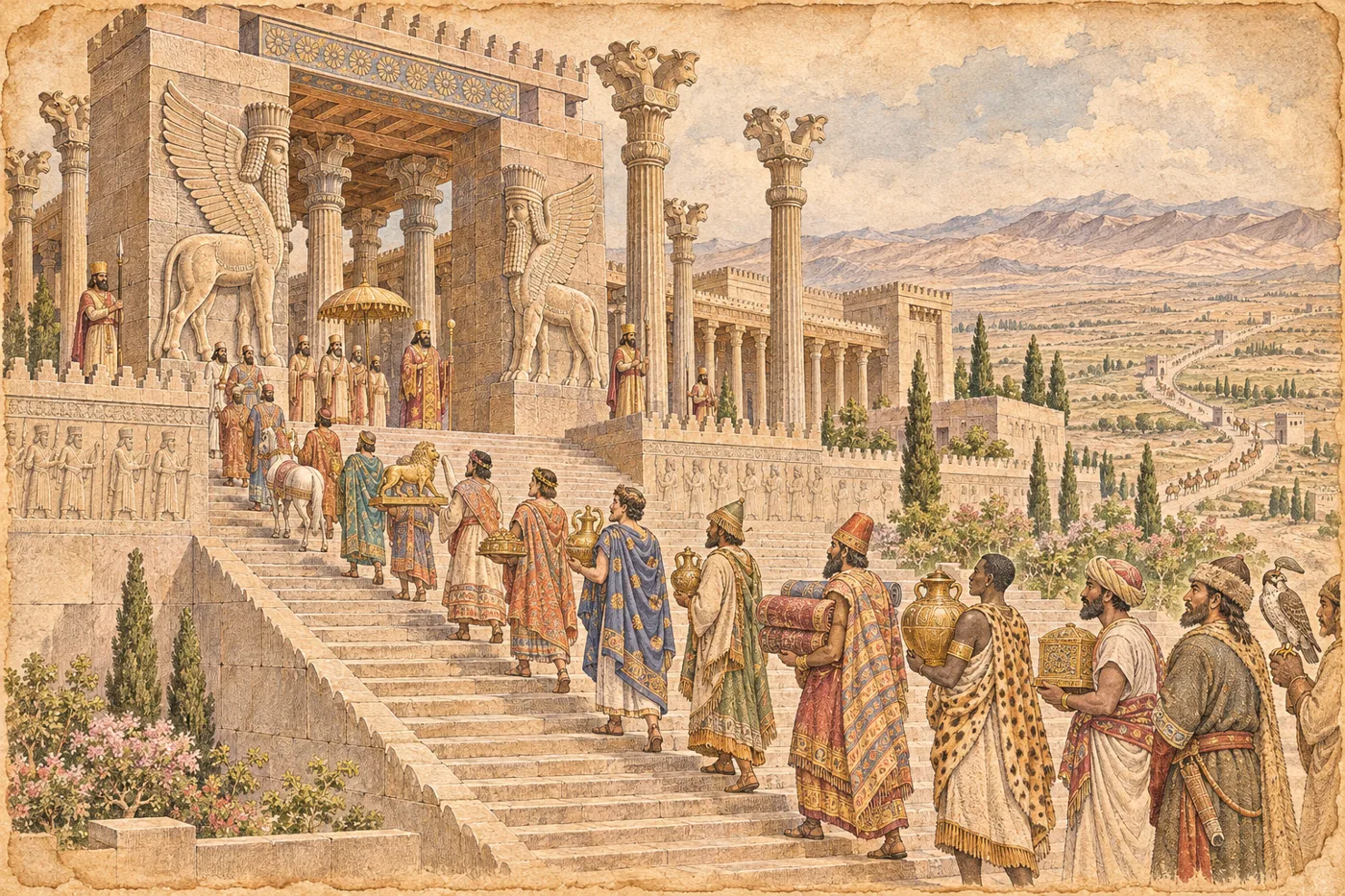
Why did a giant empire containing so many ethnic groups last for about 200 years?
In the 6th century BC, a king rose from what is now the Iranian plateau. Cyrus II. The Achaemenid Persian Empire he created quickly expanded from Mesopotamia to Egypt and near the Indus River, becoming one of the largest empires of the time.
In 539 BC, Cyrus conquered Babylon. At that time, the Jewish people who had been brought to Babylon were allowed to return home. Persia basically adopted a policy of respecting the religions and customs of conquered lands. As long as they did not rebel and paid taxes, they could worship whichever gods they pleased. For ruling a multi-ethnic empire, this was more advantageous.
Darius I organized the empire. He divided the country into about twenty provinces with governors (satraps), established a tax system, and issued gold coins (darics). He built a great highway, the Royal Road, connecting the capital Susa with Sardis in the west—about 2,500 km according to Herodotus (also using roads from the Assyrian period). He also set up staging posts to allow information to be carried quickly. Greek records mention inspectors called the ‘King’s Eyes’ and ‘King’s Ears’ who toured the provinces (though there is debate about whether these were actual official titles).
Persia also left a major mark in religion. Zoroastrianism sees the world as a struggle between good and evil, and teaches that a final judgment will come. Some scholars see this way of thinking as having influenced later Judaism, Christianity, and Islam.
That Persia collided with Greece to the west (the Greco-Persian Wars, c. 500–449 BC; the major Persian expeditions into Greece began in 492 BC). The Greek victories at Marathon (490 BC) and Salamis (480 BC) are famous from Greek sources, but for Persia they were events on the edge of a vast empire.
In 330 BC, Alexander the Great of Macedon destroyed Persia. But Persian culture did not disappear. Later, the Sasanian Empire (224–651 AD) arose in the land of Iran, made Zoroastrianism the state religion, fought long wars with the Roman (Byzantine) Empire, and in the 7th century was destroyed by the Islamic forces who become the main actors of the next chapter.
Mini timeline
- c. 550 BCCyrus II founds the Achaemenid Empire
- 539 BCConquest of Babylon; allows the Jews to return
- 522 BCDarius I ascends the throne and organizes the empire
- 490 BCBattle of Marathon (Greco-Persian Wars)
- 330 BCAlexander the Great destroys the Achaemenid Empire
People in this chapter
He was remembered through later ages as a king who was tolerant toward the people of conquered lands.
With provinces, taxes, roads, and coinage, he made the giant empire 'manageable'.
Meanwhile, elsewhere
Connection to Japan
Japan was moving from the Jōmon period to the Yayoi period (there are various theories about the exact timing).
Why it still matters
‘Persia’ is an old name for what is now Iran (in 1935 the government requested that the country be called ‘Iran’ internationally). The system of rapid information relay, like the Royal Road, is often cited as a prototype for later postal systems.
Perspectives differ
- Did Cyrus issue a 'Declaration of Human Rights'?
- The Cyrus Cylinder found in Babylon is sometimes called the 'first declaration of human rights', but researchers take a cautious view, considering it propaganda to legitimize the king's rule.
- When did Zoroaster live?
- There is a wide range of theories, from around 1500–1000 BC to the 6th century BC.
- Perspective on the Greco-Persian Wars
- Much of the war account depends on Greek records (Herodotus etc.), so it has been pointed out that the description may be biased toward the Greek side.
- Zoroastrianism's influence on other religions
- The theory that dualism and the Last Judgment influenced Judaism etc. is influential, but opinions differ on how direct the influence was.
Facts checked (5, verified by AI on the web)
- Confirmed Cyrus II's conquest of Babylon was in 539 BC Cyrus takes Babylon (Livius)
The conquest was in 539 BC. The edict allowing the Jews to return is dated to the following year, 538 BC. - Confirmed The Cyrus Cylinder is not necessarily the 'oldest human rights declaration', and the name of the Jews does not appear on it Why the Cyrus Cylinder matters today (Getty)
Neither Jews nor Judah appear in the cylinder inscription. Consistent with the text and the various theories. - Corrected & confirmed Length of the Royal Road (Susa–Sardis) Livius.org(古代史の解説サイト): Royal Road(ヘロドトス5.52-54)
Herodotus records Sardis to Susa as about 2,500 km (111 staging posts), with the sum of the sections being about 2,474 km. The text was revised from 'about 2400–2700 km' to 'about 2500 km (Herodotus's record)'. - Confirmed The Battle of Marathon was in 490 BC, and the Greco-Persian Wars were 492–449 BC (the major expedition began in 492 BC) Greco-Persian Wars (Britannica)
Britannica gives 492–449 BC. Marathon was around September 490 BC. - Confirmed The Sasanian Empire was destroyed by Islamic forces in 651 AD (death of Yazdegerd III) World History Encyclopedia(事典): Sasanian Empire
The Sasanian Empire was founded in 224 AD and overthrown by the Rashidun Caliphate in 651 AD; Yazdegerd III is said to have been killed near Merv (Marw) in 651 AD, as stated in the text.
Sources
Livius: Cyrus takes Babylon
Getty: Cyrus Cylinder
Britannica: Greco-Persian Wars
Livius.org(古代史の解説サイト): Royal Road(ヘロドトス5.52-54)
World History Encyclopedia(事典): Sasanian Empire
* AI-drafted and cross-checked; human review is in progress. Status: