The Birth of Islam — From a Desert Trading Town to a World Religion
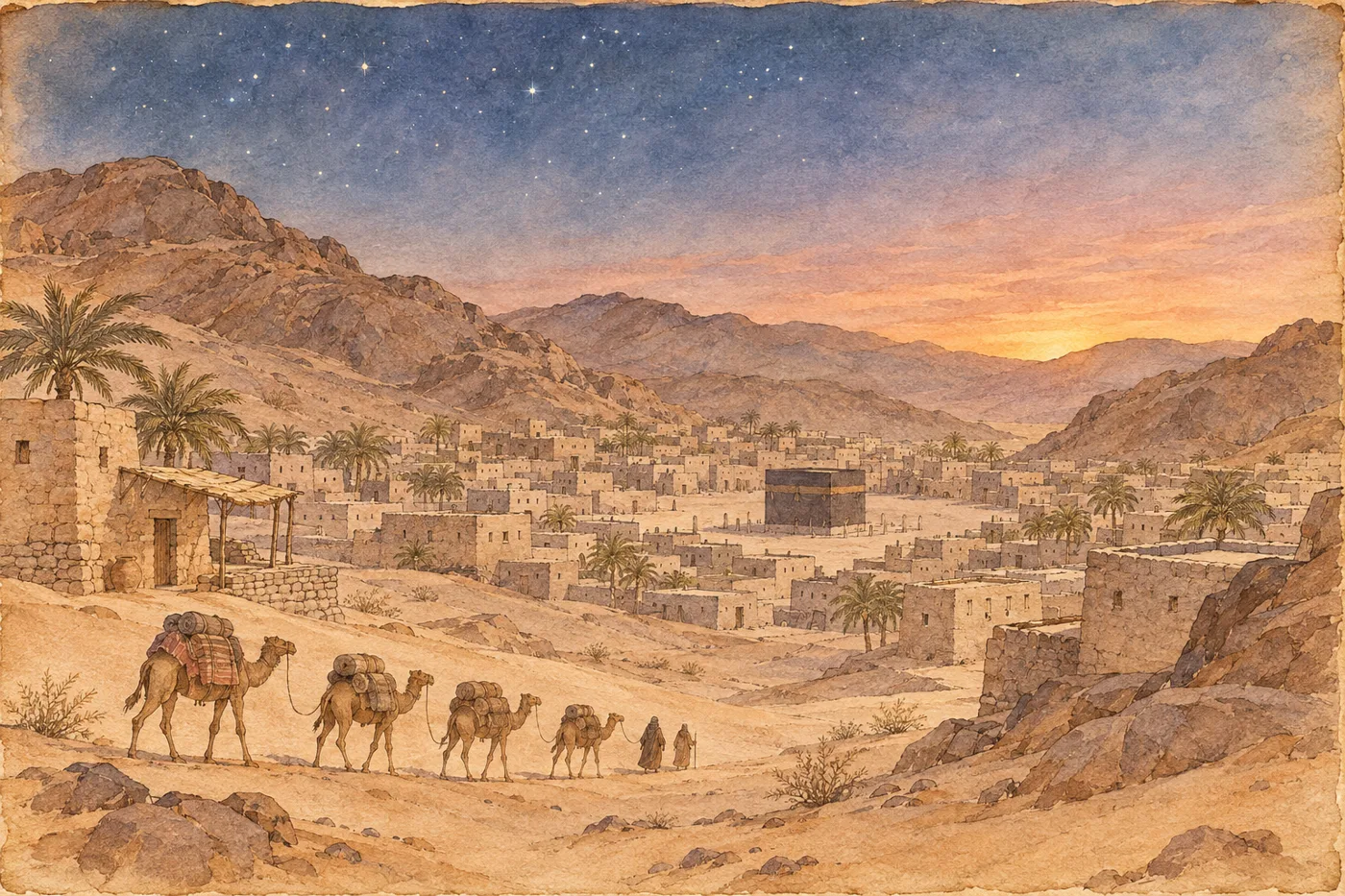
Why did a world religion emerge from a desert trading town?
In the 6th century, the Arabian Peninsula was a gap between two great powers: the Byzantine (Eastern Roman) Empire to the northwest and the Sasanian Persian Empire to the northeast. While these two empires were at war, trade and travel continued along the western side of the peninsula (along the Red Sea). One of the hubs was the merchant town of Mecca. Mecca also had the Kaaba sanctuary, a holy site that drew people and goods.
Around 570, Muhammad was born into a merchant family in this town. At about age 40, he began to speak of receiving divine revelations and preached "submission (Islam) to the one God, Allah." His teachings addressed the gap between rich and poor and the conflicts among tribes, but they were inconvenient for the powerful figures in Mecca.
Persecuted, Muhammad moved north to Yathrib (later Medina) with his followers in 622 (the Hijra). The Islamic calendar (Hijri calendar) counts this year as year one. After consolidating his community in Medina, Muhammad took Mecca (almost without fighting) in 630 and died in 632.
After Muhammad's death, the community was led by successors called "caliphs." They expanded territory with astonishing speed. They defeated the Byzantine army in 636 and the Sasanian army in 642, taking Jerusalem and Egypt. It is thought that the two great powers, exhausted by long wars, were significantly weakened.
The Umayyad Caliphate, established in 661, rapidly expanded its territory from its capital Damascus, becoming a vast empire by the early 8th century that stretched from the Iberian Peninsula in the west to Central Asia and the Indus River valley in the east. However, they did not force belief at sword-point. Jews and Christians could continue their faith by paying a tax (jizya).
Meanwhile, this expansion hid a deep internal rift. Who was worthy to be the leader? One group supported Ali, Muhammad's cousin and son-in-law, and his descendants (later the Shia). The other group, which valued consensus and the Prophet's practices, became the majority (Sunni). The killing of Ali's son Husayn at the Battle of Karbala in 680 remains a deep memory of sorrow for Shia Muslims to this day.
Mini timeline
- c. 570Muhammad born in Mecca
- 622Hijra (migration to Medina). Year one of the Islamic calendar
- 632Muhammad dies; era of the caliphs begins
- 661Umayyad Caliphate established
- 711Islamic forces advance into the Iberian Peninsula
People in this chapter
He lived as a merchant and created a new community and faith from a town on the trade routes.
Revered by the Shia as their first leader. In Sunni tradition, he is the last of the "Rightly Guided Caliphs."
Meanwhile, elsewhere
Connection to Japan
Japan was in the Asuka period, around the time Prince Umayado (Shōtoku) and others took part in government under Empress Suiko and missions were being sent to Sui China.
Why it still matters
Muslims number about 1.9 billion worldwide (estimates around 2020) and live widely in Asia and Africa. Arabic is still an official language in about 20 countries and regions.
Perspectives differ
- How reliable is early Islamic history?
- Many detailed records of Muhammad and the early conquests were compiled 100–200 years after the events. Therefore, scholars continue to debate how much can be considered historical fact.
- Reasons for the rapid conquests
- Several factors are cited: the exhaustion of Byzantium and Sasanian Persia, religious unity, and nomadic military strength. Which factor is emphasized varies among researchers.
- Notation of dates and names
- Muhammad's birth year (c. 570) is an approximate figure based on tradition. Japanese notation of names (e.g., Muhammad vs. Mahomet) also varies.
- Degree of Mecca's prosperity
- The long-standard explanation that "trade routes shifted due to warfare between the great powers, and Mecca gained enormous wealth as an international commercial city" has been re-evaluated in recent years; some now see it as mainly a center of regional trade and pilgrimage.
- The phrase 'Convert or die'
- This is considered an image spread in Europe. In actual conquests, non-Muslims were allowed to keep their faith if they paid the tax (jizya).
Facts checked (5, verified by AI on the web)
- Confirmed Hijra in 622, the first year of the Islamic (Hijri) calendar Aramco World (1979): The Turn of a Century
An Aramco World article stated that the Hijra corresponds to 622 CE, and that the Islamic calendar begins on Muharram 1 (July 16, 622). The actual date of the migration and the old name of the town are unconfirmed in this source; there are various views on the date. - Confirmed Umayyad Caliphate established in 661, capital Damascus Umayyad dynasty (Britannica)
Muawiyah I began his rule in 661. Damascus was the capital. - Confirmed Battle of Karbala (680); Husayn killed World History Encyclopedia: Battle of Karbala(事典)
The encyclopedia gives the date of the Battle of Karbala as October 10, 680, and records that Husayn was killed (beheaded). - Confirmed Defeated Byzantine army in 636 and Sasanian army in 642 Battle of Nahāvand (Britannica)
The Battle of Yarmouk was in 636; the Battle of Nihavand was in 642. - Confirmed Muhammad born c. 570, died 632 / Iberian advance in 711 World History Encyclopedia: Prophet Muhammad(事典)
The encyclopedia records that Muhammad was born in Mecca in 570 and died in 632; the Umayyad entry states that Tariq ibn Ziyad landed in the Iberian Peninsula in 711.
Sources
Aramco World (1979): The Turn of a Century
Britannica: Umayyad dynasty
Britannica: Mu'awiyah I
World History Encyclopedia: Battle of Yarmouk
Britannica: Battle of Nahāvand
World History Encyclopedia: Battle of Karbala(事典)
World History Encyclopedia: Prophet Muhammad(事典)
World History Encyclopedia: Umayyad Dynasty(事典)
* AI-drafted and cross-checked; human review is in progress. Status: