The Golden Age of Baghdad — The World’s Wisdom, Gathered in Arabic
Why were books from all over the world brought to Baghdad and translated?
In 750, the Abbasid dynasty replaced the Umayyad dynasty. The new dynasty treated not only Arabs but also many peoples, including Persians, as equal Muslims. In 762, on the banks of the Tigris River, they built a new capital, Baghdad (its official name at the time was 'City of Peace'). It was a city at the crossroads of East and West, the center of the world.
8th–9th century Baghdad was one of the largest cities in the world, with a population of several hundred thousand—some say as many as a million. Under Harun al-Rashid (r. 786–809), it was famous for its great wealth and became one of the settings of the later *One Thousand and One Nights* (the stories themselves were gathered from various regions, including India, Persia, and Arabia).
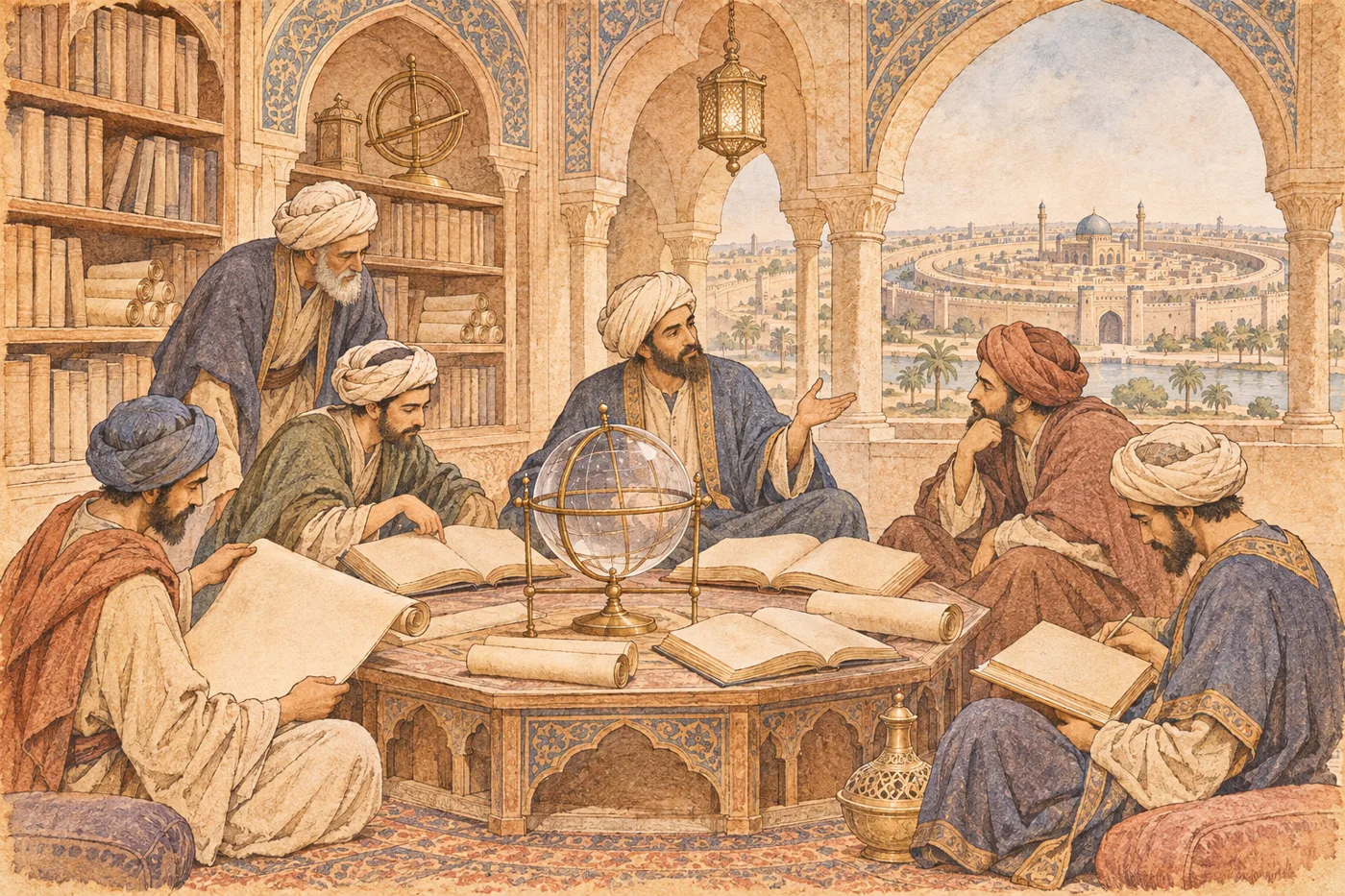
In this city, a great 'translation movement' arose. Greek philosophy, mathematics, and medicine; Indian mathematics and astronomy; Persian books—works in many languages were translated into Arabic. In the early 9th century, under Caliph al-Ma'mun, a 'House of Wisdom' is said to have existed, where scholars gathered.
They did not just translate. The mathematician al-Khwārizmī (c. 780–c. 850) compiled a book on solving equations; part of its title, 'al-jabr', later became the English word 'algebra'. His own name is said to be the origin of the word 'algorithm'. It was also the people of this world who organized the numerals including '0' (born in India) and passed them westward.
In medicine, Ibn Sīnā (known in Europe as Avicenna, 980–1037) wrote *The Canon of Medicine*, which was long used as a textbook even in European universities. Also, according to one theory, the art of papermaking was transmitted to the Islamic world from Tang prisoners taken at the Battle of Talas in 751; thanks to paper, books became cheap and plentiful.
But even the golden age came to an end. By the 10th century, the caliph's power weakened, and independent dynasties emerged in various regions. And in the 13th century, a storm from the east struck this city directly. That is the story of the next chapter.
Mini timeline
- 750The Abbasid dynasty is established
- 762Baghdad is founded
- 786–809The era of Harun al-Rashid
- c. 830The translation movement flourishes at the 'House of Wisdom'
- 10th centuryThe caliph's power weakens; independent dynasties arise in various regions
People in this chapter
His *Canon of Medicine* influenced European medical education for centuries.
He laid the foundations of algebra, and his name is said to be the origin of the word 'algorithm'.
Meanwhile, elsewhere
Connection to Japan
In Japan, the capital moved to Heian-kyō in 794, beginning the Heian period.
Why it still matters
Algebra, algorithm, alkali, alcohol, zero (the concept was born in India; the word comes via Arabic ṣifr). Many everyday scientific and mathematical terms today come from Arabic.
Perspectives differ
- The true nature of the 'House of Wisdom'
- The image of a 'huge translation institution gathering the world's knowledge' is widely known, but researchers' views differ on whether it was actually a library-scale institution or a gathering of scholars.
- Transmission of papermaking
- The story that it came from prisoners taken at the Battle of Talas in 751 is famous, but some believe it had already been transmitted by another route.
- Population of Baghdad
- The figures in historical sources are uncertain; it is often discussed as being in the range of 'several hundred thousand to a million'.
- 'They didn't just translate'
- In the past it was sometimes said that 'they only preserved Greek knowledge and gave it back to Western Europe,' but today it is recognized that they also made significant original developments.
Facts checked (5, verified by AI on the web)
- Confirmed Baghdad was founded by al-Mansur in 762 (a round city, 'City of Peace') Brown University Archaeology: Baghdad, Iraq (Aly Abouzeid)
An archaeology site at Brown University records that Caliph al-Mansur founded Baghdad in 762, its name at the time was Madinat al-Salam, a round city completed in 766. - Views differ Founder and scale of the 'House of Wisdom' Britannica: Bayt al-Hikmah
Britannica states al-Ma'mun founded Bayt al-Hikma (830), but a founding by Harun al-Rashid is also proposed and not confirmed. The main text says 'is said to,' and the debates section already discusses the nature of the institution. - Confirmed 'algebra' comes from 'al-jabr', 'algorithm' from al-Khwārizmī's name algebra (etymologist.ai)
The etymology is widely established. However, the sources checked this time were etymological dictionary sites; primary sources were not verified. The book was written around the 820s. - Views differ The theory that papermaking came from prisoners at the Battle of Talas in 751 Britannica: Papermaking
Britannica states that Chinese prisoners taught papermaking to the Arabs, but there are no contemporary Arabic sources, and there is evidence that paper was already in use in Samarkand. The main text and debates section use 'theory' and 'different route' consistently. - Confirmed *The Canon of Medicine* was long a textbook in European universities University of Alabama at Birmingham, Reynolds-Finley Library: Avicenna
A UAB Library page notes that *The Canon of Medicine* dominated medical education and practice in Europe and Asia for centuries, and a Latin translation was made by Gerard of Cremona (the page does not mention it being used until the 17th century).
Sources
Britannica: Bayt al-Hikmah
Brown University Archaeology: Baghdad, Iraq (Aly Abouzeid)
Britannica: Papermaking
World History Encyclopedia: Paper in Ancient China
University of Alabama at Birmingham, Reynolds-Finley Library: Avicenna
Britannica: Avicenna
* AI-drafted and cross-checked; human review is in progress. Status: