Jerusalem — One Town Where Three Religions Pray
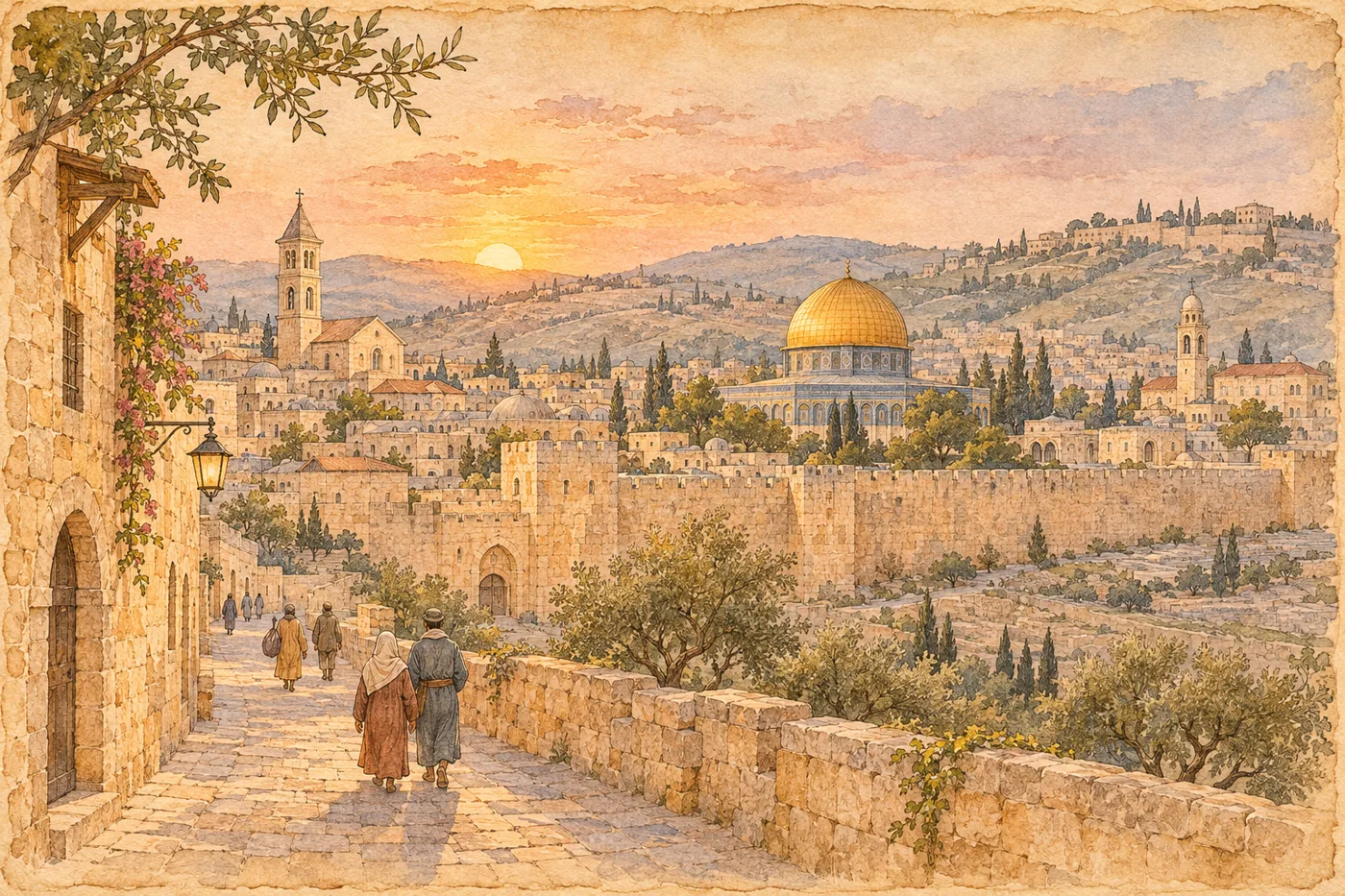
Why did this small Old City become a special place for three religions?
Jerusalem is a city spread over hills. At its center, the walled Old City is a small area about one square kilometer. The city has a very long history; the Bible says that around 1000 BC, King David made it his capital. It is said that in the time of his successor, King Solomon, the Temple was built. For the people connected to what would later become Judaism, this was the center of their faith and memory.
In 586 BC, the Neo-Babylonian Empire attacked Jerusalem and the Temple was destroyed. People later returned and rebuilt the Temple (the Second Temple). Under Roman rule, in AD 70, this Temple was destroyed again. Today's 'Wailing Wall (Western Wall)' is said to be part of the wall that supported the platform of the Second Temple and is a place of prayer for Jewish people.
For Christianity, Jerusalem is the place where Jesus is believed to have taught, been crucified, and risen from the dead. In the 4th century, under the Roman emperor Constantine, the Church of the Holy Sepulchre was built on the site believed to be that place. Pilgrims began to travel long roads to reach this town.
In the 7th century, Islamic forces entered this town (around 638; some accounts say 637). In Islam, the prophet Muhammad is said to have visited this place during a night journey and ascended to heaven, making it a holy site after Mecca and Medina. Around the end of the 7th century (about 691–92), the Dome of the Rock was built, and on the same site is the Al-Aqsa Mosque, the center of worship. The golden dome, which became brilliant through later restoration, remains a symbol of the town today.
After that, rulers changed many times. In 1099, the Crusaders occupied the town and established a Christian kingdom; in 1187, Saladin recaptured the town. Then came the Mamluk Sultanate, and from 1517 the Ottoman Empire ruled, continuing for about 400 years. There were times when people were driven from the town, but through changes in rulers, the faith and prayers of each of the three religions were passed down.
In the 20th century, after World War I, Britain ruled this land. After the 1948 First Arab–Israeli War, the town was divided into east and west, and the situation after the 1967 Six-Day War also changed in complex ways. Regarding the current status of the town, there are differing claims based on differing positions, and opinions are divided in the international community. Here, we do not state which position is correct. However, the fact remains unchanged that places important to the three religions are gathered within walking distance of each other.
Mini timeline
- Around 1000 BCSaid to have been made the capital by King David
- 586 BCThe Neo-Babylonians attack the town and destroy the Temple
- AD 70Roman forces destroy the Second Temple
- Around 638Islamic forces enter the town
- 1099The Crusaders occupy the town
People in this chapter
In the Bible, he is said to have made Jerusalem his capital.
Known as the person who recaptured Jerusalem in 1187.
Meanwhile, elsewhere
Connection to Japan
In 1099, Japan was in the late Heian period, during the cloistered rule of Retired Emperor Shirakawa. It was the same era when Jerusalem was occupied by the Crusaders.
Why it still matters
The Old City and its walls were registered as a UNESCO World Heritage site in 1981. The sacred sites of Judaism, Christianity, and Islam still welcome pilgrims today.
Perspectives differ
- Scale of the David–Solomon era
- Regarding the size of the kingdom described in the Bible, researchers' opinions are divided on how to interpret the findings of archaeology.
- Exact location of the Second Temple
- Views among researchers are divided on exactly where the central part of the Temple was located in the area of the present-day Dome of the Rock.
- Location of Jesus' crucifixion and tomb
- The traditional view identifying the Church of the Holy Sepulchre is considered strong, but there are also theories proposing other locations, and the debate continues.
- Debate over the current status
- Regarding the current political status of this town, views among the parties involved and various countries are divided. This book does not judge which is correct.
Facts checked (7, verified by AI on the web)
- Confirmed The Dome of the Rock was built around 691–92 under Abd al-Malik Britannica: Dome of the Rock
Confirmed as built around 691 by Britannica. There are also differing views on completion date and builder. - Corrected & confirmed The Islamic army's entry into Jerusalem was around 638 Britannica: Jerusalem: Roman rule (history)
Britannica says 638, World History Encyclopedia (Umar) says 637. Explanations differ as 636–638. Added 'some accounts say 637' in the text. - Confirmed Saladin recaptured Jerusalem in 1187 (occupied by Crusaders in 1099) World History Encyclopedia: Saladin's Conquest of Jerusalem (1187 CE)
October 2, 1187 is the date of surrender. - Confirmed The Old City was registered as a World Heritage site in 1981 UNESCO World Heritage Centre: Old City of Jerusalem (state of conservation)
Registered on Jordan's proposal, listed as endangered since 1982. The text only mentions the year of registration. - Corrected & confirmed The Wailing Wall is part of the retaining wall of Herod's Temple platform, surviving the destruction of 70 The Western Wall (Jewish Virtual Library)
Corrected from 'wall surrounding the Temple' to 'wall supporting the platform'. - Confirmed The Ottoman Empire ruled from 1517 for about 400 years Britannica: Jerusalem: Roman rule (history)
Britannica states that Selim I captured the town in 1517, beginning about 400 years of Turkish rule. The end of rule is 1917 (British occupation) to 1918. - Confirmed The Church of the Holy Sepulchre was built in the Constantine era (4th century) Britannica: Holy Sepulchre
Emperor Constantine built the first church, consecrated around 336, confirmed by Britannica (some sources say 335). Whether it is the actual location is debated.
Sources
World History Encyclopedia: Umar
World History Encyclopedia: Saladin's Conquest of Jerusalem (1187 CE)
UNESCO World Heritage Centre: Old City of Jerusalem (state of conservation)
Britannica: Jerusalem: Roman rule (history)
Britannica: Holy Sepulchre
Britannica: Dome of the Rock
* AI-drafted and cross-checked; human review is in progress. Status: