The Phoenicians and Their Alphabet: The Legacy of Seafaring Merchants
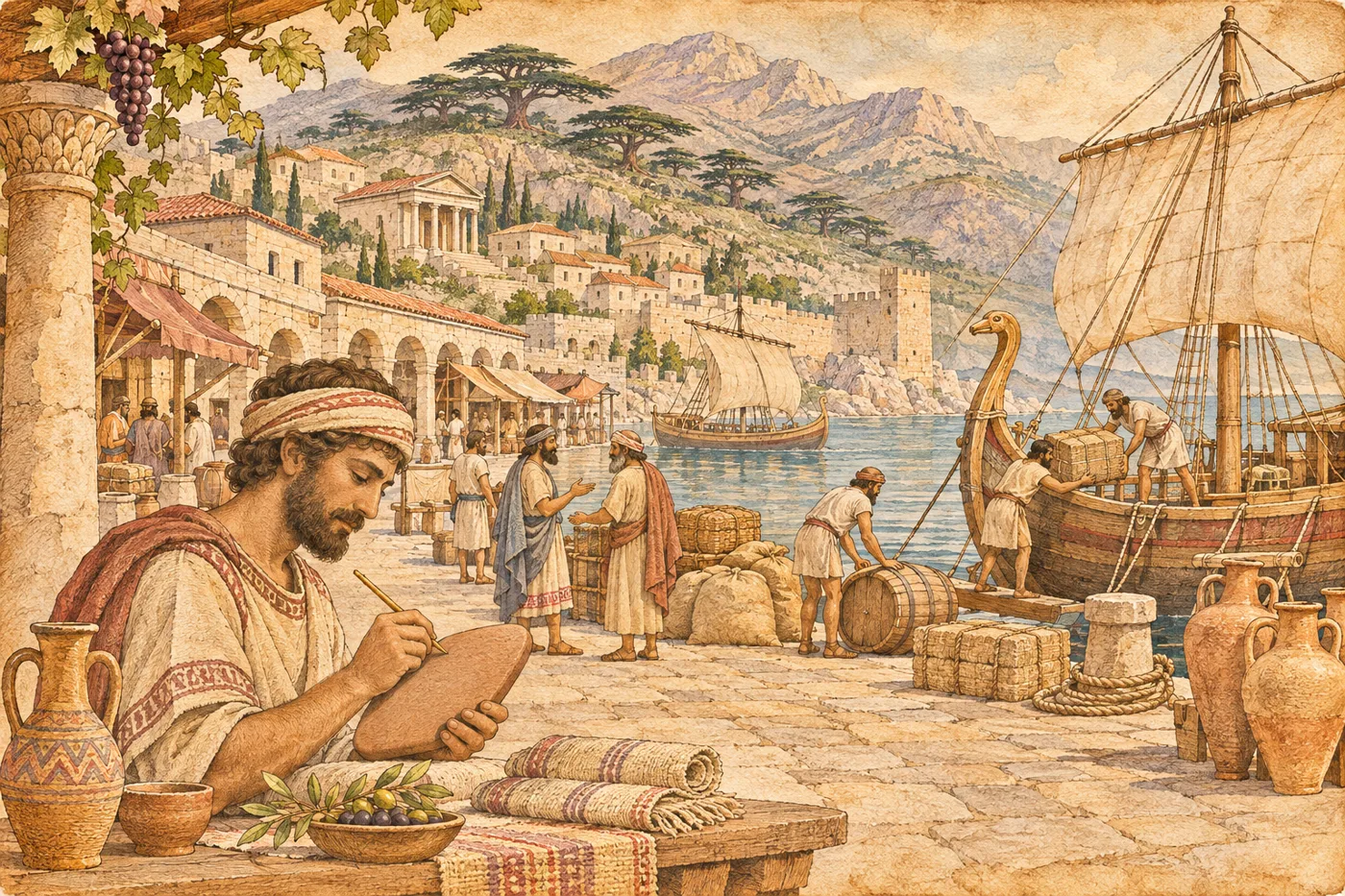
Why did the script of a seafaring merchant people become the ancestor of the letters we use today?
Along the eastern coast of the Mediterranean, in the area of present-day Lebanon, the cities of a people known as the Phoenicians flourished from around 1200 BC: Tyre (Tyre), Sidon, and Byblos, among others. Each was an independent city-state; they never united into a single large nation. 'Phoenicia' is a name given by the Greeks, said to be derived from their purple dye.
Their livelihood was based on maritime trade. Tyre's purple dye is said to have been worn even by the kings of Mesopotamia. Glass, metalwork, and timber were also transported by ship. Byblos was known for trade in Lebanese cedar and papyrus, and the Phoenician cities were renowned for their advanced shipbuilding. Tyre is thought to have reached the height of its power around 1000 BC. In the time of King Hiram I, it is said to have allied with the Kingdom of Israel.
Their ships sailed westward, establishing ports and trading posts across the Mediterranean. One of these would later become the great power Carthage. Tradition tells that Princess Elissa (Dido) of Tyre, fleeing her brother, founded a city on the coast of North Africa around 814 BC. However, whether Dido was a historical figure is debated, and she is often regarded as a legendary character.
The Phoenician alphabet used by these people is dated to around 1100 BC. It was a small set of consonants only; vowels were not written. With few characters, it was easy to learn, and no doubt convenient for merchants. Many researchers believe its origins can be traced back to the Canaanite script (Proto-Sinaitic script), which was inspired by Egyptian hieroglyphs.
This script traveled with ships and merchants to Greece. Written records in Greece increase from the 700s BC, coinciding with the period when Phoenician ships were traversing the Mediterranean. The Greek historian Herodotus wrote that the Phoenician prince Cadmus brought the alphabet to Greece. From the Greek alphabet, the Latin alphabet was born, leading to many of the scripts used today.
Around 345 BC (the date is debated), Artaxerxes III of the Achaemenid Empire attacked Sidon, which had rebelled, and in 332 BC, Alexander the Great captured Tyre after a siege of about seven months (the date of Sidon's fall is debated). The power of the mainland cities waned. Yet Carthage flourished for a long time, and the alphabet was passed on, transformed by other peoples. A merchant's tool became the world's script.
Mini timeline
- c. 1200 BCPhoenician city-states begin to flourish on the eastern Mediterranean coast
- c. 1100 BCThe Phoenician alphabet is said to have come into use
- c. 1000 BCTyre is considered to have reached its greatest power
- c. 814 BCPeople from Tyre are said to have founded Carthage (tradition)
- 700s BCA script based on the Phoenician alphabet comes into use in Greece
- 332 BCAlexander the Great captures Tyre
People in this chapter
Ruled Tyre around the 10th century BC (said to be c. 969–c. 936 BC), and is said to have allied with the Kingdom of Israel.
According to tradition, she fled Tyre and founded the city of Carthage. Whether she actually existed is unclear.
Meanwhile, elsewhere
Connection to Japan
Around the time the Phoenician alphabet was spreading, the Japanese archipelago was transitioning from the end of the Jōmon period to the beginning of the Yayoi period (dates are debated). There were no writing systems yet.
Why it still matters
The alphabets widely used around the world today (such as the Latin and Cyrillic scripts) are part of a lineage that originated with the Phoenician alphabet and passed through the Greek alphabet. The ingenuity of seafaring merchants lives on, even millennia later.
Perspectives differ
- The origins of the alphabet
- While the view that the script traces back to the Proto-Sinaitic script, inspired by Egyptian hieroglyphs, is considered influential, researchers differ on the dates, locations, and specific details of its development.
- When and how it reached Greece
- Written records in Greece increase in the 700s BC, but there are various theories about when and where the script was adopted.
- The story of Carthage's founding
- The date of around 814 BC and the story of Dido are traditions. Whether Dido was a historical figure is debated among researchers.
- The unity of the 'Phoenicians'
- The Phoenicians were not a single unified nation or ethnic group; they were people of independent city-states. The collective name is a Greek perspective, and the extent of their shared identity is debated.
Facts checked (6, verified by AI on the web)
- Confirmed Carthage is said to have been founded from Tyre around 814 BC World History Encyclopedia(事典): Carthage
Encyclopedias give the traditional foundation date as c. 814 BC with the mother city as Tyre. They note that Dido's historicity is disputed. The text treats this as 'tradition'. - Corrected & confirmed The Phoenician alphabet is dated to around 1100 BC World History Encyclopedia(事典): Phoenicia
A timeline in an encyclopedia gives c. 1100 BC. The Penn Museum mentions older sources like the Proto-Sinaitic script, hence the phrasing 'around' and 'is said to have come into use'. - Confirmed Greek written records appear in the 700s BC, and the Latin alphabet developed from the Greek alphabet Penn Museum, Expedition: The Alphabet
The Penn Museum dates the Greek alphabet to the 700s BC, states that Latin developed from Greek, and that Greeks adopted it from Phoenicians. - Confirmed Early Semitic scripts had only consonants, and many scholars believe the Proto-Sinaitic script was the precursor Penn Museum, Expedition: The Alphabet
The source says 'many scholars accept that the Canaanites invented it, inspired by Egyptian hieroglyphs.' Proto-Sinaitic has been deciphered only in part. - Confirmed Alexander the Great captured Tyre in 332 BC after a siege (about 7 months) World History Encyclopedia(事典): Phoenicia
An encyclopedia gives a siege from January to July 332 BC. There is a minor inconsistency in the same page's end date (322 BC), but 332 BC is mainstream. - Confirmed The Phoenician alphabet had 22 letters World History Encyclopedia: The Phoenician Alphabet & Language(事典)
An encyclopedia describes the Phoenician alphabet as having 22 letters, a simplification of Egyptian hieroglyphs.
Sources
Penn Museum, Expedition: The Alphabet
World History Encyclopedia(事典): Phoenicia
World History Encyclopedia(事典): Carthage
World History Encyclopedia: The Phoenician Alphabet & Language(事典)
* AI-drafted and cross-checked; human review is in progress. Status: