The Ottoman Empire — A 600-Year Empire Spanning Three Continents
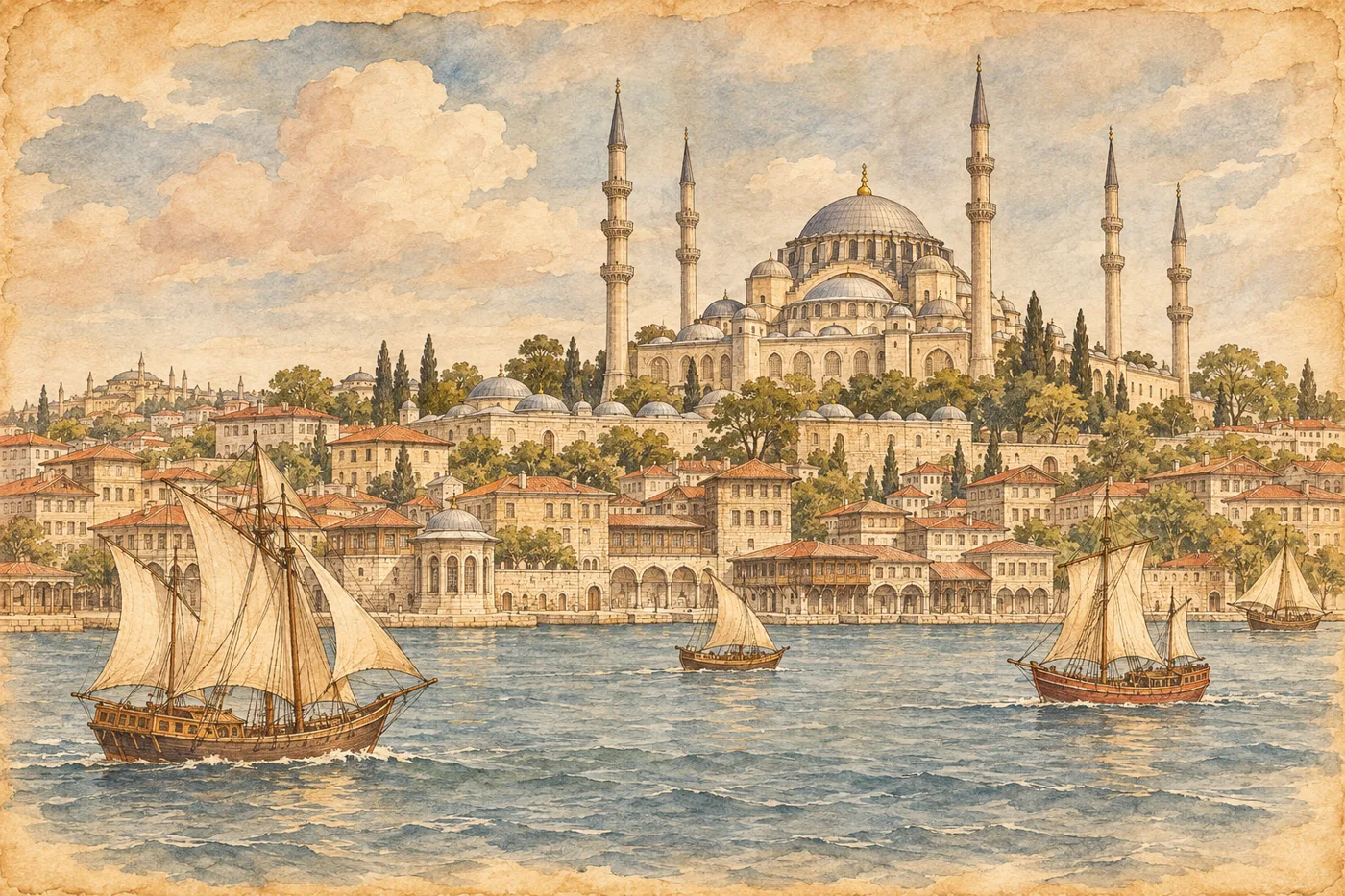
Why did this multi-religious, multi-ethnic empire last for 600 years?
At the end of the 13th century, a small beylik was born in the northwestern corner of Anatolia (modern-day Turkey). According to tradition, it was around 1299 under Osman I. Taking advantage of the decline of the Byzantine Empire and the Mongols, this state gradually grew stronger (the founding year is an approximate figure based on tradition).
The turning point came in 1453. Mehmed II used massive cannons to conquer Constantinople, the capital of the Byzantine Empire, which had stood for over a thousand years. This city, later called Istanbul, became the capital of the Ottoman Empire. In 1517, they defeated the Mamluk Sultanate in Egypt and also gained control of the two holy cities, Mecca and Medina.
The peak came under Suleiman I (r. 1520–66). The empire stretched across the Balkans, Anatolia, Syria, Egypt, and North Africa, and in 1529 it besieged Vienna, the stronghold of the Habsburgs. It was a great power spanning three continents: Europe, Asia, and Africa.
How did they govern so many ethnic groups and religions? The Ottomans are said to have adopted a system called the millet system, which allowed religious communities of Jews, Christians, and others a degree of autonomy over their own laws and schools. There was also the devshirme system, which gathered Christian boys, educated them, and employed them as administrators or as the standing army (Janissaries). Capable individuals, even of low birth, could rise to high positions.
From the late 17th century, the Ottomans began losing wars against Europe. The second siege of Vienna failed in 1683, and with the Treaty of Karlowitz in 1699, they lost vast territories. In the 19th century, due to nationalist movements within the empire and pressure from great powers like Russia and Britain, it became known as the 'Sick Man of Europe'.
Defeated in World War I, the Ottoman Empire saw the abolition of the sultanate in 1922, and the Republic of Turkey was established in 1923. Under Mustafa Kemal (Atatürk), Turkey became a new state promoting secularism. The curtain fell on the empire's 600-year history.
Mini timeline
- c. 1299Osman I is said to have founded the state
- 1453Conquest of Constantinople (fall of the Byzantine Empire)
- 1517Defeated the Mamluks, gaining control of Egypt and Arab regions
- 1529Suleiman I's first siege of Vienna
- 1699Lost territory with the Treaty of Karlowitz
- 1922Abolition of the sultanate
People in this chapter
At age 21, he conquered the city of a thousand years. He was the sultan who laid the foundations for the future empire.
Known as 'Suleiman the Magnificent', he organized the legal code and is also called 'the Lawgiver' in Turkey.
Meanwhile, elsewhere
Connection to Japan
The Ottoman Empire's roughly 600 years correspond in Japan from the late Kamakura period to the Taishō period. At its peak, Japan was in the Sengoku period; firearms arrived in 1543, greatly changing the nature of warfare.
Why it still matters
Istanbul, Turkey's largest city, is one of the world's rare cities straddling Europe and Asia. The habit of enjoying coffee is said to have spread to Europe largely through Ottoman influence.
Perspectives differ
- Founding Year
- The year 1299 is a conventional date based on later tradition; the actual circumstances of the founding are not well understood.
- Reality of the Millet System
- While the autonomy of religious communities has been described as a 'tolerant system', in reality, the system differed by period, and some view it as a concept refined later on.
- View of 'Decline'
- The perspective that lumps the period after the 17th century as 'decline' is currently being reconsidered, with emphasis on the empire's significant capacity for adaptation to change.
- Sultan and Caliph
- There is debate over when the status of the Ottoman ruler as also being the 'Caliph' became emphasized.
Facts checked (5, verified by AI on the web)
- Confirmed The Ottoman state was founded by Osman I around 1299 World History Encyclopedia: Osman I
c. 1299. The World History Encyclopedia also dates his reign to 1299–1326, but gives his death year as c. 1323, making these approximate dates (as noted in debates). - Confirmed Mehmed II conquered Constantinople in 1453 Fall of Constantinople (Britannica)
May 29, 1453. - Confirmed The Mamluk Sultanate was defeated in 1517 World History Encyclopedia: Ottoman Empire
Selim I conquered the Mamluk Sultanate in 1516–17 (WHE: Mamluk realm engulfed by 1517). The transfer of the caliphate is sometimes viewed as a later narrative, as noted in debates. - Confirmed Suleiman I reigned from 1520 to 1566 and besieged Vienna for the first time in 1529 World History Encyclopedia: Ottoman Empire
Suleiman I reigned 1520–1566; the failed Vienna campaign of 1529 (per WHE timeline). - Confirmed Lost territory in the 1699 Treaty of Karlowitz, and the sultanate was abolished in 1922 World History Encyclopedia: Ottoman Empire(事典)
Text states the Treaty of Karlowitz ceded vast European territories, and the sultanate was abolished by the Grand National Assembly on November 1, 1922. 1699 also confirmed via Rubicon article.
Sources
World History Encyclopedia: Osman I
Britannica: Fall of Constantinople
World History Encyclopedia: Battles & Conquests of the Ottoman Empire
World History Encyclopedia: Ottoman Empire
Rubicon: The 1699 Treaty of Karlowitz
* AI-drafted and cross-checked; human review is in progress. Status: