The Safavid Empire — The Birth of “Iran” as We Know It
Why did Iran become a country of a different sect from its neighbors?
While the Ottoman Empire was growing large in the west, another great state was born in Iran to its east. In 1501, a mere teenager named Ismail I ascended the throne in Tabriz and founded the Safavid dynasty. This family had originally been the lineage of the leaders of a mystic (Sufi) order. The order’s followers were mainly Turkic nomadic warriors.
Ismail I declared Shi‘a Islam (the Twelver Imami sect) the state religion. At the time, the neighboring Ottoman Empire and Central Asia were predominantly Sunni. Consequently, the Safavids and the Ottomans would clash for a long time, with religious differences compounding the conflict. In the 1514 Battle of Chaldiran, the Safavids were defeated by the Ottomans.
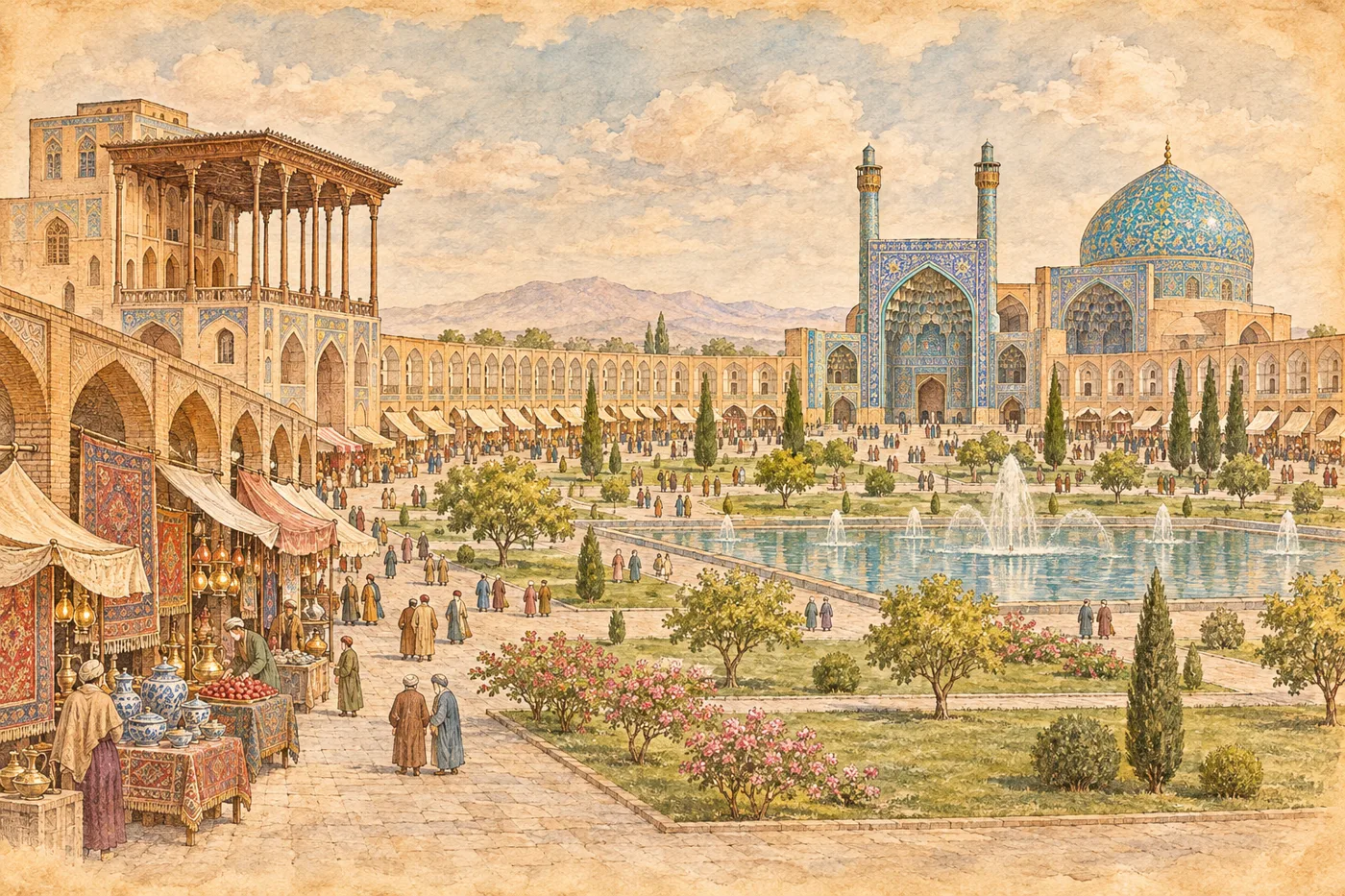
The heyday was created by Abbas I (r. 1588–1629; some sources give his accession as 1587). The shah reformed the army and administration, and recovered some territory from the Ottomans. He then moved the capital to a new city, Isfahan, building a beautiful metropolis with a great square, mosques, markets, and bridges. It is said that people praised it as “Isfahan is half the world.”
This state also prospered through trade. Persian silk was an important export commodity to Europe. Abbas I is also known for relocating Armenian merchants near the new capital to boost commerce. In addition, crafts still beloved around the world—such as Persian carpets, beautiful tiles, and miniature paintings—flourished during this period.
However, from the late 17th century onward, the Safavid Empire gradually declined. In 1722, the capital Isfahan was besieged and fell to Afghan forces from the east, causing great instability. Later, Nader Shah emerged and restored the state, but in 1736 he himself ascended the throne. Some view the 1722 fall as the end, but the Safavid dynasty is generally considered to have ended in 1736.
Still, the Safavid legacy lives on in modern Iran: the majority of the population being Shi‘a, a culture centered on the Persian language, and the cityscape of Isfahan. It is said that the foundation of the country called “Iran” was laid in this era.
Mini timeline
- 1501Ismail I founds the Safavid Empire
- 1514Battle of Chaldiran (defeated by the Ottoman Empire)
- 1588Abbas I ascends the throne (also given as 1587)
- 1722Isfahan falls
- 1736The Safavid Empire ends
People in this chapter
He ascended the throne as a teenager and made Shi‘a Islam the state religion.
He moved the capital to Isfahan and built a beautiful city.
Meanwhile, elsewhere
Connection to Japan
In Japan, this corresponds to the Sengoku period through the early Edo period. Abbas I was a near-contemporary of Toyotomi Hideyoshi and Tokugawa Ieyasu.
Why it still matters
Isfahan’s “Imam Square” (formerly the Royal Square) is a UNESCO World Heritage site and still a place of relaxation for citizens. Persian carpets remain a celebrated Iranian craft worldwide.
Perspectives differ
- How the Shi‘a-ification progressed
- It is widely known that Ismail I made Shi‘a Islam the state religion, but scholars debate how coercive the conversion of the populace was and over what period it took place.
- Origins of the Safavid family
- Views diverge on the ethnic origins of the Safavid family (Kurdish, Turkic, Iranian, etc.), depending on how historical sources are interpreted.
- The view of the Safavids as the ‘prototype of Iran’
- While some regard the Safavid Empire as the prototype of modern Iran, other researchers are more cautious, arguing that the formation of a national consciousness came much later.
Facts checked (5, verified by AI on the web)
- Confirmed In 1501, Ismail I ascended the throne and made Twelver Imami Shi‘a the state religion. Britannica: Ismail I
He was crowned in Tabriz (December and July dates both exist). He was 14 at the time of accession. - Confirmed In 1514, the Safavids were defeated by the Ottoman Empire at the Battle of Chaldiran. Britannica: Safavid dynasty (summary)
August 23, 1514. - Corrected & confirmed Abbas I reigned 1588–1629 and moved the capital to Isfahan. Britannica: Abbas I
Some accounts give his accession as 1587, noted in the text. The move of the capital occurred around 1597–98 (sources vary). - Corrected & confirmed In 1722 Isfahan fell, and in 1736 Nader Shah ascended the throne, ending the Safavid Empire. 米議会図書館 Country Studies: Iran「The Safavids, 1501-1722」
A small Afghan force captured the capital in 1722, ending Safavid rule. Tahmasp Qoli (Nader) himself took the throne in 1736. Some see 1722 as the end, so this is noted in the text. - Unverified Relocation of Armenian merchants and export of Persian silk.
LoC Country Studies accessed: Armenians appear only as slave soldiers; no mention of merchant migration or silk export (only state silk monopoly). Iranica returns 403.
Sources
Britannica: Ismail I
Britannica: Abbas I
Britannica: Safavid dynasty (summary)
米議会図書館 Country Studies: Iran「The Safavids, 1501-1722」
* AI-drafted and cross-checked; human review is in progress. Status: