The First Emperor and the Birth of 'China' — Unifying Writing, Measures, and Roads
Why were the scattered states able to be brought together into one?
As we saw in the previous chapter, the Zhou moved its capital east around 770 BC. From this time, the Zhou's power weakened, and regional strongmen (lords) began focusing on strengthening their own states. This marks the beginning of the Spring and Autumn and Warring States periods. With the spread of iron tools and ox-drawn plows, agricultural output increased, and the states grew while fighting one another.
This era also saw a remarkable flowering of philosophers. Confucius preached 'benevolence' and 'ritual propriety,' profoundly influencing later East Asian thought. Thinkers from many different schools emerged, collectively known as the Hundred Schools of Thought. The age of war was also an age of serious reflection on how to govern a state.
Among these states, Qin in the western frontier rose to prominence. Around the mid-4th century BC, the statesman Shang Yang implemented reforms based on law to mobilize the people. Those who achieved merit were granted rank. Through this system, Qin became a state with a powerful army.
In 221 BC, the Qin king, Zheng, defeated the other states one after another and unified the realm. He took the title 'First Emperor' (Shi Huangdi). The title 'Emperor' (Huangdi) was used for the first time at this point and would be passed down for about 2,000 years. The country was divided into commanderies and counties, governed by officials appointed by the emperor.
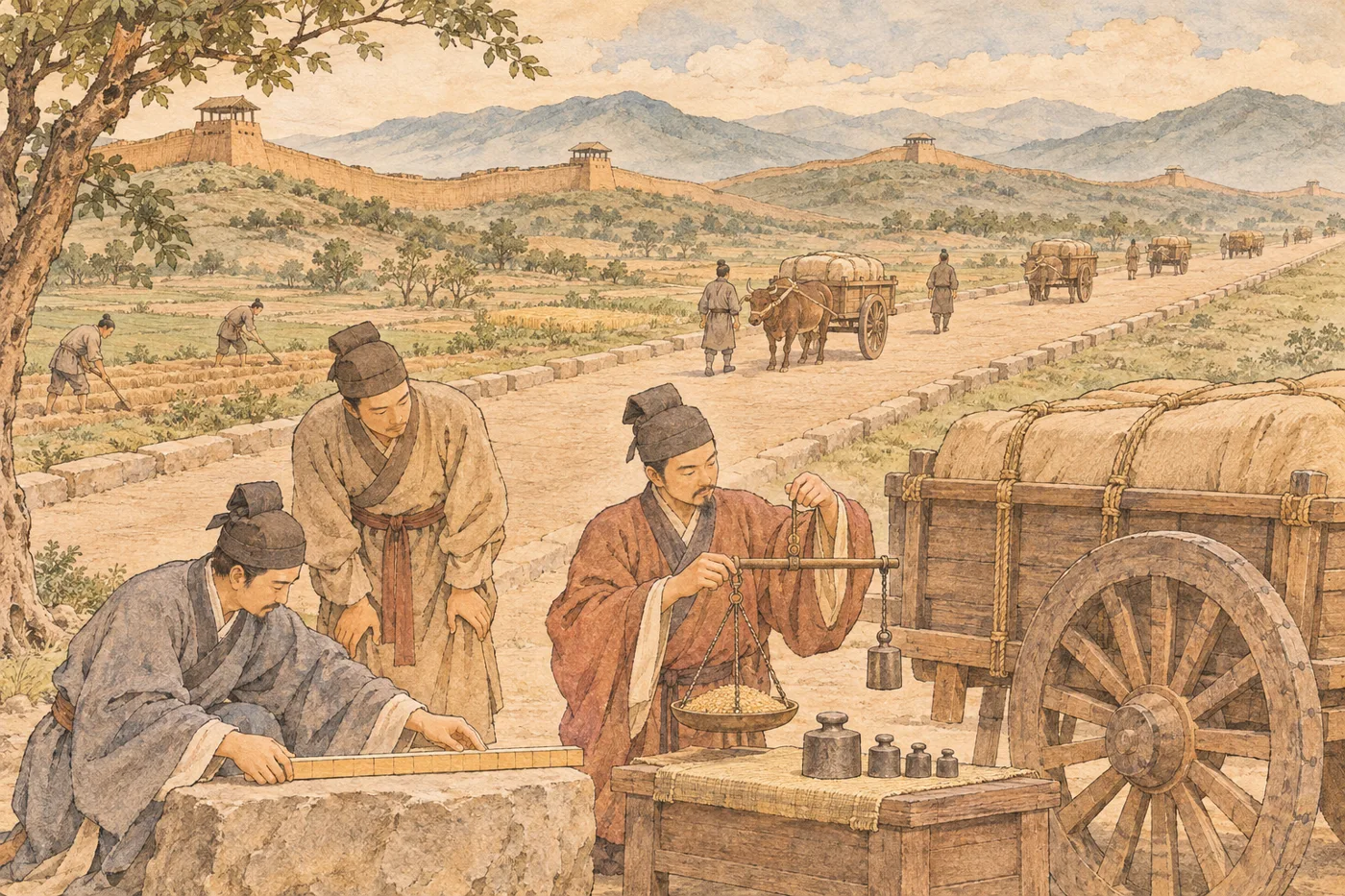
The First Emperor standardized the 'measures' of the state: the form of characters, units of length and weight (weights and measures), currency, and the axle width of chariots. He built roads and, in the north, is said to have connected existing walls to fortify the frontier. On the other hand, heavy labor service and taxes burdened the people's lives, and he is also said to have suppressed thought (the burning of books and burying of scholars).
In 210 BC, the First Emperor died on a journey. The following year, the revolt of Chen Sheng and Wu Guang broke out and spread across the land. In 206 BC, Qin fell, just about 15 years after unification. However, the system of commanderies and counties and the concept of 'Emperor' were inherited by later dynasties.
Mini timeline
- c. 770 BCZhou moves capital east (marks beginning of Spring and Autumn period)
- mid-4th century BCShang Yang's reforms advance in Qin
- 221 BCQin unifies China; ruler takes title 'First Emperor'
- 213–212 BCBurning of books and burying of scholars (as recorded)
- 206 BCQin falls
People in this chapter
The first 'Emperor.' Described both for his unification achievements and his harsh rule.
Advanced rule by law and made Qin a powerful state. Reportedly later fell victim to his own strict laws.
Meanwhile, elsewhere
Connection to Japan
The Japanese archipelago, from the end of the Jōmon period into the Yayoi period, saw the spread of rice farming. Legends persist in various parts of Japan that Xu Fu, who sought the elixir of immortality for the First Emperor, crossed to Japan, but whether this is historical fact is unknown.
Why it still matters
Chinese characters developed from the standardized script of this era. Near the First Emperor's tomb, thousands of life-sized terracotta warriors were discovered (in 1974), now a UNESCO World Heritage site.
Perspectives differ
- Evaluation of the First Emperor
- There are views that emphasize his achievements in unification, and others that emphasize his harsh rule (heavy labor, punishments). Later dynasties tended to portray previous dynasties unfavorably, so care is needed in interpreting historical sources.
- Reality of the Burning of Books and Burying of Scholars
- The story of 'burning books and burying scholars alive' is famous, but scholars disagree on whether the victims were Confucian scholars or magicians (fangshi), and on the number of people involved.
- The Qin Great Wall
- The Qin wall is thought to have largely connected existing walls of various states, and was mostly made of tamped earth. The stone and brick wall familiar today is mainly from the Ming dynasty.
- Etymology of 'China'
- The theory that the English word 'China' derives from 'Qin' is widely known, but other theories exist and it is not settled.
- Beginning of the Warring States Period
- There are several theories for the boundary between the Spring and Autumn period and the Warring States period, including 453 BC, 403 BC, and 475 BC.
Facts checked (5, verified by AI on the web)
- Confirmed Unified in 221 BC and created the new title 'Emperor.' Lived 259–210 BC Shi Huangdi(事典)World History Encyclopedia
Text confirms c. 259-210 BCE, proclaimed emperor in 221 BCE, founded Qin, and Shi Huangdi is a title. Liverpool Museum article also confirms birth year 259 BCE, unification in 221 BCE, and title creation (death stated only as 'died at age 49'). - Confirmed Shang Yang died in 338 BC, and his reforms laid the foundation for Qin's rise to power Britannica: Shang Yang
Some sources give the start of his reforms as 356 BC (text says 'mid-4th century BC') - Confirmed Burning of books occurred in 213 BC Britannica: book banning
Whether books were actually burned or merely hidden from the public is unclear (Britannica: Chinese literature) - Views differ Burying of scholars occurred in 212 BC Shi Huangdi(事典)World History Encyclopedia
WHE text dates the burning of books and burying of scholars to 213 BCE; sources vary between 213/212 BCE. Liverpool Museum article gives no year, only mentions burying craftsmen. Safer to phrase as 'is said to have occurred' without specifying the year. - Corrected & confirmed Qin fell in 206 BC (some sources say 207 BC) Britannica: Qin dynasty
Within Britannica articles, both 207 BC and 206 BC appear. This text retains 206 BC.
Sources
Britannica: Shang Yang
Britannica: Qin dynasty
Britannica: book banning
Britannica: Qin Shi Huang
高校世界史の教科書・用語集
Liverpool Museums: Who was China's First Emperor?
* AI-drafted and cross-checked; human review is in progress. Status: