The Spring and Autumn & Warring States Periods and the Hundred Schools of Thought — Thinkers Born from Chaos
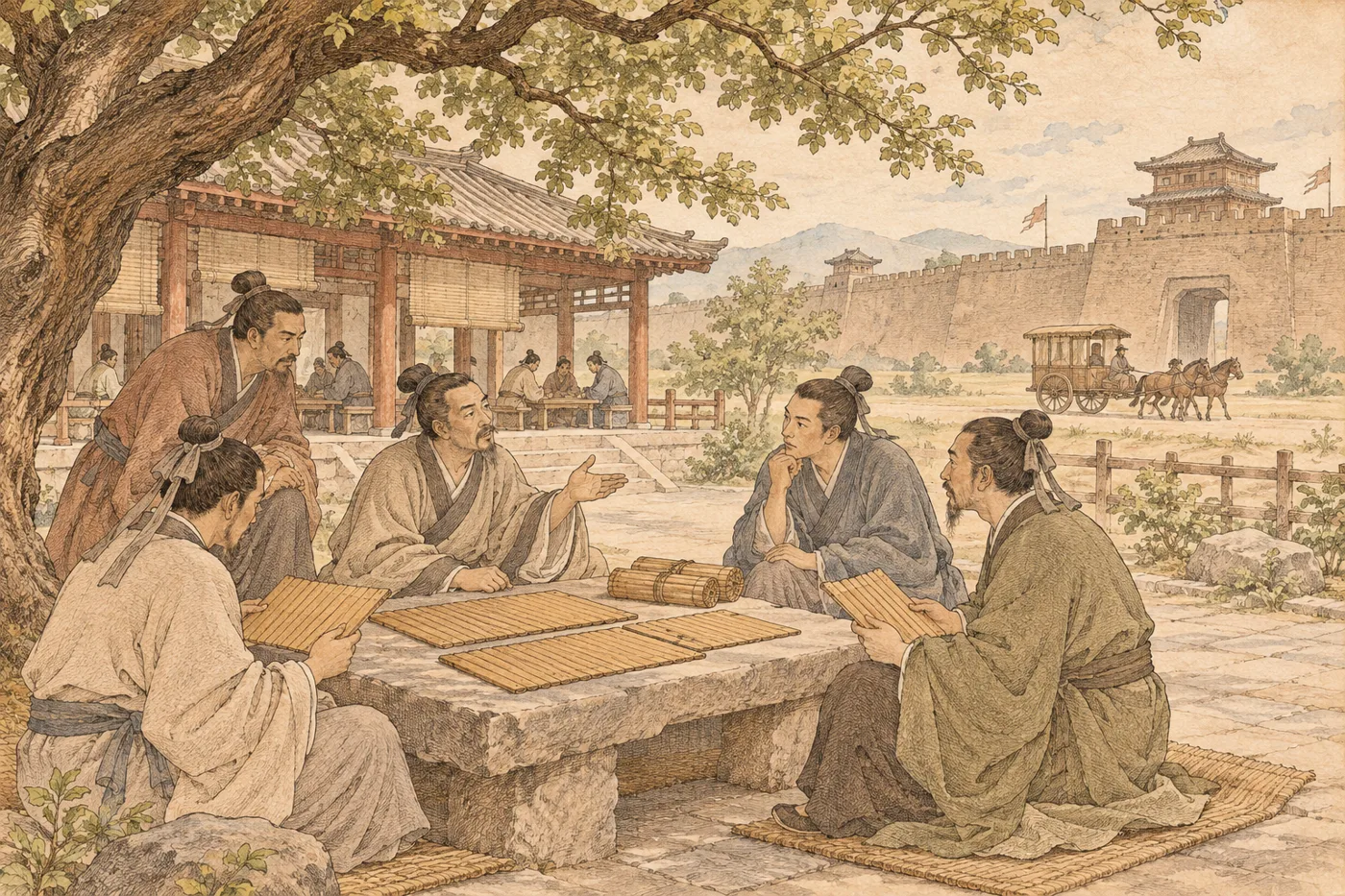
Why did so many thinkers appear in China during this age of constant warfare?
Around 770 BC, the Zhou royal court moved its capital east, and this later period is called the 'Eastern Zhou.' The king’s power weakened, and regional states began to compete for strength. This long era of chaos is conventionally divided into the Spring and Autumn period (early half) and the Warring States period (later half), though exactly where the boundary lies depends on the account. Amid the continuous warfare, people who seriously pondered 'how can the world be set right?' began to appear from all over.
The foremost representative is Confucius. Traditionally dated to around 551–479 BC, he was a teacher in the state of Lu. He valued compassion (ren) and proper conduct (li), and advocated cultivating noble character through learning. Confucius’s words are collected in the Analects, though it is thought to be a work compiled by his disciples and later hands. There is debate over how accurately Confucius’s own ideas have been transmitted.
Another stream is the school known as Daoism, associated with the name Laozi. The Laozi (or Daodejing) is a short book that speaks of a way of life that does not go against the natural flow of things. However, scholars are divided on whether a person named Laozi actually existed. Today, the prevailing view is that it was not the work of a single author, but rather a collection of sayings that gathered over a long period, approaching its current form by the mid-3rd century BC.
Mozi is thought to have lived from the late 5th to early 4th century BC, and may have come from a background close to that of artisans. He preached 'universal love' (jian ai)—caring for everyone without discrimination—and opposed wars of aggression. But he was not a mere pacifist; his group was also skilled in defending cities under attack. He received harsh criticism from Confucians such as Mencius.
During the Warring States period, the Legalists (Fajia) thought about how to build a strong state. Through the reforms of Shang Yang (died 338 BC) around the mid-4th century BC, the state of Qin grew powerful. Han Fei argued that since people act out of self-interest, they should be governed by clear rules and rewards and punishments. Han Fei is said to have died in Qin, around 233 BC. The label 'Legalist' is a later classification; the thinkers of the time do not seem to have called themselves that.
In 221 BC, Qin unified China, bringing the Warring States period to an end. In 213 BC, it is said that Chancellor Li Si proposed removing many books held in private hands. By the time of Emperor Wu of Han (r. 141–87 BC), Confucian teachings had become the state doctrine. The 'hundred' in 'Hundred Schools' means 'many' and does not refer to an actual number. An age of conflict was also an age of deep inquiry into humanity and society.
Mini timeline
- c. 770 BCZhou moves its capital east; the Eastern Zhou period begins
- c. 551 BCConfucius is said to have been born (traditional account)
- late 5th–early 4th c. BCMozi preaches universal love and opposition to wars of aggression
- 338 BCShang Yang, reformer of Qin, dies
- c. 233 BCHan Fei is said to have died in Qin
- 221 BCQin unifies China; the Warring States period ends
People in this chapter
He emphasized ren and li, and advocated cultivating people through learning. His teachings are transmitted in the Analects.
He argued for governance through clear rules and rewards and punishments. His ideas are compiled in the Han Feizi, and are said to have influenced the rule of King Zheng of Qin (later the First Emperor), a contemporary.
Meanwhile, elsewhere
Connection to Japan
In the Japanese archipelago, this corresponds to the end of the Jōmon period and the beginning of the Yayoi period. Rice cultivation is thought to have gradually spread, though the exact start date is debated.
Why it still matters
The name of Confucius can still be seen today in schools and cultural exchange facilities around the world. The Analects and the Laozi have been translated into many languages and continue to be read as starting points for asking how people should live and how society should be governed.
Perspectives differ
- Boundary between Spring and Autumn and Warring States
- When the two periods are divided varies by research and textbook, with dates such as around the 5th century BC or around 403 BC.
- Whether Laozi actually existed
- There are views that regard Laozi as a historical figure and views that regard him as a legendary one; there are also various theories on whether the Laozi is the work of a single author.
- The Analects and Confucius's teachings
- Scholars are divided on how accurately the Analects transmits Confucius's teachings.
- The classification 'Legalist'
- The prevailing view is that 'Legalist' is a later classification, but debate continues over the name and whether it can be considered a single school of thought.
Facts checked (6, verified by AI on the web)
- Confirmed Confucius is traditionally dated to c. 551–479 BC and was a teacher in Lu Stanford Encyclopedia of Philosophy: Confucius
Confirmed by the Stanford Encyclopedia of Philosophy as 'traditionally 551–479 BCE' and 'man of Lu.' The Analects is noted as compiled by disciples. - Confirmed Laozi's existence is debated, and the Laozi formed over multiple layers during the Warring States period Stanford Encyclopedia of Philosophy: Laozi
The same article notes that some scholars regard Laozi as legendary, and cites the Guodian bamboo slips (tomb c. 300 BC) and Mawangdui silk manuscripts (tomb sealed 168 BC), and the view that a stable form emerged by the mid-3rd century BC. - Confirmed Mozi preached universal love, opposed wars of aggression, and led a group skilled in defense Stanford Encyclopedia of Philosophy: Mohism
Confirmed: mid-to-late 5th c. BC, possible artisan background, condemnation of offensive war and emphasis on defense, criticism by Mencius. - Confirmed Han Fei died in 233 BC and is said to have been killed under the King of Qin / Shang Yang died in 338 BC Stanford Encyclopedia of Philosophy: Chinese Legalism
Recorded as 'allegedly killed in the custody of the King of Qin.' The label 'Legalist' is a later bibliographic classification, and early thinkers did not use the term themselves. - Confirmed Qin unified in 221 BC, Li Si proposed disposing of private books in 213 BC, and Confucianism became state doctrine under Emperor Wu of Han Stanford Encyclopedia of Philosophy: Chinese Legalism
Li Si's proposal in 213 BC confirmed by SEP (Legalists); unification in 221 BC and Confucian state adoption under Emperor Wu (r. 141–87 BC) confirmed by World History Encyclopedia; details of Wu's reign are summarized here. - Confirmed Zhou moved east in 770 BC; Eastern Zhou lasted until c. 256 BC (or 221 BC) Asian Art Museum Education: Hundred Schools of Philosophy
Asia Museum educational page notes 770–256 BCE and text mentions 'c. 1071–221 BC,' indicating variance in dating. The boundary between Spring and Autumn and Warring States is not specified on that page, and the text does not assert a fixed date.
Sources
Stanford Encyclopedia of Philosophy: Confucius
Stanford Encyclopedia of Philosophy: Laozi
Stanford Encyclopedia of Philosophy: Mohism
Stanford Encyclopedia of Philosophy: Chinese Legalism
World History Encyclopedia(事典): Ancient Chinese Philosophy
Asian Art Museum Education: Hundred Schools of Philosophy
* AI-drafted and cross-checked; human review is in progress. Status: