The Han, the Xiongnu, and the Silk Road — A Route Across Steppe and Desert
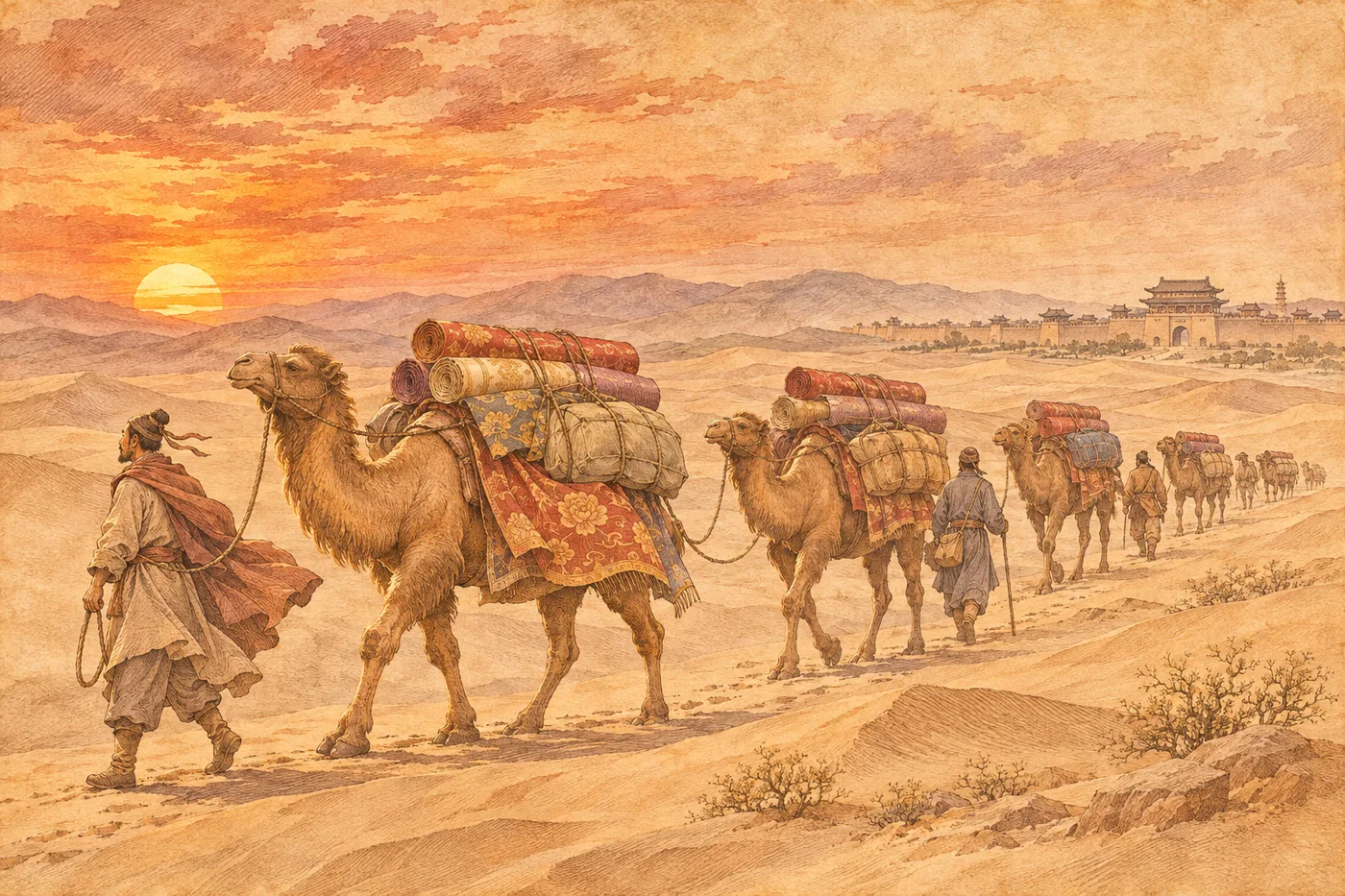
Why was Chinese silk carried all the way to distant Europe?
After the fall of Qin, Liu Bang, a man of peasant origin, emerged victorious and founded the Han in 202 BC. Learning from Qin's failures, the Han initially ruled with a light hand. The empire reached its peak under Emperor Wu (r. 141–87 BC). It is said that Confucianism came to be valued as a political philosophy around this time.
The Han's greatest headache was the Xiongnu, a nomadic state on the northern steppes. The Xiongnu had grown strong under Modu Chanyu, and Liu Bang struggled against them in 200 BC. After that, the Han maintained peace by sending gifts. Emperor Wu sought to change this relationship by looking for allies who could help attack the Xiongnu from two sides.
Around 139 BC, Emperor Wu sent Zhang Qian westward. Zhang Qian was captured by the Xiongnu along the way, and after more than ten years of hardship he returned, bringing back information about the western kingdoms. This information spurred the Han to expand contacts with the western regions. The east-west route thus created was later called the Silk Road.
The name 'Silk Road' began to be used in 19th-century Germany and was popularized by the geographer Richthofen in 1877. The actual route was not a single road, but a mesh-like network connecting oases. Silk, lacquerware, and metal products traveled west; grapes, glassware, and fine horses traveled east. People carried not only goods, but also religions and knowledge. Buddhism is thought to have reached China via this road.
This era also saw progress in the writing of history. Sima Qian is said to have completed the 'Records of the Grand Historian' around the 90s to 85 BC (the exact year of completion is debated). Also, in 105 AD, Cai Lun is said to have improved the method of papermaking and presented it to the court. Both left a great impact on the later world.
The Han, once overthrown by Wang Mang's Xin dynasty, was restored by Liu Xiu (Emperor Guangwu) in 25 AD. This is called the Later Han. The Later Han maintained relations with the Western Regions, and in 97 AD sent Gan Ying toward 'Da Qin' (the Roman Empire), but Gan Ying is said to have turned back from around the coast of the Persian Gulf. However, in the latter half of the 2nd century, politics fell into disorder, the Yellow Turban Rebellion broke out in 184, and the Later Han fell in 220.
Mini timeline
- 202 BCLiu Bang founds the Han
- c. 139 BCZhang Qian sets out for the Western Regions
- c. 90–85 BCSima Qian is said to have completed the 'Records of the Grand Historian'
- 105 ADCai Lun is said to have presented the papermaking method to the court
- 220 ADThe Later Han falls
People in this chapter
Although captured by the Xiongnu, he traveled to the Western Regions and opened a route linking the Han with the West.
The author of the 'Records of the Grand Historian'. He depicted not only kings and heroes but also merchants, assassins, and many other kinds of people.
Meanwhile, elsewhere
Connection to Japan
The 'Book of the Later Han' records that in 57 AD, the king of 'Nakoku' in northern Kyushu received a seal from Emperor Guangwu of the Later Han. A gold seal discovered in 1784 on Shikanoshima Island in Fukuoka during the Edo period is believed to be this seal, but its authenticity is debated.
Why it still matters
The Han Chinese people, the Chinese language (Hanyu), and Chinese characters (Hanzi) — all take their 'Han' from this dynasty. In 2014, part of the Silk Road (the routes from Chang'an to the Tianshan range) was registered as a World Heritage site.
Perspectives differ
- Inventor of paper
- The mainstream view is that Cai Lun improved and popularized paper rather than 'inventing' it. Paper-like materials have been found in sites predating Cai Lun.
- Confucianism as state religion
- Textbooks sometimes state that Confucianism became the 'state religion' under Emperor Wu, but scholars differ on the actual process and timing.
- Contact with Rome
- Exactly how far west Gan Ying went, and whether the record of an envoy from 'King Andun of Da Qin' in 166 AD was actually from Rome, remains uncertain.
- The name 'Silk Road'
- This name was coined in the 19th century; people at the time did not call it the 'Silk Road'. Many things besides silk were also transported.
- Authenticity of the gold seal
- The view that the Shikanoshima gold seal is genuine is influential, but there is also a theory that it is a forgery, and debate continues.
Facts checked (7, verified by AI on the web)
- Confirmed Emperor Wu reigned 141–87 BC. Confucianism was officially recognized by the state. Britannica: Wudi
- Corrected & confirmed Zhang Qian set out around 139 BC (some sources say 138 BC). He returned after about 13 years. Britannica: Zhang Qian
Britannica says 138 BC and about 13 years. The text's 'around 139 BC' and 'more than ten years' are acceptable. - Confirmed Liu Bang defeated Xiang Yu in 202 BC and later became emperor (some sources date his title as King of Han to 206 BC). Britannica: Gaozu
- Corrected & confirmed The 'Records of the Grand Historian' was completed around 91 BC. Britannica: Shiji
Text revised to: around the 90s–85 BC, with the exact year debated (Encyclopedia of World History says c. 94 BC, Britannica says c. 85 BC). - Confirmed Cai Lun presented the papermaking method in 105 AD. However, paper-like artifacts from earlier periods exist. Hamburg CSMC: A Short History of Paper in Imperial China
Cai Lun is widely seen more as an improver than an inventor. The text's use of 'improved' is consistent. - Corrected & confirmed The name 'Silk Road' was coined by Richthofen. Mertens: Did Richthofen Really Coin “the Silk Road”?(The Silk Road誌)
Text revised: it was used as early as 1874, and Richthofen popularized it in 1877. - Corrected & confirmed Gan Ying was sent to Da Qin (Rome) in 97 AD. University of Washington Silk Road: Hou Hanshu, Chapter on the Western Regions
A University of Washington translation of the 'Book of the Later Han' records that Ban Chao sent Gan Ying to Da Qin in 97 AD; Gan Ying reached 'the great sea' near Tiaozhi but gave up crossing after hearing stories from Parthian sailors. The text's 'turned back from the Persian Gulf coast' is already noted. The 200 BC battle between Modu Chanyu and Liu Bang has not been confirmed this time (unverified).
Sources
Britannica: Wudi
Britannica: Zhang Qian
Britannica: Gaozu (Han)
Britannica: Shiji
Britannica: Sima Qian
Hamburg CSMC: Paper in Imperial China
Mertens: Did Richthofen Really Coin the Silk Road?
高校世界史の教科書・用語集
University of Washington Silk Road: Hou Hanshu, Chapter on the Western Regions
* AI-drafted and cross-checked; human review is in progress. Status: