Chang’an of the Tang Dynasty and the Japanese Missions — A Capital Where People from Across the World Gathered
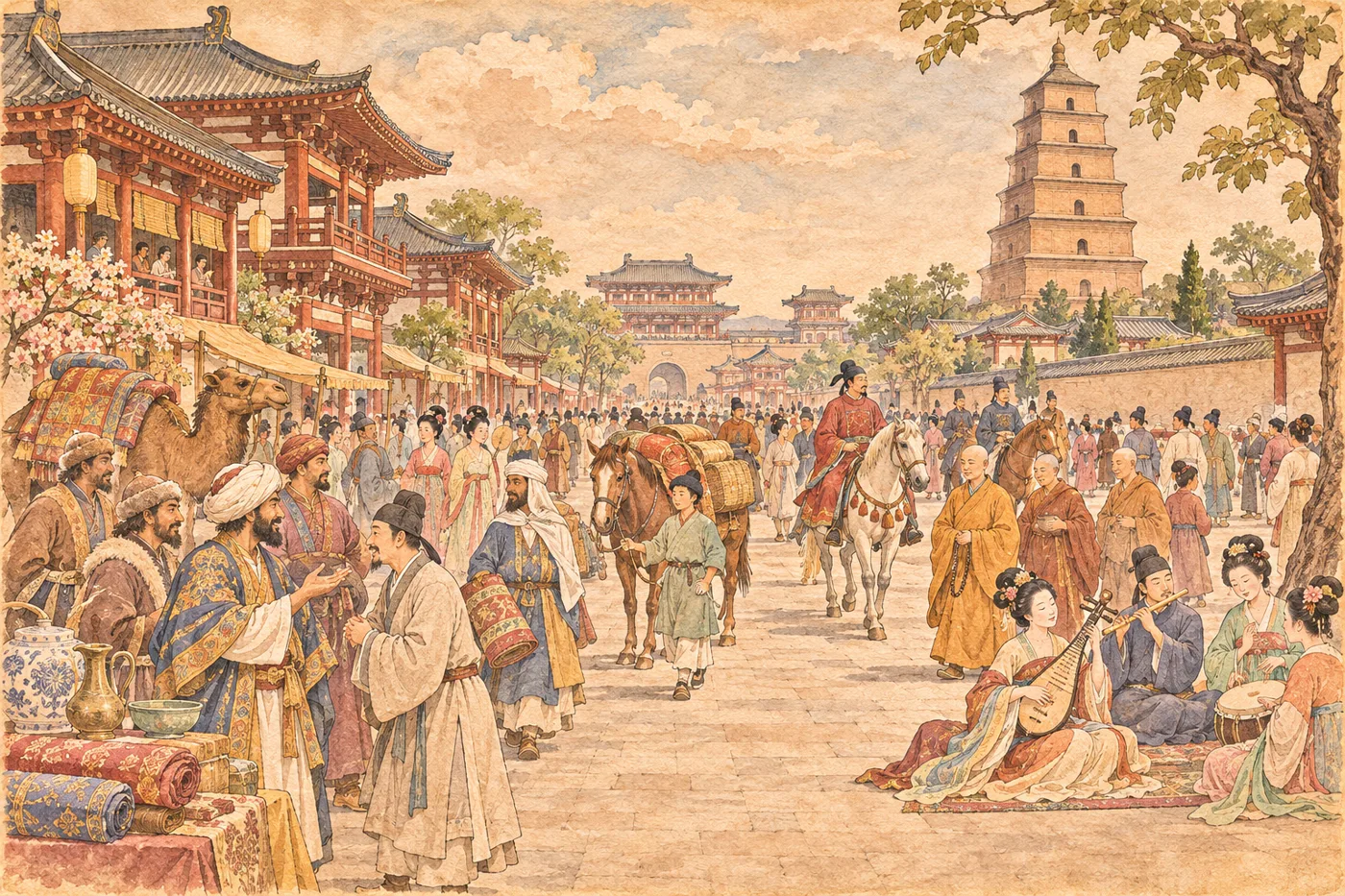
Why did people from all over the world gather in Chang’an, the Tang capital?
After the Han dynasty fell, China entered a long period of division. The Sui dynasty, founded in 581, brought order to this chaos. The Sui reunified north and south in 589, is said to have begun the system of selecting officials through examinations (the keju, or imperial examination), and also built the Grand Canal linking the Yellow River and the Yangtze. However, the people were exhausted by massive construction projects and foreign expeditions, and the Sui fell in 618.
The dynasty that followed was the Tang. Under the second emperor, Taizong, government was stable and was praised as the "Reign of Zhenguan." The Tang developed a system of laws and institutions (ritsuryō) that greatly influenced neighboring lands.
The Tang capital, Chang’an (present-day Xi’an), was a vast planned city laid out like a grid. Its population is said to have been one million (various theories exist). In the markets were merchants from Persia and Sogdiana, Turkic nomads, people from Silla on the Korean Peninsula, and also people from Japan. Not only Buddhism but also Zoroastrianism, a branch of Christianity (Nestorianism), and later Islam were introduced.
There were monks who traveled all the way to India in search of Buddhist scriptures. Xuanzang left Chang’an around 629 and returned in 645 with many sutras. The record of his journey became the *Great Tang Records on the Western Regions*, which later served as the basis for the story *Journey to the West*. Poets such as Li Bai and Du Fu also appeared during this period.
From Japan, missions to the Tang (kentōshi) were sent many times, beginning in 630. Some, like Abe no Nakamaro, even became officials in the Tang court. Also, after great hardship, the monk Jianzhen arrived in Japan in 753 to transmit Buddhist precepts. The Japanese capital of Heijō-kyō is said to have been modeled after Chang’an.
In the mid-8th century, in 751, the Tang fought against Islamic forces at the Talas River in the west. In 755, the An Lushan Rebellion, led by the generals An Lushan and Shi Siming, broke out within the country, shaking the Tang greatly. Military officers in various regions grew powerful, and revolts continued. In 907, the Tang fell, and China entered another period of division.
Mini timeline
- 589The Sui reunifies north and south
- 618The Tang dynasty is founded
- 645Xuanzang returns from India
- 755The An Lushan Rebellion occurs
- 907The Tang dynasty falls
People in this chapter
He helped his father found the Tang, later became emperor, and consolidated the state.
He made a dangerous journey to study in India and brought back a vast number of sutras to China.
Meanwhile, elsewhere
Connection to Japan
Japan was in the Asuka period through the first half of the Heian period. The Japanese missions to Tang China were re-evaluated in 894 on a proposal by Sugawara no Michizane, and after that they effectively ceased.
Why it still matters
Xi’an, where Chang’an once stood, still has its city walls and the Giant Wild Goose Pagoda from that era, and is known as a tourist destination. Quite a few on’yomi (Chinese-style readings) of Japanese kanji and schools of Buddhism were introduced during the Tang period.
Perspectives differ
- Population of Chang’an
- The figure of 'one million' is famous, but depending on how the historical sources are read, some estimates put it at several hundred thousand, so the exact number is unknown.
- Tang 'internationalism'
- It has often been emphasized that the Tang was open to the world, but in recent years it has also been pointed out that in practice foreigners were strictly controlled.
- End of the missions to the Tang
- It is often said that the missions were 'stopped' in 894, but there is also a view that plans were reconsidered and they simply died out naturally.
- Assessment of Wu Zetian
- The Tang saw the appearance of Wu Zetian, virtually the only female emperor in Chinese history (r. 690–705). Records from the time were written from a male perspective, and assessments vary among researchers.
Facts checked (6, verified by AI on the web)
- Confirmed The Sui was founded in 581 and reunified north and south in 589. It began selecting officials through examinations (a precursor to the keju) and built the Grand Canal. Britannica: Sui dynasty
- Confirmed The Tang was founded in 618 (by Li Yuan) and was destroyed by Zhu Quanzhong in 907. Britannica: Tang dynasty
The An Lushan Rebellion of 755 could not be directly confirmed in this search (unverified). - Confirmed Xuanzang left Chang’an in 629 and returned in 645. Britannica: Xuanzang
Britannica says he brought back 657 scriptures. - Confirmed Jianzhen arrived in Japan in 753 (succeeding on his sixth attempt). Britannica: Ganjin
Some sources give the year as 754. - Confirmed Chang’an’s population is said to have been one million. World History Encyclopedia: Chang'an
Some records give about one million within the city and about three million including the suburbs. - Unverified Emperor Taizong (Li Shimin) was born in 598 or 599. World History Encyclopedia(事典): Emperor Taizong of Tang
WHE text only states born 598, with no mention of the 599 theory. Britannica returns 403 (text unread). No basis found for listing both theories.
Sources
Britannica: Sui dynasty
Britannica: Tang dynasty
Britannica: Xuanzang
Britannica: Ganjin
World History Encyclopedia: Chang'an
(no direct source confirmed)
* AI-drafted and cross-checked; human review is in progress. Status: