The Imperial Examinations — A 1,300-Year Experiment in Selecting Officials by Test
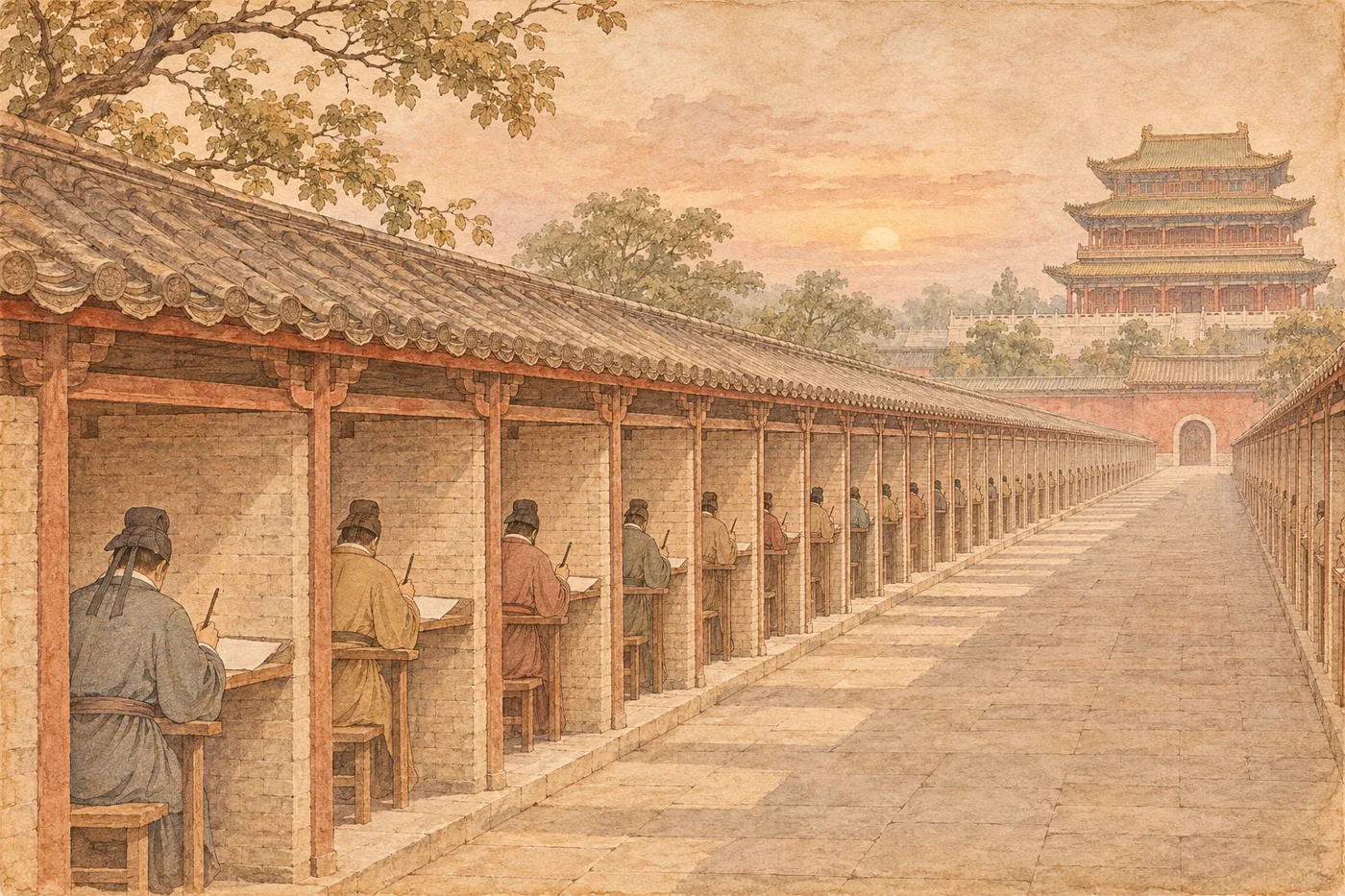
Why did China maintain a system of selecting officials by exam results for over a thousand years?
The imperial examination system (keju) was a mechanism for selecting officials based on exam results. It is explained that from the Sui dynasty (581–618), there was a path to become a government official through written exams. Before that, family status and recommendations held great power. With exams, a path might open depending on one's studies. This idea deeply shaped China's politics and society for over a thousand years.
In the Tang dynasty, exams were held every year, and it is explained that there were at most about 2,000 examinees. It was still just one path to becoming an official. The turning point came in the Song (960–1279). To moderate the power of the military, the court sought to bring in men of learning as bureaucrats. From 973, it is said that the emperor himself oversaw the final exam.
Attention was also paid to fairness. The names on answer sheets were replaced with numbers, and it is said that officials transcribed the answers to prevent identification by handwriting. Still, the number of examinees continued to grow; from fewer than 30,000 at the beginning of the Song, it is said to have risen to about 400,000 by the end. Since the number of official posts did not increase, in some regions only one in 333 people passed, and the average age of successful candidates was a little over 30.
The core of the exams was the Confucian classics. In the Ming dynasty, the Four Books—the Analects, Mencius, Great Learning, and Doctrine of the Mean—became essential studies, and a prescribed style of writing called the eight-legged essay was also practiced. At the exam venue, each candidate entered a small cell and took the exam for about three days. They brought their own food and candles, and there was a body search at the entrance. It is said that the writer Pu Songling described them as looking like beggars or prisoners.
This system spread to neighboring countries. In Korea, the examinations were divided into literary, military, and miscellaneous categories, with the literary exam on the classics being most highly regarded. However, studying required time and money, and it is said that many successful candidates came from the upper-class yangban families. In Vietnam, the first exam is said to have been held in 1075, and the later Nguyen dynasty (1802–1945) also selected officials through exams on the classics.
The Qing abolished the imperial examinations in 1905. The focus on memorizing the classics is criticized as one reason for the lag in learning new sciences and technologies. On the other hand, there is also a view that values the idea of choosing people by exam rather than by birth. Even in the late 19th century, the highest degree, jinshi, is said to have been granted to only about 300 people in exams held once every three years. Even after abolition, a system granting imperial examination titles to graduates of new-style schools is said to have continued until the end of the Qing in 1912.
Mini timeline
- Late 6th – early 7th centuryIn the Sui dynasty, recruitment via written exams is said to have begun
- 973In the Song, the emperor begins personally overseeing the final exam
- 1075The first exam in Vietnam is said to have been held
- Ming dynasty (14th–17th century)The Four Books become central to the exams, and the eight-legged essay format is established
- 1905The Qing abolishes the imperial examinations
- 1912The Qing ends, and the system of granting imperial examination titles also ends
People in this chapter
Author of Strange Tales from a Chinese Studio, he is said to have left descriptions of what exam takers went through.
The decree abolishing the imperial examinations in 1905 is said to have been issued in his name.
Meanwhile, elsewhere
Connection to Japan
In ancient Japan, too, a system of selecting officials by exam was adopted, but it is said that family background remained a strong influence. The year 1905, when the Qing abolished the imperial examinations, corresponds to the 38th year of Meiji, the year of the Russo-Japanese War.
Why it still matters
The idea of selecting people by exam continues today in civil service exams and entrance exams in many countries around the world. In Hanoi, Vietnam, the Temple of Literature, a place for Confucian study, is said to remain.
Perspectives differ
- When and where it began
- While many explanations say it began in earnest in the Sui dynasty, there is also a view that it gradually formed as an extension of earlier recommendation-based recruitment. Here, we state 'said to have begun in the Sui.'
- How fair it was
- There were fairness measures such as hiding names, and stories of successful candidates from poor families are also told. On the other hand, it is pointed out that studying required time and money, which favored wealthy families. Evaluation differs depending on which aspect is given more weight.
- Relationship with the delay in modernization
- There is a view that the classic-centered exams delayed the study of science and technology. On the other hand, there is also a cautious opinion that the exam system alone cannot be blamed.
- Meaning of the '1905 abolition'
- The exams ended with the decree of 1905, but some say that the imperial examination titles were still granted until around 1911–12. Scholars' explanations differ on whether to treat the abolition as a single point in 1905 or as a longer process.
Facts checked (10, verified by AI on the web)
- Confirmed From the Sui dynasty, there was a path to become a government official through written exams Asia for Educators (Columbia University): Song Dynasty China, The Confucian Scholar
The text states: 'From the Sui (581-617), one could become an official after passing a series of written exams.' Explanations differ on where to place the true beginning. - Confirmed In the Song, the number of examinees increased from fewer than 30,000 to about 400,000; in some regions, the pass rate was 1 in 333; the average age was a little over 30 Asia for Educators (Columbia University): Song Dynasty China, The Confucian Scholar
Confirmed in the text. Also mentions the name replacement and answer transcription by officials. - Confirmed In the Tang, exams were yearly with up to about 2,000 examinees. From 973 in the Song, the emperor oversaw the final exam World History Encyclopedia: The Civil Service Examinations of Imperial China
Confirmed by encyclopedia entries (up to 2,000 candidates; from 973, the emperor supervised the final exam). - Confirmed In the Ming, the Four Books became essential; the eight-legged essay existed; examinees spent about three days in individual rooms; there were body searches. Pu Songling wrote 'like beggars' and 'like prisoners' World History Encyclopedia: The Civil Service Examinations of Imperial China
Confirmed by encyclopedia entries. The quote attributed to Pu Songling is also from the same article. - Confirmed The Korean examinations were divided into literary, military, and miscellaneous; the literary exam on the classics was most highly regarded; many successful candidates came from yangban families Seoul Museum of History: Exhibition Hall of Donated Collection (gwageo)
Confirmed by exhibition commentary at the Seoul Museum of History. Frequency and abolition date not mentioned. - Confirmed In Vietnam, the first exam was held in 1075, and the Nguyen dynasty (1802–1945) also selected officials through exams on the classics Middlebury College: Education in Vietnam, History of Education
The date 1075 is confirmed by a Middlebury webpage; the Nguyen dynasty exams are confirmed by Columbia University's Asia for Educators Vietnam timeline (https://afe.easia.columbia.edu/timelines/vietnam_timeline.htm). The end date of Vietnam's examinations (sometimes given as 1919) is not confirmed and not stated in the text. - Unverified The Korean examinations were abolished in 1894 by the Gabo Reforms 韓国人事革新処: 대한민국 공무원의 역사(公務員制度の歴史)
Partially. The page states 'The Gabo Reform of 1894 enacted laws on official appointments (Jeongwan-guk Regulations, Election Regulations), aiming to select talent through open competitive exams,' but does not explicitly state the 'abolition' of the gwageo. Monash University page returns 403. Safer to weaken the year to 'ended around the 1894 reforms.' - Corrected & confirmed The Qing abolished the examinations in 1905, but a system granting imperial examination titles to graduates of new-style schools continued until the end of the Qing Cambridge Core: The longer abolition of the Chinese imperial examination system, 1900s-1910s
The 1905 abolition is confirmed by World History Encyclopedia. A Cambridge article states the title system introduced in 1904 granted imperial examination titles until the late Qing. The exact date of the abolition decree (sometimes given as September 2) is not confirmed, so the text does not give a day. - Confirmed In the late 19th century, about 550 jinshi were produced every three years UC San Diego (D. K. Jordan): XIXth-Century Chinese Civil Service Examinations
Confirmed from a table showing output every three years (comparing the 50 years before and after 1850). Exam candidate numbers and pass rates not on the same page. - Unverified The decree to abolish the imperial examinations was issued in the name of Emperor Guangxu / In ancient Japan, there was also an exam system, but family background remained a strong influence World History Encyclopedia(事典): The Civil Service Examinations of Imperial China
Emperor Guangxu part unverified. Encyclopedia only states 'Qing abolished the imperial exams in 1905.' UC Davis (Jia) paper states 'September 2, 1905, Empress Dowager Cixi approved the memorial ordering the abolition.' Thus the involvement of the emperor's name is complex. For Japan: LoC paper 'Heian Court Poetry as World Literature' states 'Sons of high-ranking nobles (Third Rank and above) could enter the Daigaku-ryō without exams, while lower ranks faced difficult exams,' confirming the influence of family background.
Sources
Asia for Educators (Columbia University): Song Dynasty China, The Confucian Scholar
World History Encyclopedia: The Civil Service Examinations of Imperial China
UC San Diego (D. K. Jordan): XIXth-Century Chinese Civil Service Examinations
Cambridge Core: The longer abolition of the Chinese imperial examination system, 1900s-1910s
Seoul Museum of History: Exhibition Hall of Donated Collection (gwageo)
Middlebury College: Education in Vietnam, History of Education
Univ. of California Davis(Jia): The Impact of the Abolition of China's Civil Service Exam
米国議会図書館所蔵: The Heian Court Poetry as World Literature(大学寮の記述)
* AI-drafted and cross-checked; human review is in progress. Status: