Song Dynasty Seas and a Tech Revolution — Paper Money, Gunpowder, and the Compass
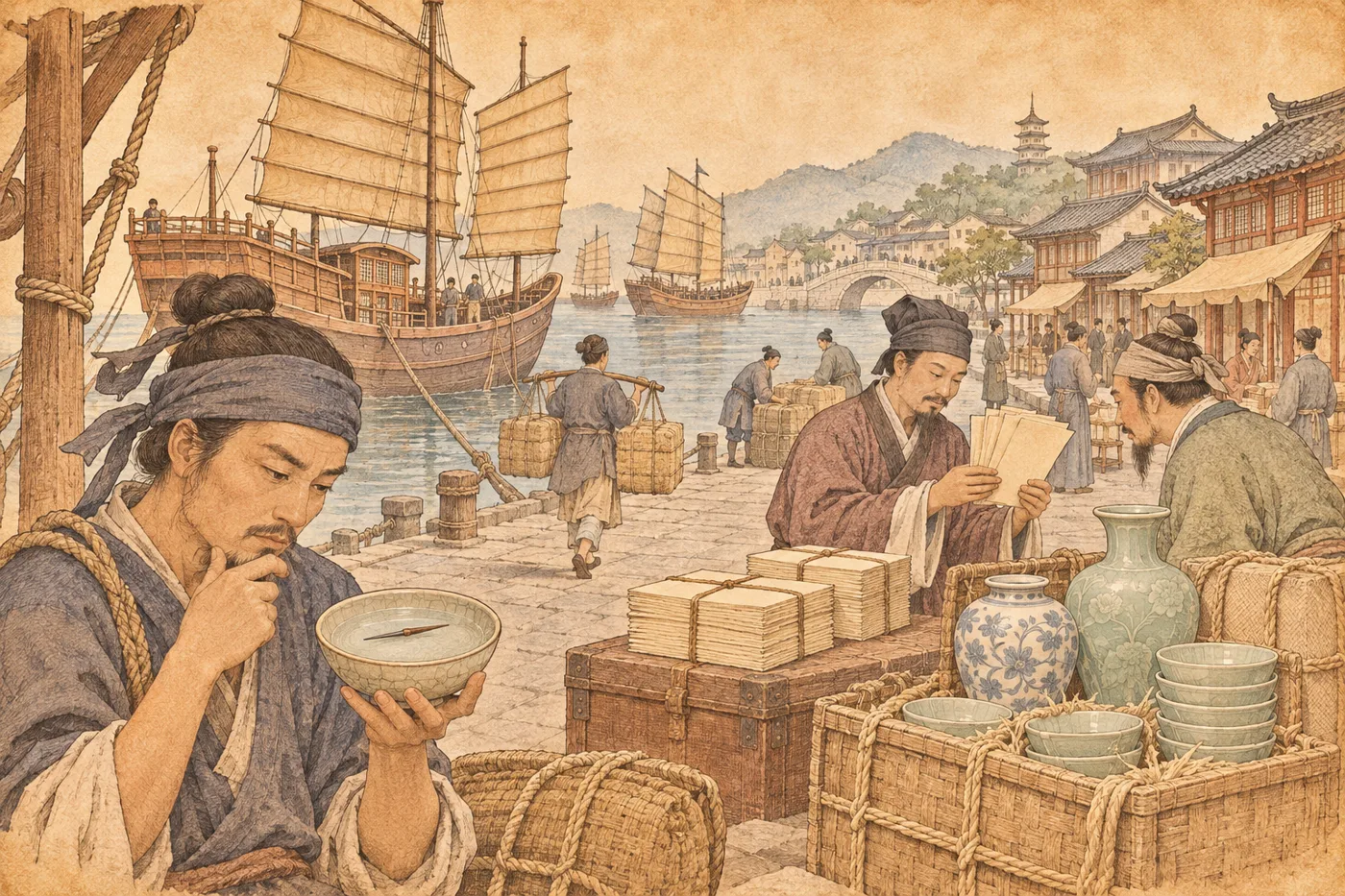
Why did world-changing inventions keep appearing one after another during the Song dynasty?
After the Tang fell, China entered a period of division called the Five Dynasties and Ten Kingdoms. The man who brought order was Zhao Kuangyin, who founded the Song in 960. The Song chose to rule not by military force but by valuing civil officials selected through exams (the keju).
To the north was the strong Liao dynasty of the Khitan. In 1004, the Treaty of Chanyuan made peace, with the Song sending annual gifts of silver and silk. Later, the Jurchen Jin grew powerful and in 1127 captured the Song capital, Kaifeng. The Song moved south to Lin'an (modern Hangzhou). From this point on, the dynasty is called the Southern Song.
Though the Song struggled militarily, its economy grew remarkably. In the southern Yangzi River region, new rice varieties spread and harvests increased. The population is thought to have grown significantly. The prosperity of the capital Kaifeng is depicted in detail in a handscroll called 'Along the River During the Qingming Festival.'
Technology also advanced greatly. In Sichuan, paper money called 'jiaozi' came into use in the 11th century, one of the world's earliest paper currencies. Military use of gunpowder, the compass for navigation, and movable-type printing also appear in records from this period. These are sometimes called the 'Three Great Inventions.'
Maritime trade flourished. Offices to manage trade (shibosi) were set up in Quanzhou and Guangzhou. Large sailing ships (junks) loaded with ceramics and silk set out for Southeast Asia and the Indian Ocean. Japan too, under Taira no Kiyomori, pushed trade with the Song, and large amounts of Song copper coins flowed into Japan.
In thought, Zhu Xi reorganized Confucianism into what became known as Neo-Confucianism. It had a major influence on later China, Korea, and Japan. However, in the 13th century, the Mongols appeared in the north and pressured the Southern Song. Lin'an surrendered in 1276, and the Southern Song fell in 1279.
Mini timeline
- 960Zhao Kuangyin founds the Song dynasty
- 1004Treaty of Chanyuan brings peace with the Liao
- 11th centuryPaper money 'jiaozi' comes into use in Sichuan
- 1127Capital falls to the Jin; Southern Song begins
- 1279Southern Song falls
People in this chapter
A military man who became emperor and created a system that valued civil officials.
He systematized Confucianism and had a major influence on later East Asian scholarship.
Meanwhile, elsewhere
Connection to Japan
Japan was in the late Heian to Kamakura periods. Taira no Kiyomori improved the port of Hyōgo (Ōwada-no-tomari) and promoted trade with the Song. Copper coins imported from the Song were widely used as currency in Japan.
Why it still matters
Hangzhou's West Lake, near the site of the Southern Song capital, was registered as a World Heritage site in 2011. Paper money, compasses, and gunpowder are still everyday things in today's world.
Perspectives differ
- Origins and transmission of the 'Three Great Inventions'
- It is widely held that gunpowder, the compass, and printing developed in China, but scholars debate the routes by which each reached Europe and how direct the influence was. The term 'Three Great Inventions' itself was popularized by Europeans.
- Song population
- Some estimates put the Song population at over 100 million in the 12th century, but contemporary statistics are incomplete, and figures vary.
- 'World's oldest paper money'
- Jiaozi is famous as an early paper currency, but whether it is the 'oldest' depends on how paper money is defined.
- Location depicted in 'Along the River During the Qingming Festival'
- The handscroll is widely thought to depict Kaifeng, but some argue for another city, while others see it as an idealized scene.
Facts checked (5, verified by AI on the web)
- Confirmed The Song was founded in 960 by Zhao Kuangyin after a coup (Northern Song 960–1127, Southern Song 1127–1279) Britannica: Song dynasty
- Confirmed The Treaty of Chanyuan was in 1004 (some sources say 1005). The Song sent annual gifts of silver and silk World History Encyclopedia: Song Dynasty
Initially 100,000 taels of silver and 200,000 bolts of silk, later increased - Confirmed Jiaozi came into use in Sichuan in the 11th century (from private deposit receipts to government issue around 1023) World History Encyclopedia: Paper Money in Song China
The date of the first government issue varies by source - Confirmed In 1127 the Jin captured Kaifeng, beginning the Southern Song. The Southern Song fell in 1279 Britannica: Jingkang Incident
- Confirmed Zhu Xi was a Confucian scholar from 1130 to 1200 Britannica: Zhu Xi
Sources
Britannica: Song dynasty
Britannica: Jingkang Incident
Britannica: Zhu Xi
World History Encyclopedia: Song Dynasty
World History Encyclopedia: Paper Money in Song China
(no direct source confirmed)
* AI-drafted and cross-checked; human review is in progress. Status: