The Mongol Yuan — A Steppe Empire That Ruled China
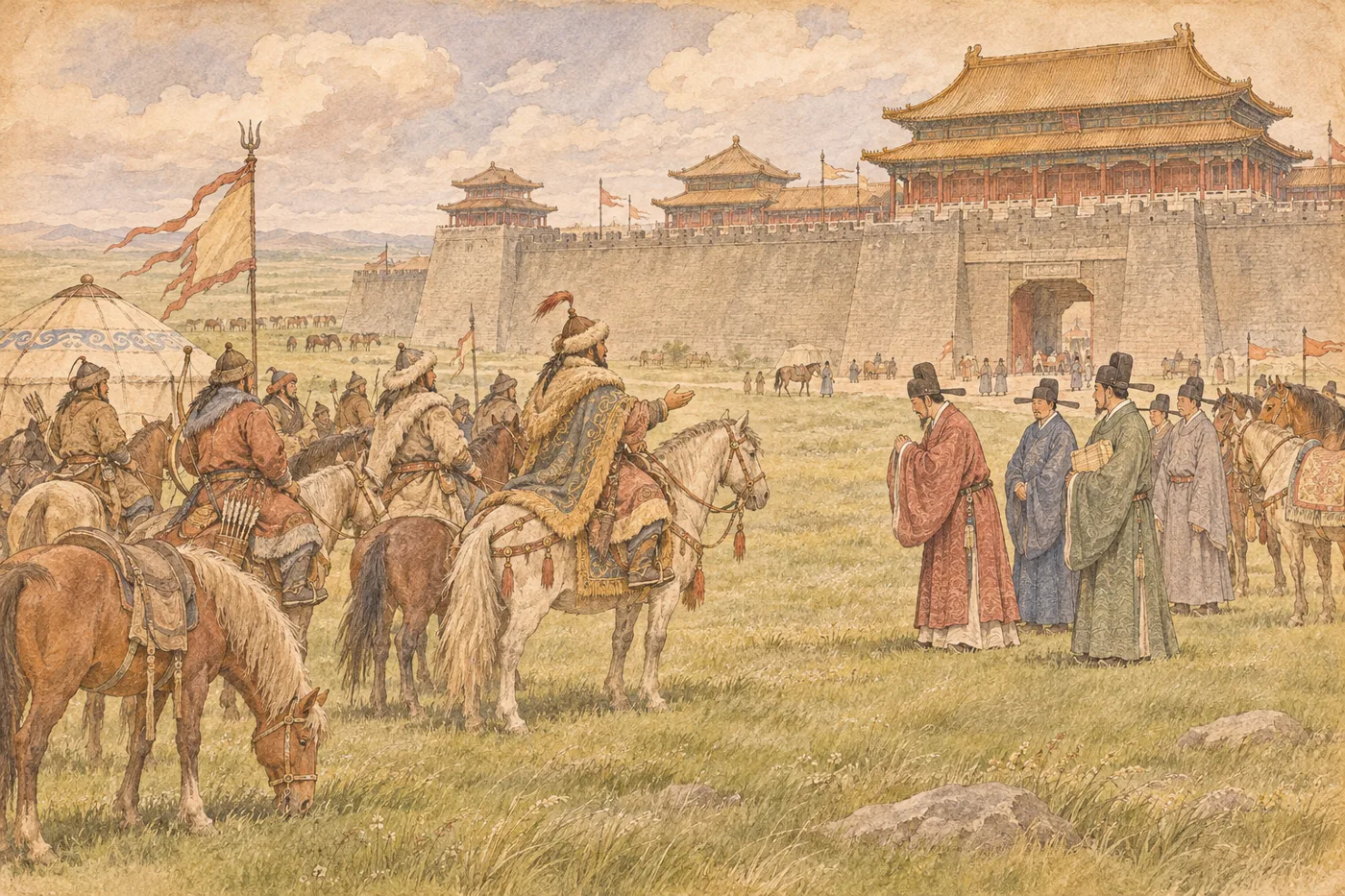
How did horse-riding people of the steppes come to move all of Eurasia?
In the early 13th century, nomadic tribes on the Mongolian Plateau were fighting each other. The man who united them was Temüjin. In 1206, at a gathering of tribal leaders (a kurultai), he is said to have received the title “Genghis Khan.” His army was organized into units of ten, a hundred, and a thousand, and with the mobility and discipline of cavalry, it successively crushed neighboring countries.
The Mongol army attacked the Jin in the east and countries in the Islamic world in the west. Genghis Khan's grandson Khubilai (Kublai) became khan in 1260 and in 1271 established the dynastic name “Great Yuan.” Then in 1276 he forced the surrender of the Southern Song capital, and in 1279 completely destroyed the Southern Song, bringing all of China under his control. The capital was Dadu (present-day Beijing).
Under Yuan rule, it is said there was a distinction among Mongols, Semu people (from the west), Han (in the north), and Southerners (Nanren, in the south). The civil service examinations were temporarily suspended and later reinstated. Meanwhile, paper money called jiaochao was widely used, and relay stations (jamchi) were set up along roads, making travel and communication between East and West easier.
In this environment, East-West exchange flourished as never before. The Italian merchant Marco Polo is recorded in The Travels of Marco Polo as having served Khubilai. Astronomy and mathematics came from the Islamic world, and a new calendar (the Shoushi calendar) was created in China. Blue-and-white porcelain (qinghua) also spread during this period.
Khubilai also sent forces to neighboring regions. Troops attacked Japan twice, in 1274 and 1281 (the Mongol invasions, known in Japan as the Bunei and Kōan campaigns). Expeditions to Vietnam and Java met with difficulties and did not succeed.
By the mid-14th century, political turmoil and natural disasters sparked rebellions in various places (the Red Turban Rebellion). From among these emerged Zhu Yuanzhang, who founded the Ming dynasty in 1368. The Yuan emperor retreated to the northern steppes. The Mongol Empire once played a role in connecting East and West across Eurasia.
Mini timeline
- 1206Temüjin receives the title of Genghis Khan
- 1271Khubilai establishes the dynastic name 'Great Yuan'
- 1274 & 1281Yuan attacks Japan (Mongol invasions)
- 1279Southern Song falls; Yuan controls all of China
- 1368Yuan retreats north; Ming dynasty founded
People in this chapter
He united the fragmented tribes and laid the foundation for ruling a vast territory in a short time.
He established the dynastic name 'Great Yuan' and placed the capital at Dadu. He also put effort into developing maritime transport and the paper money system.
Meanwhile, elsewhere
Connection to Japan
Japan was in the Kamakura period. After the two Mongol invasions, the shogunate continued to bear the burden of defense, which is said to have led to later political changes.
Why it still matters
Mongol people live in both present-day Mongolia and China’s Inner Mongolia Autonomous Region.
Perspectives differ
- Marco Polo’s travels
- Scholars are divided over whether the travel account in his Travels is factual and whether he himself went as far as China.
- Reality of the 'four classes'
- The widely known explanation of a hierarchy of Mongols, Semu, Han, and Southerners is debated among researchers as to whether it was a legally established system.
- Assessment of the 'divine wind'
- It is said that a storm drove back the Yuan forces during the Mongol invasions, but there is debate over the storm’s significance and the reasons for the Yuan withdrawal.
- How to position the Yuan
- There are differing perspectives—seeing the Yuan as one of China’s dynasties (the current Chinese historical view) or as part of the Mongol Empire (the Mongolian historical view)—and how it is described varies depending on one's standpoint.
- Damage from the conquests
- Estimates suggest that North China’s population dropped significantly due to Mongol invasions, but figures vary widely because of differences in census methods at the time.
Facts checked (6, verified by AI on the web)
- Confirmed Temüjin was elected Genghis Khan in 1206 Britannica: Mongol empire
- Confirmed Khubilai ascended in 1260, established the dynastic name Great Yuan in 1271, and destroyed the Southern Song in 1279 Britannica: Kublai Khan
His 1260 accession faced a rival khan, leading to disputes over legitimacy - Confirmed The Mongol invasions of Japan occurred in 1274 and 1281, with typhoons playing a major role Britannica: Kamikaze of 1274 and 1281
Sources differ on the typhoon date in 1281 (August 14 or 15). Issues with later supply ships and boats are also noted - Confirmed Zhu Yuanzhang founded the Ming in 1368, with Nanjing as his capital Britannica: Hongwu
- Confirmed Genghis Khan lived ca. 1162–1227; Khubilai lived 1215–1294 Britannica: Kublai Khan
Genghis Khan's birth year is approximate - Unverified Whether the 'four classes' of Mongols, Semu, Han, and Southerners was an institutionalized system World History Encyclopedia(事典): Yuan Dynasty
Unverified (controversial side). Encyclopedia describes the four social ranks as 'official status' with differences in taxes, justice, and official appointments (e.g., 25% quota for Southerners). Search summaries mention post-1990s studies questioning the four-class system, but those texts were not opened. The text's 'views differ' is maintained.
Sources
Britannica: Mongol empire
Britannica: Kublai Khan
Britannica: Kamikaze of 1274 and 1281
Britannica: Hongwu
(no direct source confirmed)
* AI-drafted and cross-checked; human review is in progress. Status: