The Ming and Qing Dynasties and the World of Tribute — An Empire That Closed and Opened the Seas
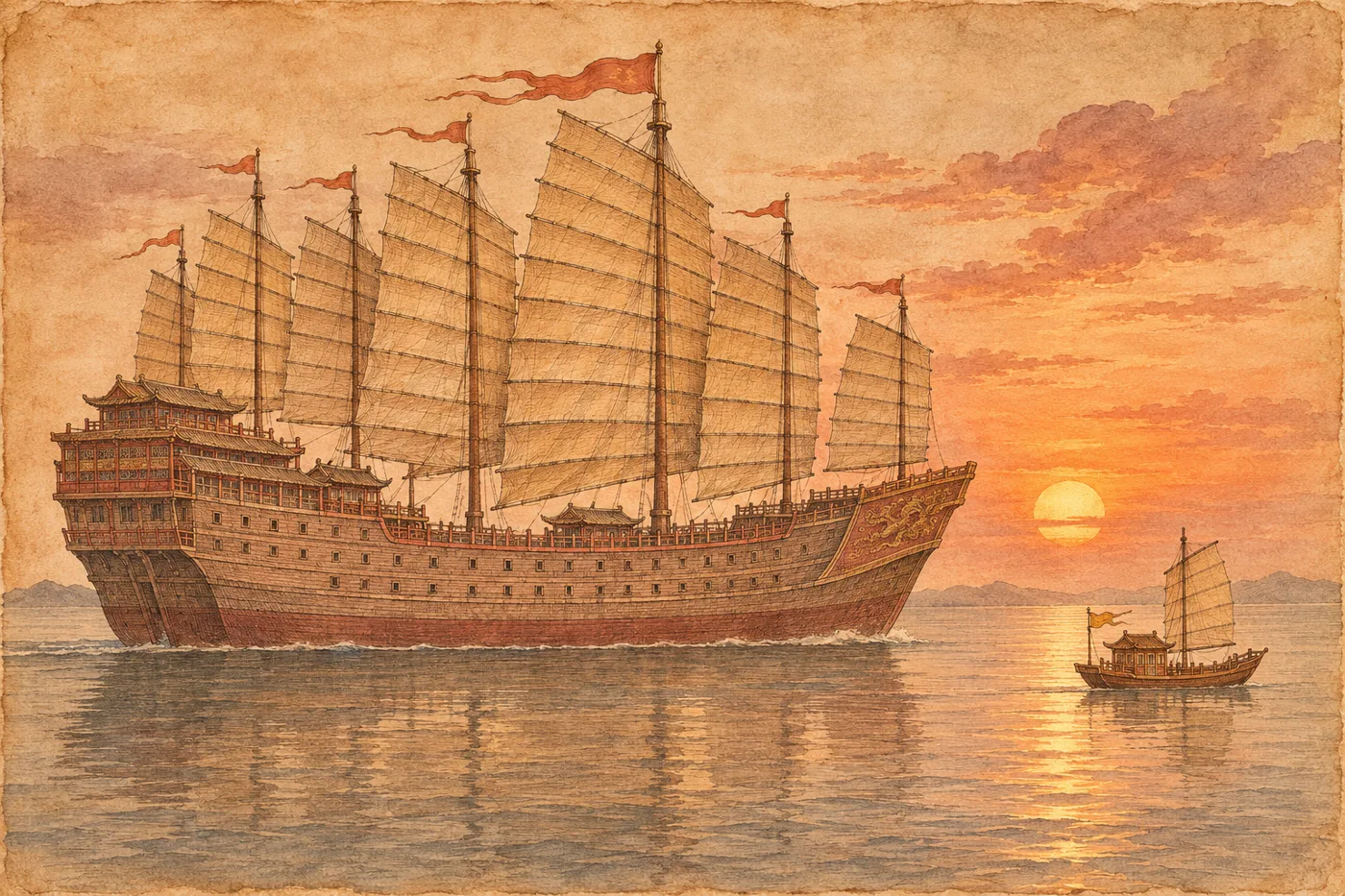
Why did the world's greatest power go out to sea, and then close it off?
In 1368, Zhu Yuanzhang (the Hongwu Emperor) founded the Ming dynasty at Nanjing. He concentrated all power in the emperor and abolished the post of prime minister. With neighboring countries, he established a system known as 'tribute'—envoys brought gifts to the emperor, who gave back even more valuable items. This system integrated diplomacy and trade.
The third emperor, the Yongle Emperor, sent Zheng He's fleet to Southeast Asia, the Indian Ocean, and the east coast of Africa multiple times, starting in 1405. In 1421, he moved the capital to Beijing and built the Forbidden City. Zheng He's voyages took place seven times, until 1433. The size of the fleet is debated, but it is thought to have been extraordinarily large for its time.
After that, the Ming stopped its seafaring policy and strengthened the 'sea ban,' restricting private overseas trade. Even so, maritime trade never ceased. In the 16th century, large amounts of silver from Japan and the Americas flowed into China. Silver was also used to pay taxes, greatly transforming the Ming economy and society.
In the first half of the 17th century, the Ming weakened due to crop failures and rebellions, and in 1644 a peasant rebel army captured Beijing, bringing the dynasty to an end. Taking advantage of this, the Qing, which had risen in Manchuria to the northeast, entered Beijing and took control of China. The Qing is also known for its strong policies, such as requiring Han Chinese to adopt Manchu customs (the queue hairstyle).
The Qing reached its peak under three emperors: Kangxi, Yongzheng, and Qianlong. It brought Taiwan, Mongolia, Tibet, and Xinjiang under its control, becoming a multi-ethnic state with vast territories. The population is said to have reached about 300 million by the end of the 18th century, aided by the spread of new crops like sweet potatoes and maize.
From 1757, trade with European ships was restricted to just one port, Guangzhou. Seeking tea, silk, and porcelain, merchants from Britain and other countries visited, and silver flowed into China. In 1793, a British envoy, George Macartney, met the Qianlong Emperor to seek expanded trade, but his request was denied. This misunderstanding would lead to conflict later.
Mini timeline
- 1368Zhu Yuanzhang founds the Ming dynasty
- 1405Zheng He's fleet sets sail for the first time
- 1644The Ming falls; the Qing enters Beijing
- 1757Trade with European ships restricted to the single port of Guangzhou
- 1793British Macartney mission meets the Qianlong Emperor
People in this chapter
Led fleets on imperial orders, voyaging from Southeast Asia to the east coast of Africa.
Oversaw the Qing at its zenith, but by the end of his reign, challenges were emerging at home and abroad.
Meanwhile, elsewhere
Connection to Japan
In Japan, this period spans from the Muromachi and Sengoku eras through the Edo period. Ashikaga Yoshimitsu began trade with Ming China (tally trade) in the early 15th century. When Toyotomi Hideyoshi invaded Korea in 1592, Ming China sent reinforcements to Korea. Even during the Edo period, trade with Qing China continued at Nagasaki.
Why it still matters
Beijing's Forbidden City is now open as the Palace Museum, a World Heritage site. The territorial extent of modern China is based on the territories of the Qing dynasty.
Perspectives differ
- Size of Zheng He's fleet
- Records claim that 'treasure ships exceeded 100 meters in length' and 'the fleet numbered hundreds of ships,' but some view these as exaggerations, and the actual size is unknown (one account gives the first voyage as about 60 ships and about 28,000 men).
- Reasons for ending the voyages
- Possible reasons include high costs and prioritizing northern defense, but nothing is certain.
- Meaning of 'tribute'
- There is a view that tribute represented a relationship of 'subordination' to the Chinese emperor, and another view that it was essentially a nearly equal form of trade and diplomacy; this also varied by country and period.
- Was the Qing a Chinese dynasty?
- There is a view that sees the Qing as a continuous Chinese dynasty, and another that sees it as an empire ruled by Manchus over multiple ethnic groups (the New Qing History), a subject of debate among scholars.
- Population estimates
- The figure of '300 million' in the 18th century is based on limited survey methods of the time, and estimates vary.
Facts checked (5, verified by AI on the web)
- Confirmed Zheng He's voyages: seven voyages from 1405 to 1433; the first is said to have had 62 ships and about 27,800 men Britannica: Zheng He
Text revision: added the size of the first voyage (about 60 ships, about 28,000 men) to the debates section. - Confirmed In 1757, foreign trade was restricted to the single port of Guangzhou Britannica: Canton system
Some Britannica entries give 1759 or 1760. - Confirmed In 1793, the Macartney mission met the Qianlong Emperor but its requests were refused Britannica: Macartney Embassy
- Corrected & confirmed The Qianlong Emperor was the '6th emperor' of the Qing Britannica: Qianlong
Britannica calls him the '4th emperor' (counting from the entry into Beijing). Text revision: specified '6th generation from Nurhaci.' - Corrected & confirmed The population exceeded 300 million in the 18th century Columbia University, Asia for Educators: Key Points 1750-1919
Columbia University sources state that the Qing population rose from about 150 million in 1650 to about 300 million by 1800 (softened 'exceeded 300 million in the 18th century' to 'reached about 300 million by the end of the 18th century').
Sources
Britannica: Zheng He
Britannica: Canton system
Britannica: Macartney Embassy
Britannica: Qianlong
高校世界史の教科書・用語集
Columbia University, Asia for Educators: Key Points 1750-1919
* AI-drafted and cross-checked; human review is in progress. Status: