The Joseon Dynasty and Hangeul — A Script Made for the People
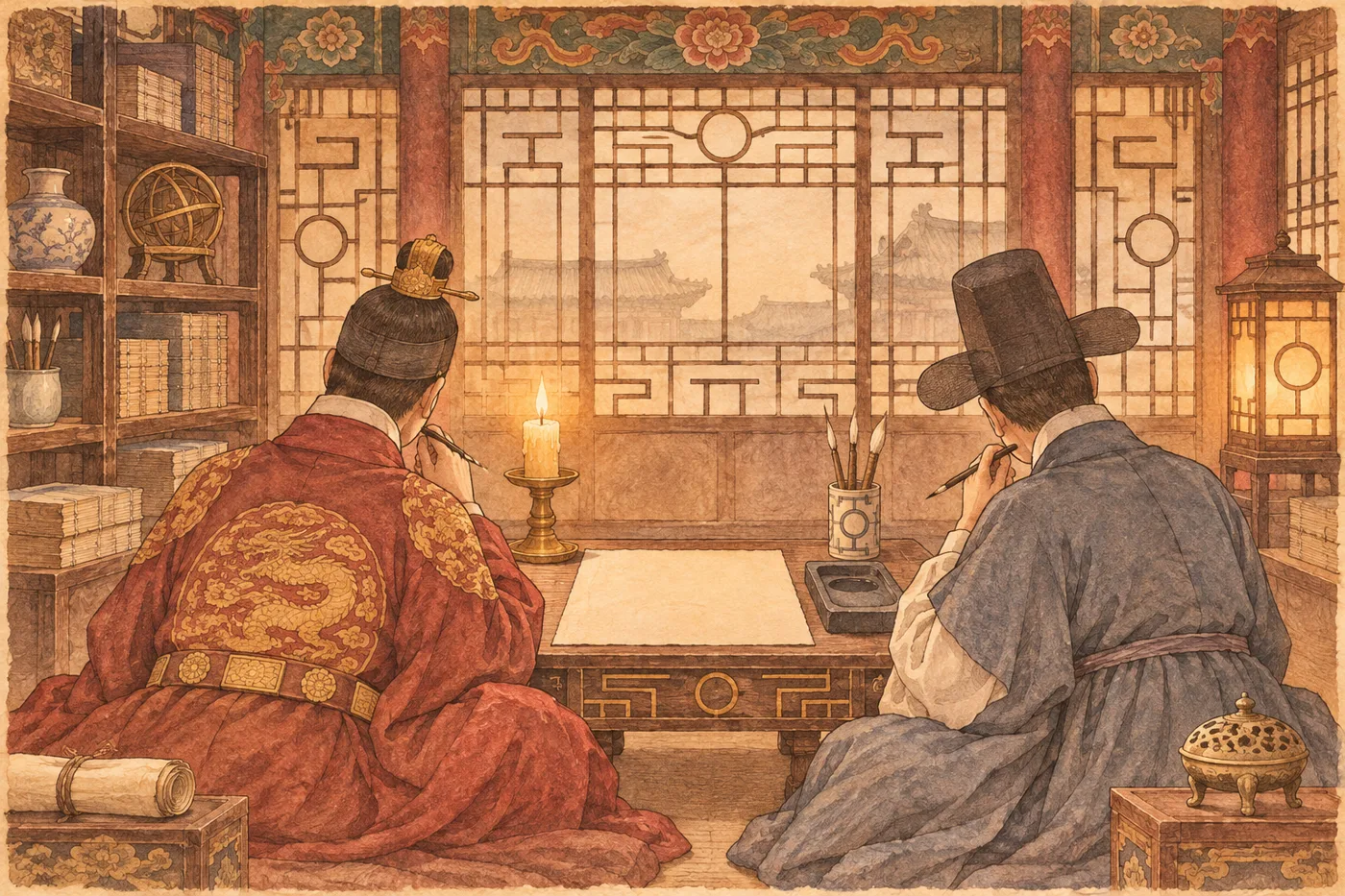
Did you know there’s a story about a king who created a new writing system for his country?
In 1392, the military general Yi Seong-gye became king, replacing Goryeo, and named the country Joseon (the exact date is given as 1392 or 1392–93, depending on the source). Later, the capital was moved to Hanyang (present-day Seoul). This dynasty made Confucianism (Neo-Confucianism) the state ideology, and lasted about 500 years—including the period after 1897, when the name was changed to the Korean Empire—until 1910. It is one of the longest-lasting dynasties in the world.
The fourth king, Sejong (r. 1418–1450), is known as a ruler who valued learning. He organized the Jiphyeonjeon (Hall of Worthies), a research institute where scholars worked on astronomy, agriculture, music, and more. Among Sejong’s achievements, the most famous is the creation of a new script.
Until then, writing in Korea was mainly done in Classical Chinese. There was also a system called idu, which used Chinese characters for their sound or meaning to write Korean, but it took a long time to learn. It is said that Sejong was troubled that “there are people who have a language but cannot write it down.” The new script was created around 1443, and in 1446 it was proclaimed as Hunminjeongeum (the Correct Sounds for the Instruction of the People).
The script is explained as having consonants shaped after the mouth and tongue when making sounds. The vowels are said to be based on shapes representing Heaven, Earth, and Man. Originally it had 28 letters; today 24 are used. By the way, the name “Hangeul” became common only in the early 20th century—it was not the name used in Sejong’s time.
The dynasty continued. In 1592 and 1597, Japanese forces invaded Korea. In Korea it is called the Imjin Waeran (Japanese Disturbance of the Imjin Year) and the Jeongyu Jaeran; in Japan it is called the Bunroku and Keicho Campaigns. With help from Ming Chinese forces, the Japanese withdrew in 1598. The war is said to have left a major impact on Korea, Japan, and Ming China.
For a long time, Hangeul was looked down on as “eonmun” (vulgar script) while official documents continued to use Classical Chinese. But it survived through letters and stories written by women and commoners. Late 19th-century reforms called for its use in official documents (though mixed scripts with Chinese characters remained common), and in the 20th century it spread along with the name “Hangeul.” Let’s look at the flow up to the end of the dynasty in 1910 in later chapters. Today, October 9 is Hangeul Day in South Korea.
Mini timeline
- 1392Yi Seong-gye founds the Joseon Dynasty
- c. 1443A new script is created under Sejong
- 1446The Hunminjeongeum is proclaimed
- 1592The Imjin Waeran (Bunroku Campaign) begins
- 1910The Joseon Dynasty ends
People in this chapter
Known for valuing learning and promoting the creation of a new script.
A Goryeo general who founded a new dynasty in 1392.
Meanwhile, elsewhere
Connection to Japan
Japan was in the Muromachi period. The year 1392, when the Joseon Dynasty was founded, also saw the unification of the Northern and Southern Courts. At the end of the 16th century, the two countries went to war. Later, in the Edo period, Joseon sent diplomatic missions (Tongsinsa) to Japan.
Why it still matters
In South Korea, October 9 is Hangeul Day, a national holiday. Hangeul is sometimes called one of the most rational writing systems in the world. The explanatory text Hunminjeongeum, published in 1446, is registered in UNESCO’s Memory of the World Register.
Perspectives differ
- Was the script created by Sejong alone?
- The common view is that Sejong took the lead. However, there is also a theory that scholars at the Jiphyeonjeon were heavily involved, and the extent of their roles is debated.
- Origin of the letter shapes
- The Hunminjeongeum commentary says the shapes are based on the speech organs. Other theories suggest a connection to Mongolian Phags-pa script, and scholars debate this.
- Year of creation vs. year of proclamation
- The script is said to have been completed around 1443 and proclaimed in 1446. Because the date given in the Sejong Sillok (Annals of King Sejong) in the lunar calendar spans late 1443 to early 1444 when converted to the Western calendar, some sources say 1443 and others say 1444. The proclamation date is also given as September or October, depending on the source.
- Names and interpretations of the Imjin Waeran (Bunroku and Keicho Campaigns)
- In Korea it is called the Imjin Waeran and Jeongyu Jaeran; in Japan, the Bunroku and Keicho Campaigns. The names, purposes, and assessments of the war differ by country, and there is debate among scholars.
Facts checked (7, verified by AI on the web)
- Confirmed Sejong created the script around 1443 and proclaimed it as Hunminjeongeum in 1446 Korean Ministry of Culture, Sports and Tourism: Hangeul
Confirmed in text: Hangeul was created in 1443 and proclaimed by Sejong in 1446. - Unverified October 9 is Hangeul Day in South Korea (based on conversion of the lunar date September 10, 1446) VisitKorea: Public Holidays (Hangeul Day)
VisitKorea text confirms Hangul Day is October 9, commemorating the proclamation of Hunminjeongeum in 1446. The basis for converting to September 10 in the lunar calendar is not on the page and unverified in accessible official sources. - Confirmed Hunminjeongeum (the explanatory text) was registered in UNESCO's Memory of the World in 1997 UNESCO Memory of the World: Hunminjeongum Manuscript
Page text confirms registration year 1997, publication year 1446, and it is the Haerye Edition. - Views differ Yi Seong-gye ascended the throne in 1392, the name Joseon was adopted in 1393, and the capital moved to Hanyang in 1394 Britannica: Joseon dynasty
Ascension in 1392 matches Britannica and WHE. For the adoption of the name Joseon, WHE gives 1392, other sources give 1393; the year differs. The text has been revised from stating '1393' to '1392–93 depending on the source.' The capital of Hanyang (present-day Seoul) was established in 1394 (Britannica: Seoul). The dynasty ended in 1910. - Confirmed The Imjin Waeran (Bunroku and Keicho campaigns) consisted of two invasions in 1592 and 1597, with Japanese withdrawal in 1598 and Ming assistance World History Encyclopedia: The Japanese Invasion of Korea, 1592-8 CE
First invasion 1592–93, second 1597–98. Ming sent aid, and after Hideyoshi’s death in September 1598, a ceasefire and withdrawal followed (WHE). - Confirmed Consonants are shaped after speech organs, originally 28 letters, now 24 National Folk Museum of Korea: The Korean alphabet, Hangeul
According to the National Folk Museum of Korea, consonants are shaped after the speech organs (mouth, tongue, throat, palate), vowels represent Heaven, Earth, and Man, there were originally 28 letters (17 consonants, 11 vowels), and now 24 (14 consonants, 10 vowels). - Corrected & confirmed An 1894 reform called for using the national script (Hangeul) in official documents Library of Congress Authorities: Korean language (Hangul in official documents)
An 1894 reform stated that Hangeul should be used in official documents, but in practice mixed-script writing with Chinese characters remained common. The text has been corrected accordingly.
Sources
Korean Ministry of Culture, Sports and Tourism: Hangeul
Britannica: Joseon dynasty
World History Encyclopedia: The Japanese Invasion of Korea, 1592-8 CE
National Folk Museum of Korea: The Korean alphabet, Hangeul
Library of Congress Authorities: Korean language (Hangul in official documents)
* AI-drafted and cross-checked; human review is in progress. Status: