The Ryukyu Kingdom — A Bridge Across Asia at the Maritime Crossroads
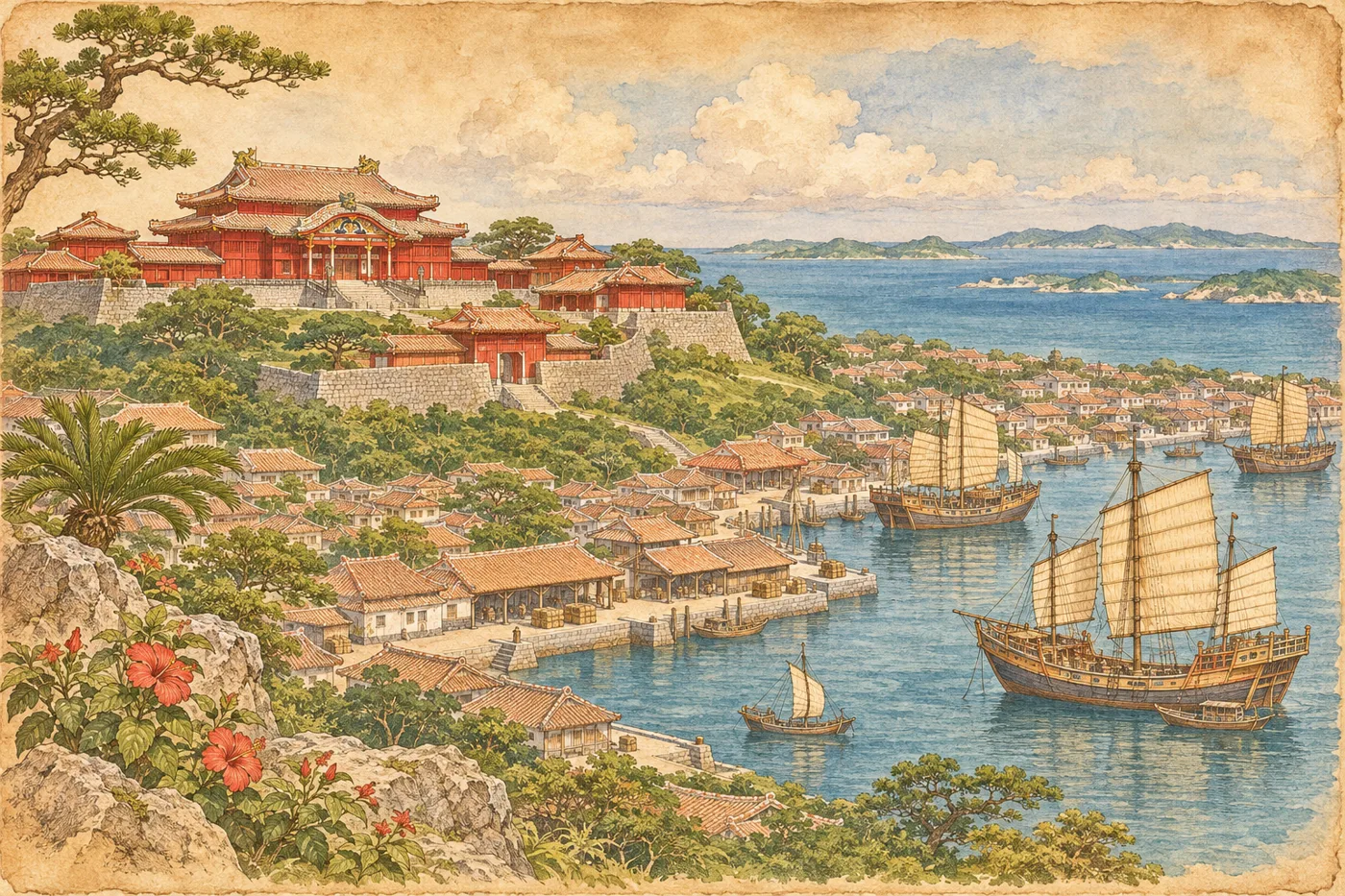
How did a small island kingdom come to be known in ports across Asia?
On Okinawa Island, around the 14th century, three powers—Hokuzan, Chuzan, and Nanzan—are said to have coexisted. In 1372, it is recorded that the king of Chuzan sent an envoy to Ming China, and the other two powers soon followed. Maritime exchange began to spread in earnest from this point.
In 1429, Sho Hashi of Chuzan unified the three mountains (sanzan) and laid the foundation of the Ryukyu Kingdom. The capital was Shuri, and the port was Naha. Some count Sho Hashi's father, Sho Shisho, as the first king. The kingdom received investiture from the Ming emperor, a formal recognition of its king, and expanded trade under that relationship.
Ryukyuan ships connected ports in China, Japan, Korea, and Southeast Asia. Chinese silk and ceramics, Japanese swords and fans, and Southeast Asian spices and sappanwood are said to have passed through Naha Port. Ryukyu itself had products like sulfur and horses, but its real strength lay in acting as an intermediary that linked goods.
A bell cast in 1458 bears an inscription that speaks of the kingdom's pride in its maritime role. It is known as the "Bridge of Ten Thousand Nations Bell," and the phrase "bridge of ten thousand nations" vividly conveys the kingdom's sea-facing character. The actual bell is still preserved at the Okinawa Prefectural Museum & Art Museum.
In the second half of the 15th century, the royal line changed, and under the later King Sho Shin, the kingdom's institutions were put in order. In the 16th century, the arrival of European ships and the movements of Chinese merchants gradually reshaped trade. In 1609, the Shimazu clan of Satsuma invaded Ryukyu. The kingdom survived, but now found itself in a difficult position, under Satsuma's influence while still maintaining relations with China.
In the 19th century, Japan moved toward becoming a modern state, establishing the Ryukyu Domain in 1872 and Okinawa Prefecture in 1879. This is known as the 'Ryukyu Disposition.' Thus the kingdom, which had lasted about 450 years, came to an end. Ryukyuan language, music, dance, and dyeing techniques are still passed down in Okinawa today.
Mini timeline
- 1372Chuzan is said to have begun paying tribute to Ming China
- 1429Sho Hashi unifies the three mountains
- 1458The Bridge of Ten Thousand Nations Bell is cast
- 1609The Shimazu clan of Satsuma invades Ryukyu
- 1879Okinawa Prefecture is established; the kingdom ends
People in this chapter
He is said to have brought the three mountains together and laid the foundation of the kingdom.
His long reign is considered a period when the kingdom's institutions were established and the country enjoyed stability.
Meanwhile, elsewhere
Connection to Japan
The Ryukyu Kingdom was founded during Japan's Muromachi period. The Satsuma invasion of 1609 came just after the Edo shogunate was established. 1879 corresponds to the 12th year of the Meiji era.
Why it still matters
Shuri Castle's main hall and other structures burned down in a 2019 fire, and reconstruction has been underway; the main hall is reported to be scheduled to open to the public in November 2026. Ryukyuan history and culture still live on in Okinawa today.
Perspectives differ
- The date of the unification of the three mountains
- 1429 is generally taken as the year of unification, but the process of unification and the precise chronology around it vary depending on the source.
- Whether investiture and tribute meant subordination
- There are differing views: one sees the relationship with the Chinese emperor as one of substantive hierarchy, while another argues it was a formal framework used for trade and diplomacy.
- Ryukyu's status after the Satsuma invasion
- There is debate over how to evaluate the kingdom's position—including the term 'dual subordination'—as it was under Satsuma's control in some respects while remaining a distinct kingdom that maintained relations with China in others.
- Interpretation of the 1879 'Ryukyu Disposition'
- Some view it as an integration accompanying the formation of a modern state, while others see it as an 'annexation' that unilaterally abolished the kingdom. The name itself remains a subject of debate.
Facts checked (7, verified by AI on the web)
- Corrected & confirmed Around 1429, Sho Hashi unified the three mountains Naha City Historical Museum: Dynasty culture and city history
The Naha City Museum's timeline says Sho Hashi defeated the king of Nanzan in 1429 and unified the three mountains. The unification process differs by source (some say Hokuzan fell in 1416 and Nanzan in 1429). Sho Hashi is not the 'first king'; his father Sho Shisho preceded him on the throne, so the main text has been adjusted accordingly. - Confirmed In 1372, Chuzan began paying tribute to Ming China Naha City Historical Museum: Dynasty culture and city history
Naha City Museum: In 1372, a Ming envoy arrived and King Satto accepted the tribute relationship, beginning Ryukyu-China relations. - Confirmed In 1458, during the reign of King Sho Taikyu, the Bridge of Ten Thousand Nations Bell was cast (extant, held by the Prefectural Museum) Naha City Historical Museum: Dynasty culture and city history
Naha City Museum: In 1458, Sho Taikyu installed the bell in the main hall of Shuri Castle. It survives and is said to be held by the Okinawa Prefectural Museum & Art Museum (the source did not confirm the holding institution). It is an Important Cultural Property. - Confirmed In 1609, Satsuma invaded, and the kingdom survived UNESCO World Heritage Centre: Gusuku Sites and Related Properties of the Kingdom of Ryukyu (nomination)
After the 1609 Satsuma invasion, the kingdom continued to exist. Its nominal independence and tribute relations with China were maintained. - Confirmed The Ryukyu Domain was established in 1872, and Okinawa Prefecture in 1879 Britannica: Ryukyu Islands
The kingdom was abolished and became Okinawa Prefecture in 1879. The precise date in 1879 varies between March and April depending on the source. - Confirmed Reconstruction of Shuri Castle's main hall and its scheduled public opening in November 2026 japan-guide.com: Shuri Castle reopens November 23
It has been reported that it will open to the public on November 23. The main text has been adjusted to express this as a plan. - Confirmed Institutions were put in order during the reign of King Sho Shin UNESCO World Heritage Centre: Gusuku Sites and Related Properties of the Kingdom of Ryukyu (nomination)
Under King Sho Shin (r. 1477–1526), administrative centralization and the systematization of rites (led by the Kikoe-ōgimi) progressed, as confirmed in UNESCO's nomination documents.
Sources
Naha City Historical Museum: Dynasty culture and city history
japan-guide.com: Shuri Castle reopens November 23
UNESCO World Heritage Centre: Gusuku Sites and Related Properties of the Kingdom of Ryukyu (nomination)
Britannica: Ryukyu Islands
* AI-drafted and cross-checked; human review is in progress. Status: