The Flow of Silver — The World Connected by Japan’s Mountains and Potosí
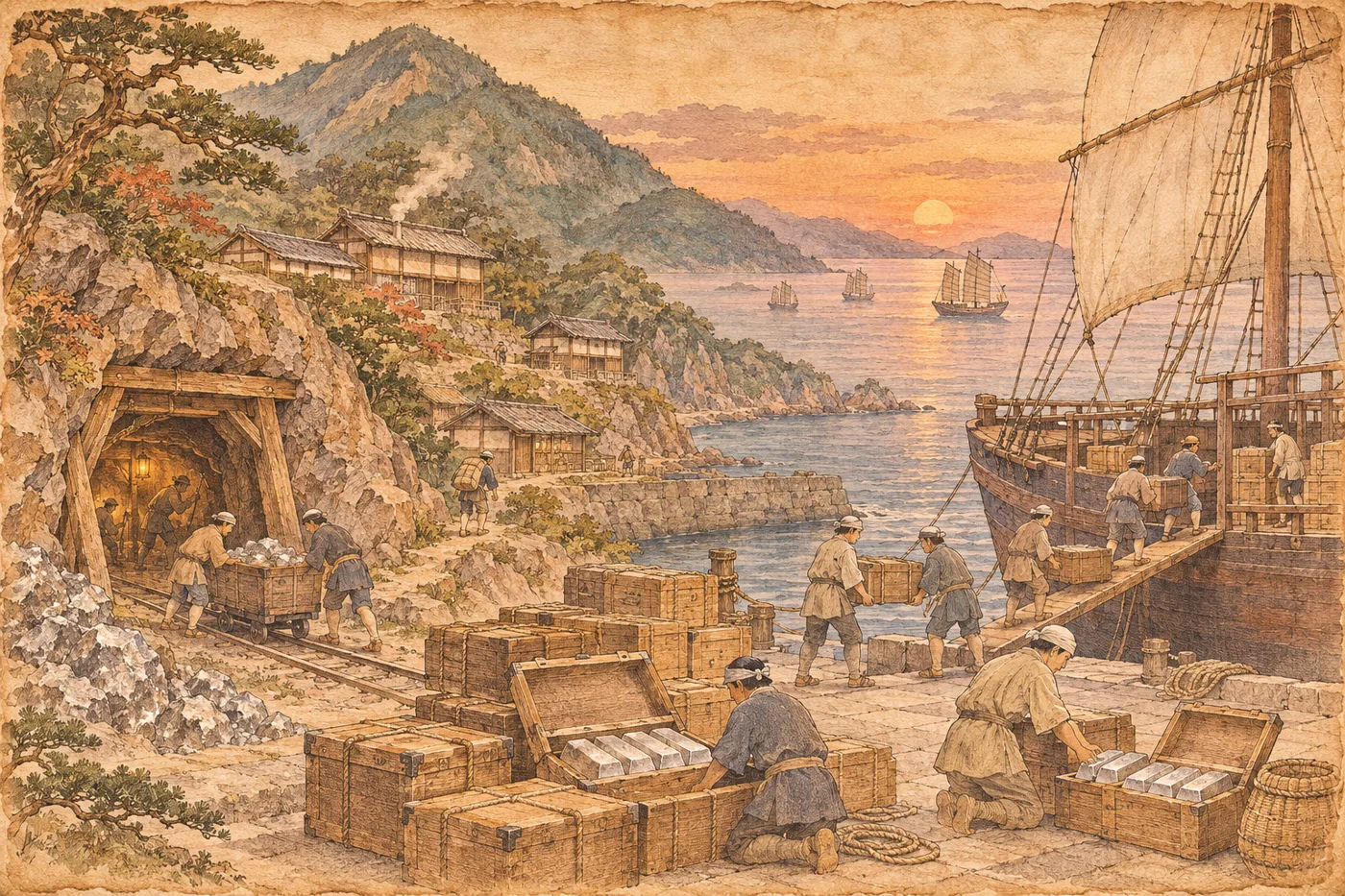
Why did the silver from Japan’s mountains and the silver from the Andes both flow toward the same country?
In the 16th century, under the Ming dynasty (1368–1644), an economy using silver as money was spreading. It is often explained that a system for paying taxes in silver (the Single Whip Law) was established. Also, large amounts of silver were needed to defend the northern border against Mongol forces. This great demand would eventually drive mining in distant lands, including Japan and the Americas.
Silver is said to have been discovered around 1527 (some accounts give 1526) at this mountain in Shimane Prefecture. According to legend, the Hakata merchant Kamiya Jutei saw the mountain shining from the sea. Using a refining technique called haifuki-hō (cupellation), high-quality silver could be produced in large quantities.
Japanese silver is said to have first been shipped directly from Japan to China. Later, Portuguese merchants based in Macau exchanged Chinese silk for Japanese silver and sold that silver to the Ming. It is even said that at least one-tenth of the silver traded in the world in the late 16th century came from the Iwami Ginzan. This was an era when a single silver mine in a Japanese mountain region drove the economy of a distant country.
On the other side of the ocean, a vast silver mountain was found at Potosí in present-day Bolivia in 1545. It is said to have been discovered by Diego de Huallpa. Around 1600, there were said to be over 600 mines, producing about 9 million pesos of silver per year. Some accounts state this was more than all other silver mines in the world combined. Under the forced labor mita system, many people undertook dangerous work.
Silver from the Americas also crossed the Pacific to Asia. In 1565, a Pacific route linking the Philippines (initially Cebu) and Acapulco was opened, and after Spain made Manila its base in 1571, the Manila Galleon trade began in earnest. Silver is said to have reached about 50 tons per year, or up to 3 million pesos on a single return voyage. In Manila, Chinese merchants linked silk and porcelain with Spanish silver, providing goods and credit to the Spanish.
Thus, the mountains of Japan, the mountains of the Andes, and the ports of the Pacific and the East China Sea were connected by the flow of silver. But the flow was not always stable. From around the end of the 16th century, the value of silver is said to have declined, and the stability of the Ming dynasty began to waver. By the end of the 1630s, the momentum of American silver is said to have faded. And we must not forget the suffering of the people who worked in the mines behind that silver.
Mini timeline
- About 1527Silver is said to have been discovered at the Iwami Ginzan
- 1545The great silver mountain at Potosí is discovered
- 1565The galleon route linking the Philippines and Acapulco begins
- 1571Spain establishes Manila as a city
- 1570s–1630sThe boom in American silver continues
- End of the 1630sThe momentum of American silver begins to wane
People in this chapter
A figure said to have discovered and developed the Iwami Silver Mine, though the story is said to have legendary aspects.
He is said to have found the silver at Potosí in 1545. The spelling of his name varies by source.
Meanwhile, elsewhere
Connection to Japan
Around 1527, when silver is said to have been discovered at the Iwami Ginzan, Japan was in the Sengoku (Warring States) period. It was also around this time that the Portuguese began arriving in Japan. Silver became a key link connecting Japan with the outside world.
Why it still matters
The Iwami Ginzan Silver Mine site is said to have been registered as a World Heritage site in 2007. Mine tunnels and the silver-mining townscape can still be seen on foot. The stories of the many people who labored in the shadows of the silver flow are also passed down.
Perspectives differ
- Japan’s share of world silver
- Some accounts state that at least one-tenth of the world’s silver in the late 16th century came from the Iwami Ginzan. Other accounts state that Japan as a whole produced about one-third, so estimates vary.
- The discovery year of Iwami Ginzan and the story of Kamiya Jutei
- Some accounts give 1526, others 1527. Also, the story of Kamiya Jutei seeing the mountain shining from the sea is said to have legendary aspects.
- How the cupellation method was transmitted
- Some accounts say it was transmitted by Korean technicians, with 1533 also mentioned. However, details of the route and date differ depending on the source.
- The relationship between the silver flow and the decline of the Ming
- Some accounts say the decrease in silver inflow was one cause of the Ming’s instability. However, other factors are thought to have been involved, and how much weight to give each varies among researchers.
- The start of mercury refining at Potosí
- Some accounts say mercury refining in South America began around 1560, while others say it was introduced by Viceroy Toledo in the 1570s. There is disagreement.
Facts checked (9, verified by AI on the web)
- Confirmed The Ming dynasty shifted to a silver-based economy and needed large amounts of silver to defend against the Mongols on the northwestern border MLIT Multilingual Database: Iwami Ginzan Silver Mine and its Cultural Landscape
Confirmed in a multilingual explanation from Japan’s Ministry of Land, Infrastructure, Transport and Tourism. A UC Santa Cruz paper also states that the Ming used silver as currency and paid wages in silver. - Unverified A system for paying taxes in silver (the Single Whip Law) was established UC Santa Cruz: Chinese Porcelain, Mexican Consumption, and the Forging of the Early Modern World Economy
UNESCO World Heritage page returns 403; no text source found for the Single Whip Method. - Confirmed Silver was discovered at Iwami Ginzan around 1527 MLIT Multilingual Database: Iwami Ginzan Silver Mine and its Cultural Landscape
The Ministry of Land, Infrastructure, Transport and Tourism explanation gives 1527. The 1526 account is only from search summaries and is unconfirmed, so the text adds ‘some accounts give 1526.’ Whether the Kamiya Jutei story is legendary is also from search summaries only and is unconfirmed. - Confirmed The cupellation method enabled mass production of high-quality silver MLIT Multilingual Database: Iwami Ginzan World Heritage Center
A page states that the cupellation method made large-scale production of high-quality silver possible. The point about it being transmitted from Korea in 1533 is not in readable sources and is unconfirmed. The text does not give a year. - Confirmed Portuguese merchants in Macau exchanged Chinese silk for Japanese silver and sold it to the Ming. At least one-tenth of the world’s silver in the late 16th century was from Iwami MLIT Multilingual Database: Iwami Ginzan Silver Mine and its Cultural Landscape
‘At least 10 percent’ and ‘silver first flowed directly from Japan to China’ are confirmed on the same page. The account that Japan produced one-third of the world’s silver is from search summaries only and is unconfirmed. - Confirmed Potosí was discovered in 1545, and around 1600 had over 600 mines producing about 9 million pesos per year World History Encyclopedia: The Silver of the Conquistadors
Confirmed in an encyclopedia (discoverer: Diego de Huallpa). The same article says mercury use began around 1560, conflicting with the 1570s account. The mita system is also mentioned in the article. - Confirmed The Manila Galleon ran from 1565, and Manila became a city in 1571. Silver amounted to about 50 tons per year, up to 3 million pesos on a single return voyage Library of Congress blog: Negotiating Empire, Part I: From Magellan to the Founding of Manila, 16th-18th Centuries
The date Manila became a city (June 24, 1571), about 50 tons of silver per year, and Chinese merchants providing goods and credit are confirmed in a Library of Congress blog. The 1565–1815 dates and the maximum 3 million pesos per voyage are confirmed in the World History Encyclopedia (Manila Galleon). Figures are estimates with ranges. - Confirmed From the end of the 16th century, the value of silver fell and the Ming’s stability wavered. The silver boom lasted from the 1570s to the 1630s, with the end of the 1630s showing a decline UC Santa Cruz: Chinese Porcelain, Mexican Consumption, and the Forging of the Early Modern World Economy
Confirmed in a paper. However, the account linking the reduced inflow in the 1630s to the fall of the Ming is from search summaries only, and the text does not assert a causal link. - Unverified The Iwami Ginzan site was registered as a World Heritage site in 2007 MLIT Multilingual Database: Iwami Ginzan Silver Mine and its Cultural Landscape
UNESCO World Heritage page returns 403; no text source found for the Single Whip Method.
Sources
MLIT Multilingual Database: Iwami Ginzan Silver Mine and its Cultural Landscape
MLIT Multilingual Database: Iwami Ginzan World Heritage Center
World History Encyclopedia: The Silver of the Conquistadors
World History Encyclopedia: Manila Galleon
Library of Congress blog: Negotiating Empire, Part I: From Magellan to the Founding of Manila, 16th-18th Centuries
UC Santa Cruz: Chinese Porcelain, Mexican Consumption, and the Forging of the Early Modern World Economy
* AI-drafted and cross-checked; human review is in progress. Status: