From the Opium War to Modernity — A Shaken Great Power, East Asia in Motion
Why did the countries of East Asia have to change so quickly?
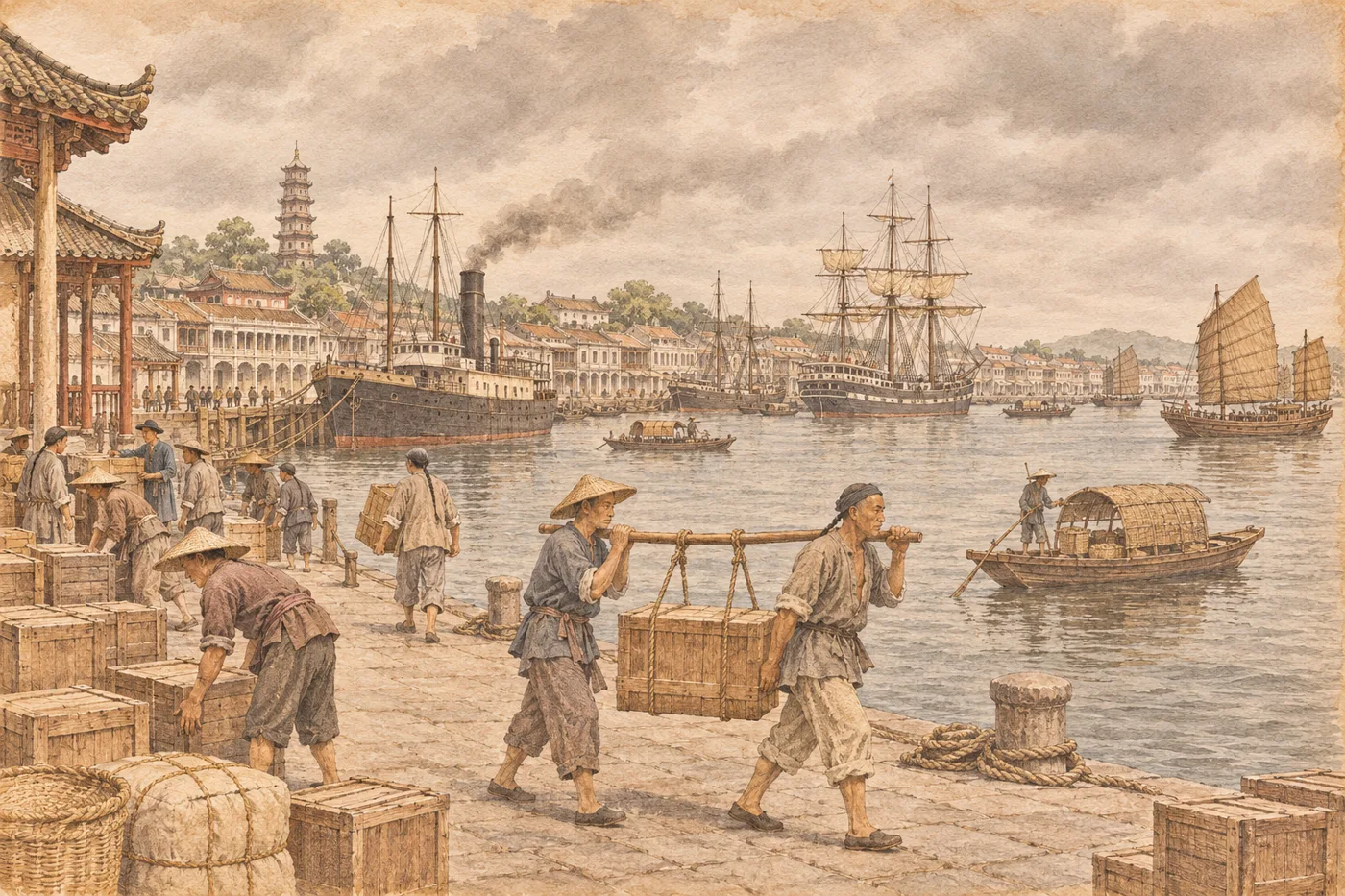
From the 18th century, the popularity of Chinese tea grew in Britain, and vast amounts of silver flowed to China to purchase it. So Britain began selling opium grown in India to China. The Qing banned this, and when Lin Zexu seized and destroyed the opium in 1839, the Opium War began in 1840.
The Qing lost and, in the Treaty of Nanjing of 1842, ceded Hong Kong Island and opened several ports. Afterwards, treaties with unequal terms regarding tariffs and legal jurisdiction were concluded. In the 1850s, the Taiping Rebellion led by Hong Xiuquan broke out, throwing the country into turmoil.
In response to external pressure and internal chaos, the Qing tried to adopt Western technology through the Self-Strengthening Movement. However, in the First Sino-Japanese War of 1894–1895, they were defeated by Japan. The Treaty of Shimonoseki ceded Taiwan to Japan, and the great powers then expanded their footholds across China.
Movements demanding reform arose repeatedly. In 1898, the Hundred Days' Reform led by Kang Youwei and others was attempted but failed quickly. In 1900, the Boxer Rebellion, which opposed foreign influence, spread, and troops of the great powers entered Beijing. In 1911, an uprising in Wuchang sparked the Xinhai Revolution, and in 1912 the Republic of China was established under Sun Yat-sen and others, while the Qing emperor abdicated.
Thereafter, China experienced a period in which military leaders controlled various regions. The Chinese Communist Party was founded in 1921, and there followed ongoing conflict and cooperation with the Nationalists. Japan instigated the Mukden Incident in 1931 and established Manchukuo, and in 1937 the Second Sino-Japanese War began. The war continued until Japan's defeat in 1945, causing great suffering for the Chinese people.
The Korean Peninsula was annexed by Japan in 1910 and remained under Japanese rule until 1945. The countries of East Asia each accumulated their own experiences of modern war and colonial rule. The memories of this period continue to influence how people in each country view history.
Mini timeline
- 1840Opium War begins
- 1894First Sino-Japanese War begins
- 1911Xinhai Revolution begins
- 1937Second Sino-Japanese War begins
- 1945Japan is defeated; war ends
People in this chapter
He was ordered to enforce the opium ban and carried out the destruction of opium. He is also known for later trying to learn about world affairs.
He led the revolutionary movement to overthrow the Qing and became the first provisional president of the Republic of China.
Meanwhile, elsewhere
Connection to Japan
In Japan, from Perry's arrival in 1853 through the end of the shogunate and the Meiji Restoration of 1868, the country moved toward the Sino-Japanese and Russo-Japanese Wars. Japan, too, was a participant in this era of East Asian history.
Why it still matters
Hong Kong was returned from Britain to China in 1997. The memories of this era still occasionally come up in discussion as differences in historical perspectives among the countries of East Asia.
Perspectives differ
- Views on the Opium War
- There is a view that focuses on the opium issue, and another that emphasizes the conflict over trade and diplomatic protocol.
- Casualties of the Taiping Rebellion
- The death toll from the Taiping Rebellion is often said to be about 20 million, with some estimates even higher; however, the statistics of the time are limited and estimates vary widely.
- How to view Manchukuo
- A common view is that it was a state effectively controlled by Japan, but the positions and assessments of those involved at the time differ by country.
- Casualties of the Second Sino-Japanese War
- Estimates of total war deaths range from several million to over 20 million. The number of victims in the Nanjing Incident also varies among researchers and countries, from tens of thousands to 300,000.
- Assessment of the Annexation of Korea
- Japan and South Korea hold differing legal opinions on whether the 1910 annexation treaty was valid or void from the outset.
Facts checked (7, verified by AI on the web)
- Confirmed Lin Zexu destroyed opium in 1839. The Treaty of Nanjing in 1842 ceded Hong Kong Island and opened five ports. Britannica: First Opium War
- Corrected & confirmed The death toll of the Taiping Rebellion (1850–1864) is said to be about 20 million. Britannica: Taiping Rebellion
Text revised: changed 'tens of millions' to 'often said to be about 20 million, with some estimates even higher' - Confirmed The Xinhai Revolution began with the Wuchang Uprising in October 1911. The Qing emperor abdicated in 1912. Britannica: The Chinese Revolution 1911-12
The Qing emperor's abdication decree was on February 12, 1912. - Unverified The Japan-Korea Annexation Treaty was signed on August 22, 1910. Japan and South Korea differ in their interpretation of the treaty's validity. Britannica: Count Terauchi Masatake
That the two countries interpret 'already null and void' in the 1965 Treaty on Basic Relations differently is unverified in readable public sources (to be checked). The text does not assert it. - Confirmed The Mukden Incident occurred in 1931; Manchukuo was established in 1932. Britannica: Mukden Incident
Puyi became emperor in 1934. - Confirmed The number of victims in the Nanjing Incident is said to range from 100,000 to over 300,000, with some views putting it at 40,000. Britannica: Nanjing Massacre
Consistent with the text's range of 'tens of thousands to 300,000'. Numbers vary depending on the range taken. - Confirmed Chinese casualties in the Second Sino-Japanese War range from several million to over 20 million. USHMM: World War II in the Pacific
USHMM estimates up to about 20 million for all of WWII. Numbers differ depending on definition.
Sources
Britannica: First Opium War
Britannica: Taiping Rebellion
Britannica: The Chinese Revolution 1911-12
Britannica: Count Terauchi Masatake
Britannica: Mukden Incident
Britannica: Nanjing Massacre
USHMM: World War II in the Pacific
(no direct source confirmed)
* AI-drafted and cross-checked; human review is in progress. Status: