The Sino-Japanese and Russo-Japanese Wars and East Asia — When Modern Borders Were Drawn
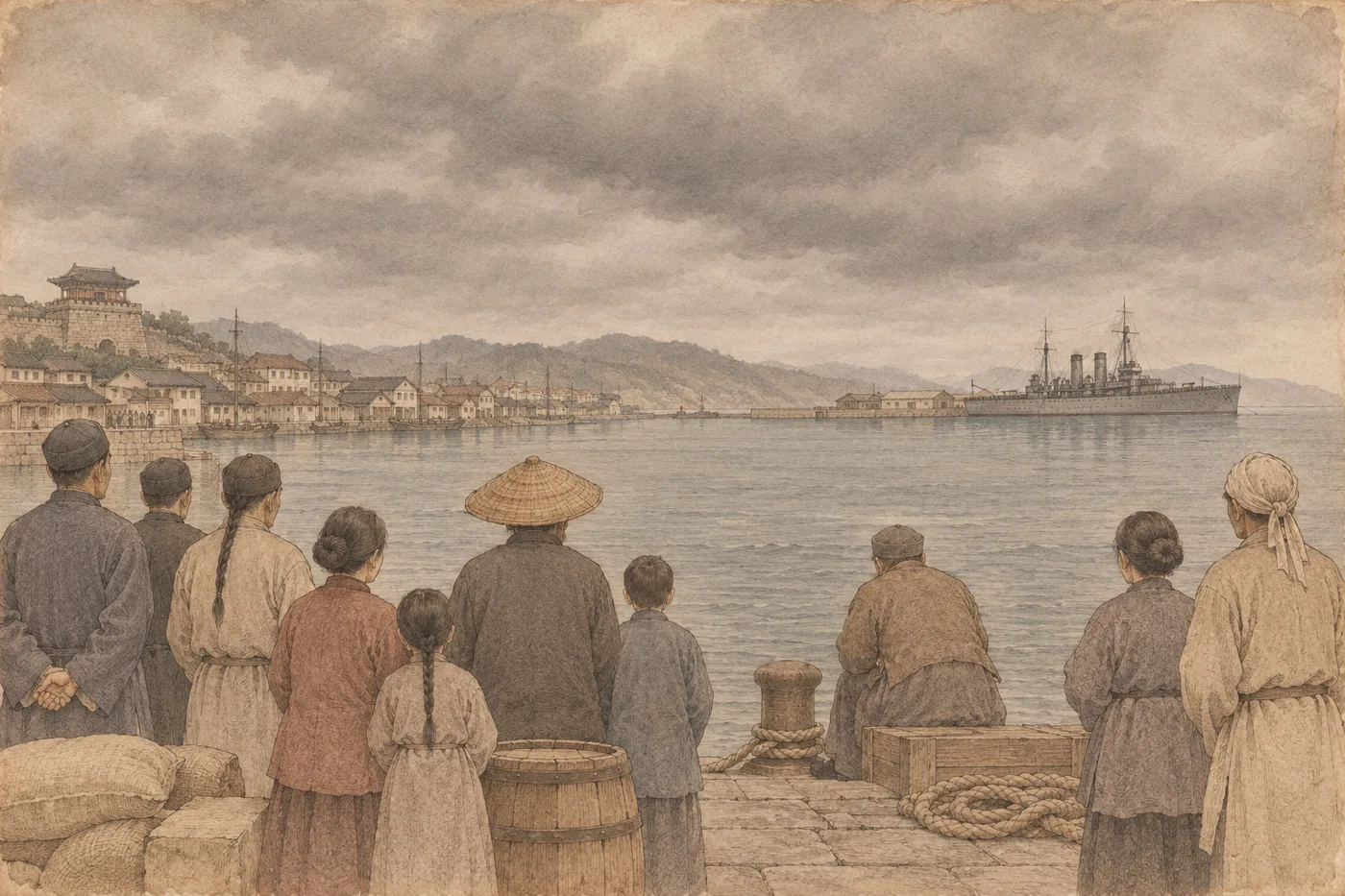
How did two wars and a series of treaties change the fate of the nations of East Asia?
In 1894, a peasant rebellion of the Donghak movement broke out on the Korean Peninsula. On June 3, the Joseon government requested military aid from Qing, and Japan also dispatched troops after notifying Qing, as provided for by the 1885 Treaty of Tientsin. However, the rebellion was quelled by the Jeonju Agreement on June 11, removing the reason for the troop dispatch. Nevertheless, Japan refused to withdraw its forces, and Qing demanded an immediate withdrawal. With both sides' arguments at odds, a standoff continued on Korean soil.
Before dawn on July 23, Japanese troops entered the royal palace in Seoul, placed King Gojong under their protection, and had a new government formed. On July 25, the naval forces of Japan and Qing clashed off Pungdo Island, and on August 1 both countries declared war. The Japanese government later set July 25 as the start of the war. For the Korean people, this was an event in which their own palace and land became a battlefield between other nations.
On April 17, 1895, the Treaty of Shimonoseki was signed. Qing recognized Korea as a 'fully independent state' and ceded the Liaodong Peninsula, Taiwan, and the Pescadores Islands to Japan. Qing strongly opposed the cession of Taiwan in particular, but Japan's Ito Hirobumi refused to yield. Six days later, Russia, Germany, and France advised the return of the Liaodong Peninsula (the Triple Intervention), and Japan returned the peninsula in November of that year in exchange for an additional indemnity from Qing. Fighting continued in Taiwan even after the treaty.
In February 1904, Japan attacked the Russian fleet at Port Arthur and declared war on the 10th. On the 12th, Qing declared neutrality and stated that it would not allow either country to seize Manchuria (Northeast China), but much of the battlefield was on that very territory. Fighting occurred at Mukden in March 1905 and in the Sea of Japan in May, and on September 5, the Treaty of Portsmouth was concluded through U.S. mediation. Japan gained predominance in Korea, Port Arthur and its railway, interests in southern Manchuria, and the southern half of Sakhalin, but received no indemnity.
During the war, the Japan–Korea Protocol was signed in February 1904 and the First Japan–Korea Agreement in August 1904. In July 1905, a record of the talks between Katsura Taro and Taft of the United States was exchanged. Under the Second Japan–Korea Agreement of November 17, Korea's foreign affairs were placed under the management of Japan's Foreign Ministry, and in February 1906 the Residency-General was established, with Ito Hirobumi becoming the first Resident-General. Because no record of the emperor's signature or ratification is found in this agreement, debate over its validity has continued ever since.
On August 22, 1910, the Japan–Korea Annexation Treaty was signed in Seoul and promulgated on the 29th. Article 1 states that the Emperor of Korea cedes his entire sovereignty over Korea to the Emperor of Japan. In Japan, there is a position that this was a treaty-based annexation; in Korea, there is a position that the treaty was concluded under duress and is not valid. This book does not state which is correct. The three countries read the same timeline with different memories.
Mini timeline
- June 1894Joseon requests troops from Qing; Japan also dispatches troops.
- August 1894Japan and Qing declare war on each other.
- April 1895Treaty of Shimonoseki concluded; Triple Intervention follows.
- February 1904Russo-Japanese War begins.
- September 1905Treaty of Portsmouth concluded.
- August 1910Japan–Korea Annexation Treaty signed.
People in this chapter
He negotiated with Japan on behalf of Qing and is said to have strongly opposed the cession of Taiwan.
He participated in the negotiations for the Treaty of Shimonoseki and became the first Resident-General in 1906. He was assassinated at Harbin Station in 1909.
Meanwhile, elsewhere
Connection to Japan
In Japan, 1894–95 corresponds to Meiji 27–28 (the First Sino-Japanese War), 1904–05 to Meiji 37–38 (the Russo-Japanese War), and 1910 to Meiji 43 (the year of the annexation of Korea). It is important to understand not only the Japanese perspective, but also those of Qing/China and Joseon/Korea.
Why it still matters
In all three countries, events from this period are still discussed in textbooks, on anniversaries, and in diplomatic settings. Researchers from Japan, China, and Korea continue efforts to study this history jointly. Reading the same events while understanding differences in perspective can be a starting point for dialogue.
Perspectives differ
- Responsibility for the outbreak of the war and when the war began
- Japan and Qing each claimed legitimacy regarding notifications of troop dispatches and withdrawals. Accounts also differ on the starting date of the war, between the battle of July 25 and the declaration of war on August 1.
- Cession of Taiwan
- Qing strongly objected to the cession of Taiwan under the Treaty of Shimonoseki. Views on the treaty's validity and Taiwan's subsequent status differ among China, Taiwan, and Japan. Which is correct is not judged here.
- Meaning of the Katsura–Taft memorandum
- The 1905 record of talks is cited as a basis for U.S. recognition of Japan's involvement in Korea, while others view it as an informal confirmation of personal opinions rather than a formal treaty.
- Validity of the 1905 agreement
- Some argue that the agreement is invalid due to the lack of an imperial signature and ratification, and because it was concluded under duress. Others maintain it was valid under international law at the time. The debate continues.
- The 1910 annexation treaty and later interpretations
- The 1965 treaty that established diplomatic relations between Japan and Korea states that treaties from before 1910 are 'already null and void.' Japan and Korea reportedly give different explanations depending on when they interpret this invalidity as having taken effect.
Facts checked (10, verified by AI on the web)
- Confirmed On June 3, 1894, Joseon requested troops from Qing; Japan decided to dispatch troops in a cabinet meeting on June 2; after the Jeonju Agreement of June 11, Japan did not withdraw; both countries declared war on August 1; the Japanese government set July 25 as the start of the war. JACAR(アジア歴史資料センター)日清戦争特集: 開戦の経緯
Confirmed in JACAR's page on the course of the war outbreak. The palace occupation on July 23 and the Battle of Pungdo on July 25 are also from the same page. - Confirmed Treaty of Shimonoseki (April 17, 1895) recognized Korean independence and ceded the Liaodong Peninsula, Taiwan, and the Pescadores. The Triple Intervention occurred on April 23. JACAR(アジア歴史資料センター)日清戦争特集: 下関条約と三国干渉
Confirmed in JACAR. The indemnity amount is not listed on that page, and the main text does not mention a figure. The date of the treaty for the return of Liaodong is given as November 18 in the text and November 8 in a caption; the text uses 'November'. - Confirmed The Russo-Japanese War began with the attack on Port Arthur on February 8, 1904, and a declaration of war on the 10th. Qing declared neutrality on February 12 and stated that Manchuria would not be seized. U.S. Office of the Historian: FRUS 1904 文書92(清の中立宣言)
Neutrality declaration confirmed in FRUS 1904. War start date confirmed in JACAR timeline. The statement that much of the battlefield was in Northeast China is noted in other academic sources (unconfirmed), but the text uses the moderate term 'much'. - Confirmed Under the Treaty of Portsmouth (September 1905), Japan gained a dominant position in Korea, Port Arthur and its railway, southern Manchuria, and the southern half of Sakhalin, but received no indemnity. U.S. Office of the Historian: The Treaty of Portsmouth and the Russo-Japanese War, 1904-1905
Confirmed in the U.S. State Department's Office of the Historian. Signing date September 5 confirmed in JACAR timeline. - Confirmed Under the Second Japan–Korea Agreement of November 17, 1905, Korea's foreign affairs were managed by Japan's Foreign Ministry, and a Resident-General was appointed. The text contains no imperial signature or ratification; the Residency-General was established in February 1906. 東京大学「世界と日本」データベース: 日韓協約(1905年11月17日)条文
Confirmed the provisions on foreign affairs management and the Resident-General in the text. The absence of signature and ratification is a textual fact; whether this constitutes a basis for invalidity is debated. Residency-General establishment date from JACAR timeline. - Confirmed The Japan–Korea Annexation Treaty was signed on August 22, 1910, and promulgated on the 29th. Article 1 provides for the complete and permanent transfer of sovereignty. 東京大学「世界と日本」データベース: 韓国併合に関する条約(1910年8月22日)条文
Confirmed in the treaty text. - Confirmed The record of the Katsura–Taft talks of 1905 was not a formal treaty but a confidential meeting record. 東京大学「世界と日本」データベース: 桂・タフト協定(会談記録)
The meeting was on July 27; the record is dated July 29, as per the same database. Taft stated that he offered a 'personal opinion'. - Corrected & confirmed There is an argument that the 1905 agreement is invalid due to duress and lack of ratification (with a pro-validity position also existing in Japan). Korea.net(韓国政府の広報サイト): Etsuro Totsuka「There is no Eulsa Treaty」(2020年・個人の論説)
Confirmed through personal essays: invalidity arguments (ILC 1963 report, lack of ratification) and the Japanese position. Academic grounds for the validity argument were not confirmed, so the text merely presents both views. - Unverified The interpretation of Article 2 of the 1965 Basic Treaty between Japan and Korea — which states that treaties from before 1910 are 'already null and void' — differs between Japan and Korea. 東京大学「世界と日本」データベース: 日韓基本関係条約(1965年6月22日)
Text confirms the phrase 'already null and void' in Article 2. No official source text discussing differing interpretations between Japan and South Korea has been opened or verified. - Unverified Current official views and textbook descriptions of the Treaty of Shimonoseki and the Russo-Japanese War on the Chinese and Korean sides. JACAR(アジア歴史資料センター)日清戦争特集: 下関条約と三国干渉
Not confirmed; no official source text has been opened.
Sources
JACAR(アジア歴史資料センター)日清戦争特集: 開戦の経緯
JACAR(アジア歴史資料センター)日清戦争特集: 下関条約と三国干渉
JACAR(アジア歴史資料センター)日露戦争年表
U.S. Office of the Historian: The Treaty of Portsmouth and the Russo-Japanese War, 1904-1905
U.S. Office of the Historian: FRUS 1904 文書92(清の中立宣言)
東京大学「世界と日本」データベース: 日韓協約(1905年11月17日)条文
東京大学「世界と日本」データベース: 韓国併合に関する条約(1910年8月22日)条文
東京大学「世界と日本」データベース: 桂・タフト協定(会談記録)
Korea.net(韓国政府の広報サイト): Etsuro Totsuka「There is no Eulsa Treaty」(2020年・個人の論説)
* AI-drafted and cross-checked; human review is in progress. Status: