The Mughal Empire – A Court Where Different Faiths Met
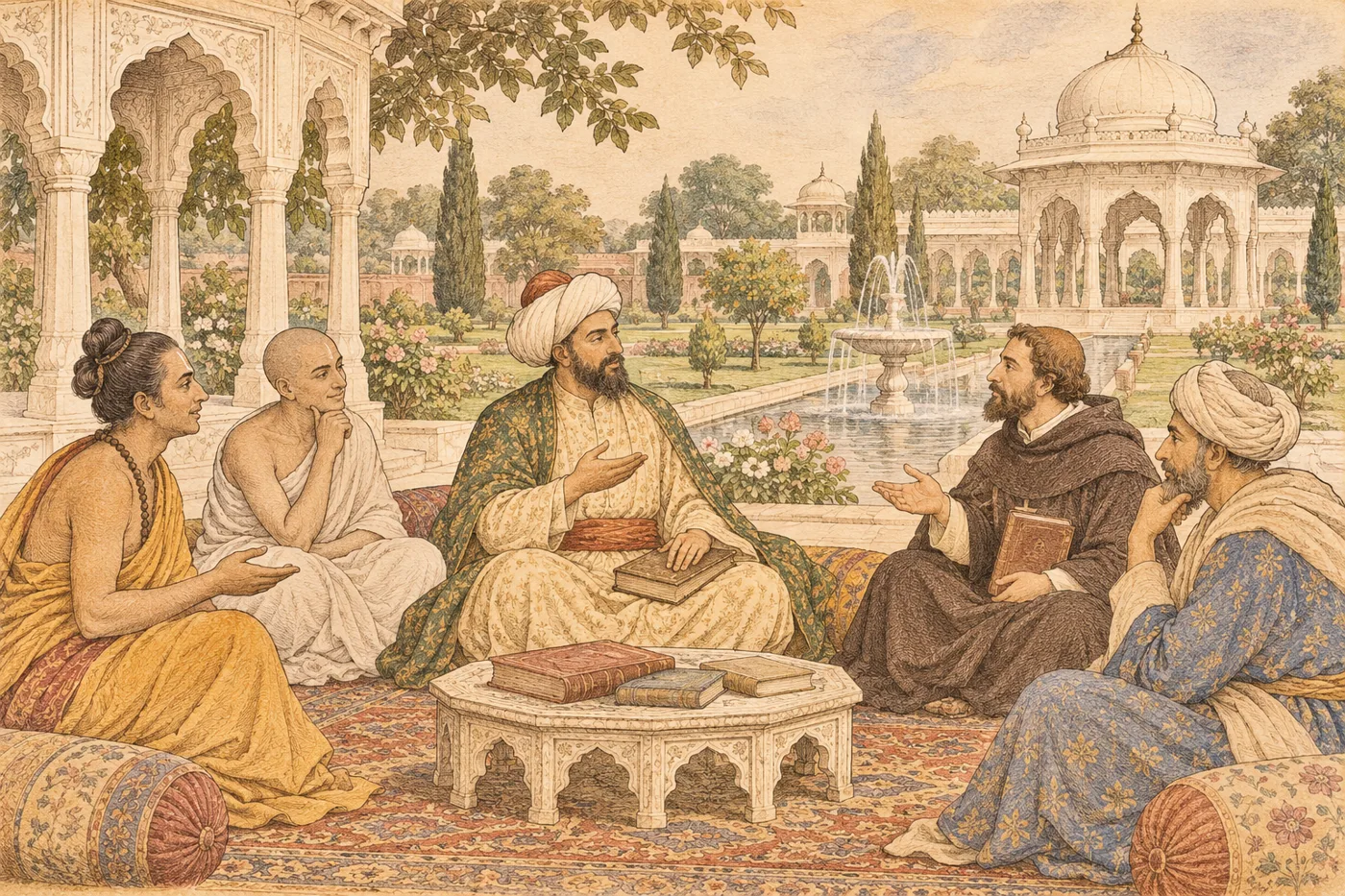
How did such a vast land of many religions stay united for nearly 200 years?
From the 8th century onward, Islamic powers gradually entered India from the northwest. In 1206, an Islamic dynasty based in Delhi (the Delhi Sultanate) began. Hindus and Muslims lived side by side, and languages, music, architecture, and food began to mix.
In 1526, at the Battle of Panipat, Babur defeated the Delhi Sultanate and founded the Mughal Empire. Babur was born in Central Asia, and is said to have been a descendant of Timur and, on his mother's side, of Genghis Khan. “Mughal” means “Mongol” in Persian. The use of muskets and cannon is said to have been one factor in his victory.
It was the third emperor, Akbar (r. 1556–1605), who greatly expanded the empire. He allied with the Hindu Rajput princes through marriage and appointed capable people regardless of religion. Between the 1560s and around 1579, he is said to have abolished taxes such as the jizya (poll tax) on non-Muslims (the exact year varies by source) and reportedly gathered scholars of different faiths for debate.
The fifth emperor, Shah Jahan (r. 1628–58), built a white marble mausoleum for his deceased wife, Mumtaz Mahal—the Taj Mahal. Construction began around 1632 and is said to have taken about 20 years. By this time, Indian cotton textiles were exported worldwide, and the empire was very wealthy.
Under the sixth emperor, Aurangzeb (r. 1658–1707), the empire reached its greatest territorial extent, expanding into southern India. However, he enforced strict Islamic rules and reinstated the jizya in 1679, provoking resistance from Hindu powers—especially the Marathas and Rajputs—as well as the Sikhs. Prolonged wars strained the treasury.
After his death in 1707, the empire rapidly lost power, and regional forces became independent. Into this chaos, European merchants arrived by sea.
Mini timeline
- 1206Delhi Sultanate begins
- 1526Battle of Panipat; Mughal Empire begins
- 1556Akbar ascends the throne
- c. 1632Construction of the Taj Mahal begins (said to have taken about 20 years)
- 1707Aurangzeb dies
People in this chapter
He appointed people across religious lines and laid the empire's foundations.
He commissioned many magnificent buildings, including the Taj Mahal.
Meanwhile, elsewhere
Connection to Japan
Japan was moving from the Warring States period into the Edo period. The height of the Mughal Empire overlapped with the start of the Tokugawa shogunate.
Why it still matters
The Taj Mahal is a UNESCO World Heritage site visited by millions every year. Hindi and Urdu, as well as Mughal-style dishes like biryani, are said to have come from the cultural mixing of this era.
Perspectives differ
- Akbar's religious policy
- Scholars are divided on whether Akbar's tolerance was driven by principle or by political calculation to win over diverse people.
- Assessment of Aurangzeb
- While he is often portrayed as a religiously intolerant emperor, recent research is reexamining this simplistic view, noting factors such as his appointment of many Hindu officials.
- Construction of the Taj Mahal
- The names of its designers are disputed, and figures like "20,000 workers" or stories of "cutting off the architects' hands" remain unverified legends.
- Reasons for the empire's decline
- Beyond attributing it to Aurangzeb's policies, multiple factors are cited—the rise of regional powers, fiscal and military problems, and the entry of European merchants—and scholars debate which to emphasize.
- Year of the jizya abolition
- The widely cited year for Akbar's abolition of the jizya is 1564, but some sources give 1579. The abolition of the pilgrimage tax is dated to the 1560s, and some view the process as gradual.
Facts checked (6, verified by AI on the web)
- Confirmed The Delhi Sultanate began in 1206 EBSCO Research Starters: Wars of the Delhi Sultanate
The Delhi Sultanate is dated 1206–1526. Aibak ascended in 1206 (some say formal recognition came in 1208–09). - Confirmed The Battle of Panipat (1526) marks the founding of the Mughal Empire EBSCO Research Starters: Battle of Pānīpat (1526)
The Battle of Panipat on April 21, 1526, is the start of the Mughal Empire. - Confirmed Akbar's reign was 1556–1605 Britannica: Mughal Dynasty timeline
- Corrected & confirmed Akbar abolished the jizya in 1564 EBSCO Research Starters: Akbar
EBSCO records jizya abolition in 1564 (pilgrimage tax abolished in 1563). Some sources give 1579; the year is debated. The main text says "between the 1560s and around 1579" and notes this in the debates. - Confirmed Aurangzeb reinstated the jizya in 1679 EBSCO Research Starters: Aurangzeb
The jizya was reinstated in 1679. - Confirmed Construction of the Taj Mahal began around 1632 and took about 20 years UNESCO: Taj Mahal
The mausoleum was completed in 1648, and the entire complex in 1653. Britannica dates the mausoleum to around 1638–39 and places the overall project at 22 years.
Sources
EBSCO Research Starters: Wars of the Delhi Sultanate
EBSCO Research Starters: Battle of Pānīpat (1526)
Britannica: Mughal Dynasty timeline
EBSCO Research Starters: Akbar
EBSCO Research Starters: Aurangzeb
UNESCO: Taj Mahal
Britannica: Taj Mahal
* AI-drafted and cross-checked; human review is in progress. Status: