The Delhi Sultanate — How Islam Took Root in Northern India
How did foreign Muslim rulers put down roots in northern India?
The Delhi Sultanate was a succession of Islamic dynasties that ruled mainly in northern India from 1206 to about 1526. It began with generals of the Ghurid dynasty from Central Asia. After the Second Battle of Tarain in 1192, Aibak took Delhi, and when his master Mu‘izz al-Din (Muhammad of Ghor) died in 1206, Aibak is said to have become an independent ruler.
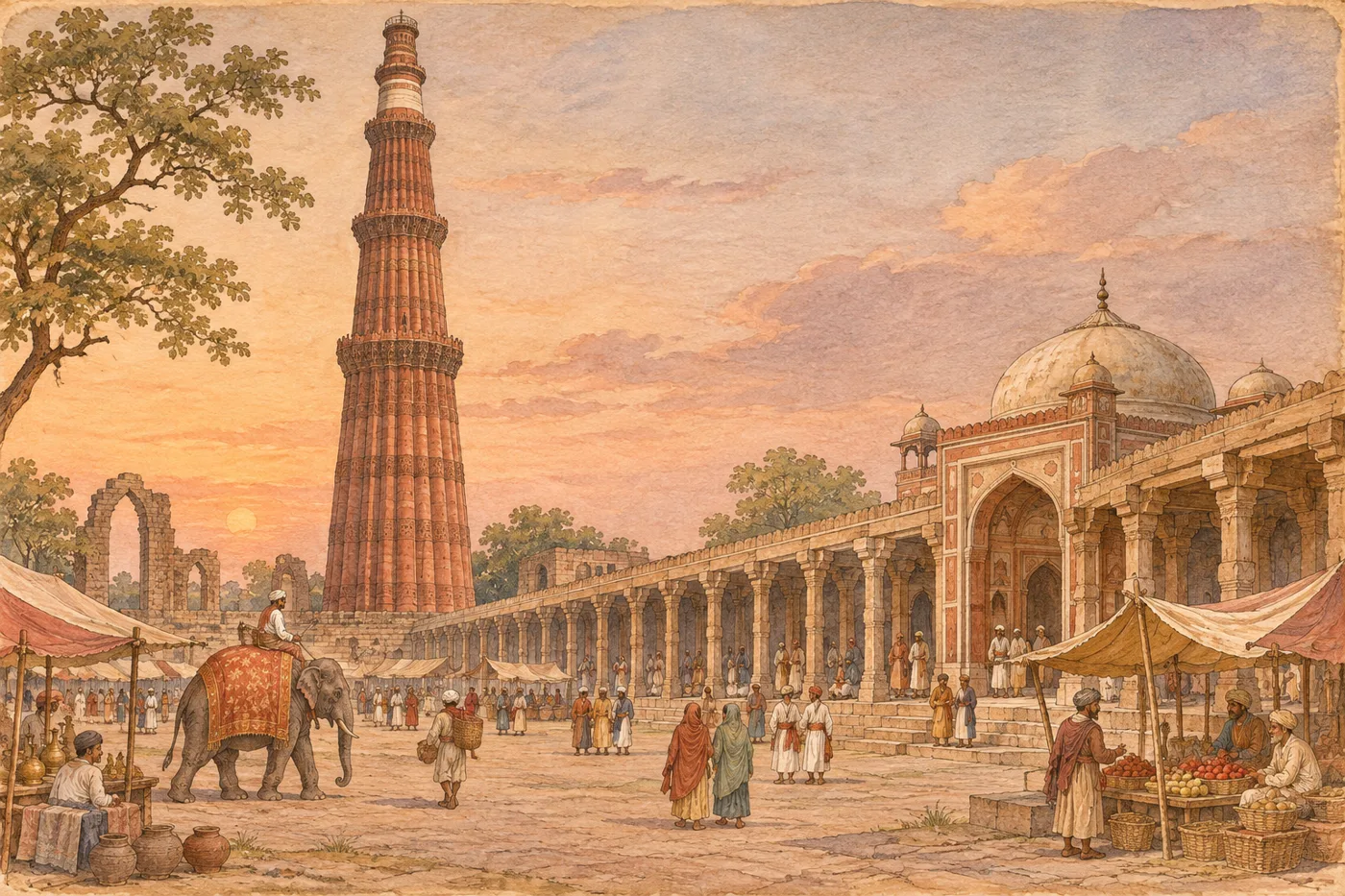
This first period lasted until about 1290 and is often called the "Slave Dynasty" (Mamluk Dynasty). South of Delhi stands the tall Qutb Minar, over 70 meters high. It is said to have been begun by Aibak, completed to four stories by his son-in-law Iltutmish, and later repaired and extended. Nearby are the remains of a mosque built under Aibak, making the complex a monument to the dynasty’s power and faith.
Iltutmish’s daughter Razia reigned from about 1236 to 1240, known as the female sultan of Delhi. Soon Mongol forces pressed in from the northwest, sacking Lahore in 1241. In 1258 Baghdad fell, dealing a blow to the heart of the Islamic world. Amid these external threats, the Delhi dynasty maintained the system it had inherited from the Ghurids.
Under the Tughluq dynasty in the 14th century, Muhammad bin Tughluq moved the capital to Daulatabad in the Deccan Plateau and later moved it back, and also reformed the currency. Both policies are said to have placed a heavy burden on the people, but historians are divided on his assessment. The next ruler, Firuz Shah, focused on building cities, schools, and irrigation works, while he is reported to have strictly imposed jizya (a poll tax) on non-Muslims, including Brahmins who had previously been exempt.
The Islamic regimes of the sultanate were not simply in conflict with Hindu populations. Ghurid coins used traditional Indian motifs. The mosque at Ajmer is said to have been built from materials taken from earlier Hindu and Jain temples, incorporating the skills of local craftsmen. However, views on the religious policies of the sultanate and its relations with Hindus vary by period and region.
In 1398, Timur from Central Asia sacked Delhi, a major blow to the sultanate. Afterward, the Sayyid and Lodi dynasties ruled Delhi. Sikandar Lodi is said to have moved the capital to Agra. In 1526, at the Battle of Panipat, the last sultan, Ibrahim Lodi, was defeated and killed by Babur’s army, ending the sultanate and ushering in the Mughal Empire.
Mini timeline
- 1192Aibak takes Delhi
- 1206After the Ghurid ruler’s death, Aibak becomes an independent ruler
- c. 1236Razia becomes sultan as a woman
- early 14th centuryMuhammad bin Tughluq moves the capital and reforms the currency
- 1398Timur sacks Delhi
- 1526The sultanate ends at the Battle of Panipat
People in this chapter
A Ghurid general who became an independent ruler after 1206 and is said to have begun construction of the Qutb Minar.
Daughter of Iltutmish, she reigned c. 1236–1240 and is known as Delhi’s only female sultan.
Meanwhile, elsewhere
Connection to Japan
In Japan, 1206 was the early Kamakura period, a few years after the death of Minamoto no Yoritomo. 1526 was the end of the Muromachi period, an age of civil war.
Why it still matters
The Qutb Minar still towers over Delhi, visited by many. Scattered across the city are walls, tombs, and mosques from this era, and their influence is thought to have passed into later North Indian architecture.
Perspectives differ
- The name "Slave Dynasty"
- It is sometimes called this based on the origins of its first kings, but there is variation in how it is described and where the dynasty’s start is placed.
- Evaluating Muhammad bin Tughluq
- Historians are divided on how to view his capital relocation and currency reform, with some seeing them as reckless and others as policies ahead of their time; there are various theories.
- Greater emphasis on conflict or coexistence
- Some accounts stress conflict and destruction of temples, while others emphasize exchange in architecture and coinage; which aspect is highlighted leads to differing assessments.
- Religious policies such as jizya
- Scholars differ on how heavy the taxation actually was and how thoroughly it was enforced, and it is noted that the perspective of the sources must be considered.
Facts checked (7, verified by AI on the web)
- Confirmed When Mu‘izz al-Din died in 1206, Aibak became an independent ruler Frances Pritchett(コロンビア大学): The early Delhi Sultanate and the "seven cities" of Delhi
Confirmed on Pritchett’s page. The same page does not explicitly state 1206 as the dynasty’s founding, and lists Aibak’s reign starting from 1192. The period 1206–1290 for the Slave Dynasty (Mamluk) is from the World History Encyclopedia. - Confirmed The Qutb Minar was begun by Aibak and completed by Iltutmish Frances Pritchett(コロンビア大学): The early Delhi Sultanate and the "seven cities" of Delhi
Listed on the same page. Height of about 72.5m based on excerpt from the encyclopedia’s Qutb Minar entry. Construction details and the origin of mosque materials are not confirmed, so the text does not make definitive statements. - Confirmed Muhammad bin Tughluq carried out a capital move and currency/tax policies, but assessments differ; Firuz Shah imposed jizya World History Encyclopedia(事典): Tughlaq Dynasty
Confirmed in the encyclopedia. Exact years of the capital move and currency reform are not in the encyclopedia, so the text uses 'early 14th century.' Jizya is from one description in the encyclopedia; the reality of taxation is debated. - Confirmed Timur sacked Delhi in 1398 World History Encyclopedia(事典): Tughlaq Dynasty
Listed in the encyclopedia as a 'final blow.' - Confirmed Sikandar Lodi moved the capital to Agra, and Ibrahim Lodi was defeated and killed at Panipat in 1526 Archaeological Survey of India(インド考古調査局): Agra Fort
Confirmed on the Archaeological Survey of India’s page on Agra Fort. Defeat by Babur’s army and the start of the Mughal Empire are from outside that page (search summary); the text sticks to a general description. - Confirmed Ghurid coins used Indian motifs, and the Ajmer mosque was built from Jain temple materials Frances Pritchett(コロンビア大学): The early Delhi Sultanate and the "seven cities" of Delhi
Confirmed on Pritchett’s page. Whether the mosque in the Qutb complex also used temple materials could not be confirmed from readable sources, so the text does not mention it. - Confirmed The Khalji dynasty began in 1290 and Alauddin repelled the Mongols / the Sayyid dynasty was followed by the Lodi dynasty Frances Pritchett(コロンビア大学): Timeline of Islam in India
Pritchett’s timeline records the Khalji dynasty (1290–1320), Alauddin repelling Mongol incursions including the 1303 siege of Delhi, and the Sayyid (1414–51) followed by Lodi (1451–1526). Dynasty years are also the same in the Library of Congress country study on Pakistan.
Sources
Frances Pritchett(コロンビア大学): The early Delhi Sultanate and the "seven cities" of Delhi
World History Encyclopedia(事典): Tughlaq Dynasty
World History Encyclopedia(事典): Delhi Sultanate(項目一覧)
World History Encyclopedia(事典): Qutb Minar
Archaeological Survey of India(インド考古調査局): Agra Fort
Frances Pritchett(コロンビア大学): Timeline of Islam in India
Library of Congress Country Study(countrystudies.us): Pakistan, Islam in India
* AI-drafted and cross-checked; human review is in progress. Status: