The East India Company — When a Company Ran a Country
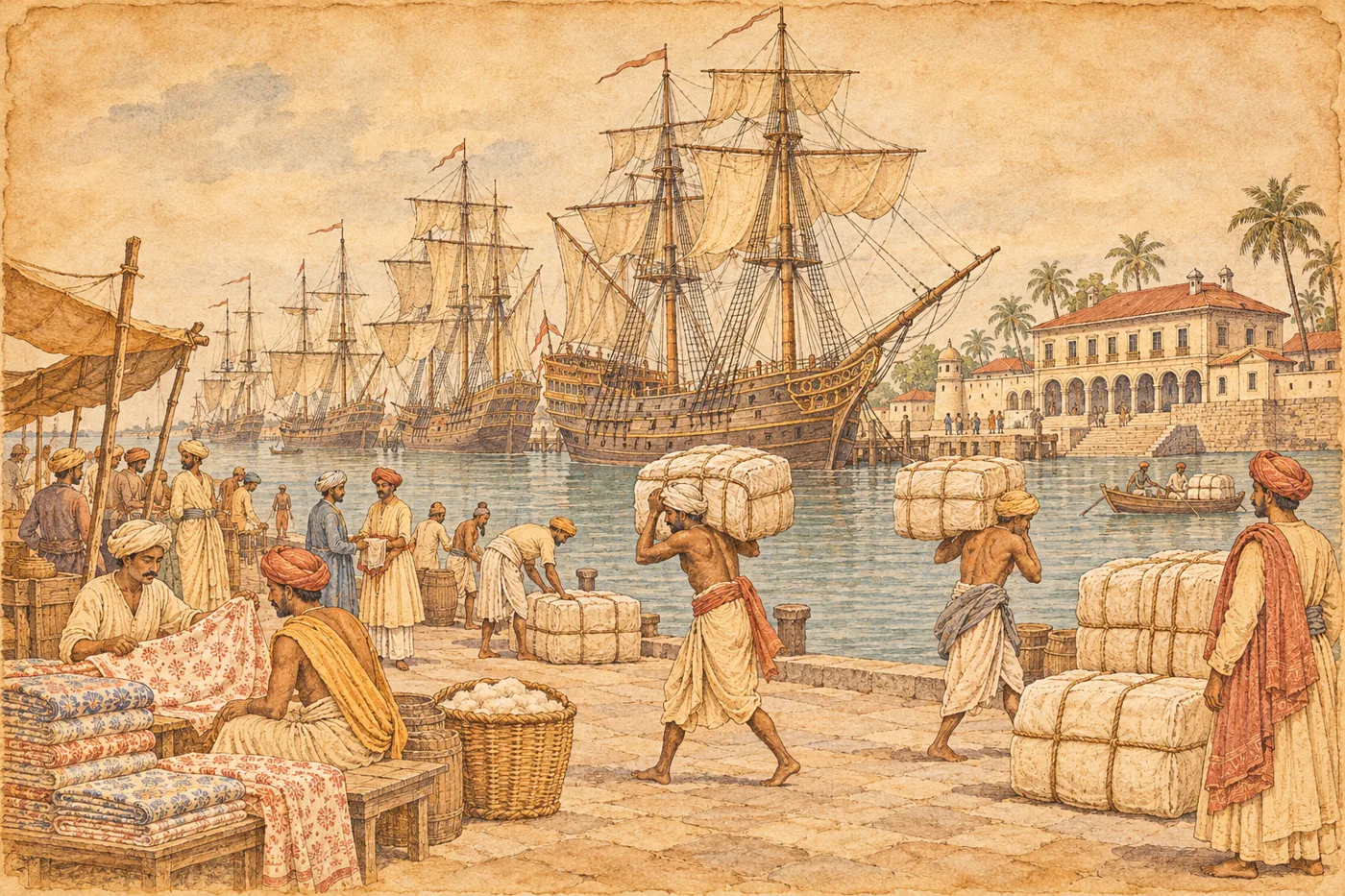
Why did a single 'company' come to rule a vast country?
In 1600, the East India Company was founded in England. It was granted a monopoly on trade with Asia, shipping spices such as pepper, and later Indian cotton textiles and tea. Similar companies were set up in the Netherlands and France.
At first, with the permission of the Mughal Empire, it was merely a group of merchants setting up trading posts in Surat, Madras, Bombay, Calcutta, and elsewhere. In the 18th century, as the Mughal Empire weakened, regional powers fought among themselves. Competing also with the French company, the East India Company hired Indian soldiers (sepoys), built its own army, and either allied with or fought regional powers.
In 1757, at the Battle of Plassey, the Company's army defeated the army of the Nawab of Bengal. This victory is said to have involved betrayal by a powerful figure on the Nawab's side. In 1765, the Company obtained the right to collect taxes (Diwani) in Bengal and other areas from the Mughal emperor. The Company thus became both a trading firm and a 'ruler' that levied taxes on land.
Heavy taxes and the influx of cotton cloth woven by British machines caused suffering for Indian peasants and weavers. Many farmers also turned to growing cash crops such as indigo, opium, and cotton. A great famine is said to have struck Bengal around 1770, claiming many lives.
Entering the 19th century, the Company expanded its territory by, for example, annexing the states of princely rulers who had no heirs. As discontent with the army and administration grew, in 1857 a rebellion broke out among the Indian soldiers of the Company army. A rumour that the new rifle cartridges were greased with cow and pig fat is said to have been one of the triggers. The revolt spread widely, joined by civilians and former princes, but was suppressed by the following year.
In 1858, the British government ended the Company's rule and began ruling India directly (later, in 1876–77, Queen Victoria assumed the title Empress of India, and it came to be called the 'Indian Empire'). The Mughal emperor was deposed and exiled to Burma. Resistance to this rule led to the independence movement of the 20th century.
Mini timeline
- 1600English East India Company founded
- 1757Battle of Plassey
- 1765Company obtains tax-collection rights (Diwani) in Bengal, etc.
- 1857Rebellion by Indian soldiers in the Company army
- 1858Company rule ends; Britain assumes direct control
People in this chapter
He led the Company's forces at the Battle of Plassey. Later assessments of him are sharply divided.
She was one of the leaders of the 1857 rebellion and died in battle in 1858.
Meanwhile, elsewhere
Connection to Japan
Japan was in the Edo period. Around the time Perry arrived in 1853 and Japan moved toward opening up, the 1857 Rebellion broke out in India.
Why it still matters
The East India Company was formally dissolved in 1874. The fact that India is still one of the world's leading English-speaking countries and that tea (Assam and Darjeeling) is a specialty product is said to owe much to the influence of this era.
Perspectives differ
- What to call the 1857 events
- In Britain it has been called the 'Sepoy Mutiny,' while in India it has also been called the 'First War of Independence.' Since not only soldiers but also peasants and princes joined, today it is often called the 'Great Rebellion of 1857'; the very name reflects one's standpoint.
- Reasons for victory at Plassey
- The Nawab's forces had superior numbers, but it is said that betrayal on the Nawab's side and the conduct of the battle decided the outcome. Which factor is given more weight differs among researchers.
- Death toll of the Bengal famine
- One estimate puts the death toll at about 10 million, or one-third of the population, but statistics from the time are uncertain and figures vary widely. There is also ongoing debate over how much the Company's taxation and policies worsened the disaster.
- Impact of British rule
- There is a view that it brought railways, legal systems, education, etc., and another view that it brought the decline of handloom weaving and heavy taxes. Assessments remain divided.
Facts checked (5, verified by AI on the web)
- Confirmed 1757 Battle of Plassey. Betrayal by a powerful figure on the Nawab's side influenced victory. World History Encyclopedia: Battle of Plassey
June 23, 1757. Clive's forces won. The prior secret pact with Mir Jafar was significant. - Confirmed 1765, Company obtained tax-collection rights (Diwani) in Bengal, etc. World History Encyclopedia: Battle of Plassey
Treaty of Allahabad (1765). - Confirmed Great Bengal famine around 1770 UCLA Center for South Asian Studies: East India Company
A UCLA page notes that in the famine of 1769–70, Company policies did not provide relief and that up to one-third of the population may have died. - Confirmed 1858, Company rule ended and direct British government rule began Britannica: British raj
Government of India Act, August 1858. The Governor-General also received the title of Viceroy. - Corrected & confirmed British Indian Empire in 1877 World History Encyclopedia: Delhi Durbar
The Royal Titles Act of 1876 gave Queen Victoria the title 'Empress of India' (effective May 1, 1876), proclaimed at the Delhi Durbar on January 1, 1877. Text amended to: 'later, in 1876–77… assumed the title Empress of India'.
Sources
World History Encyclopedia: Battle of Plassey
Britannica: East India Company
Britannica: British raj
World History Encyclopedia: Delhi Durbar
UK Parliament: Government of the Raj 1858-1914
UCLA Center for South Asian Studies: East India Company
* AI-drafted and cross-checked; human review is in progress. Status: