Gandhi and Independence / Partition — Nonviolence That Shook an Empire
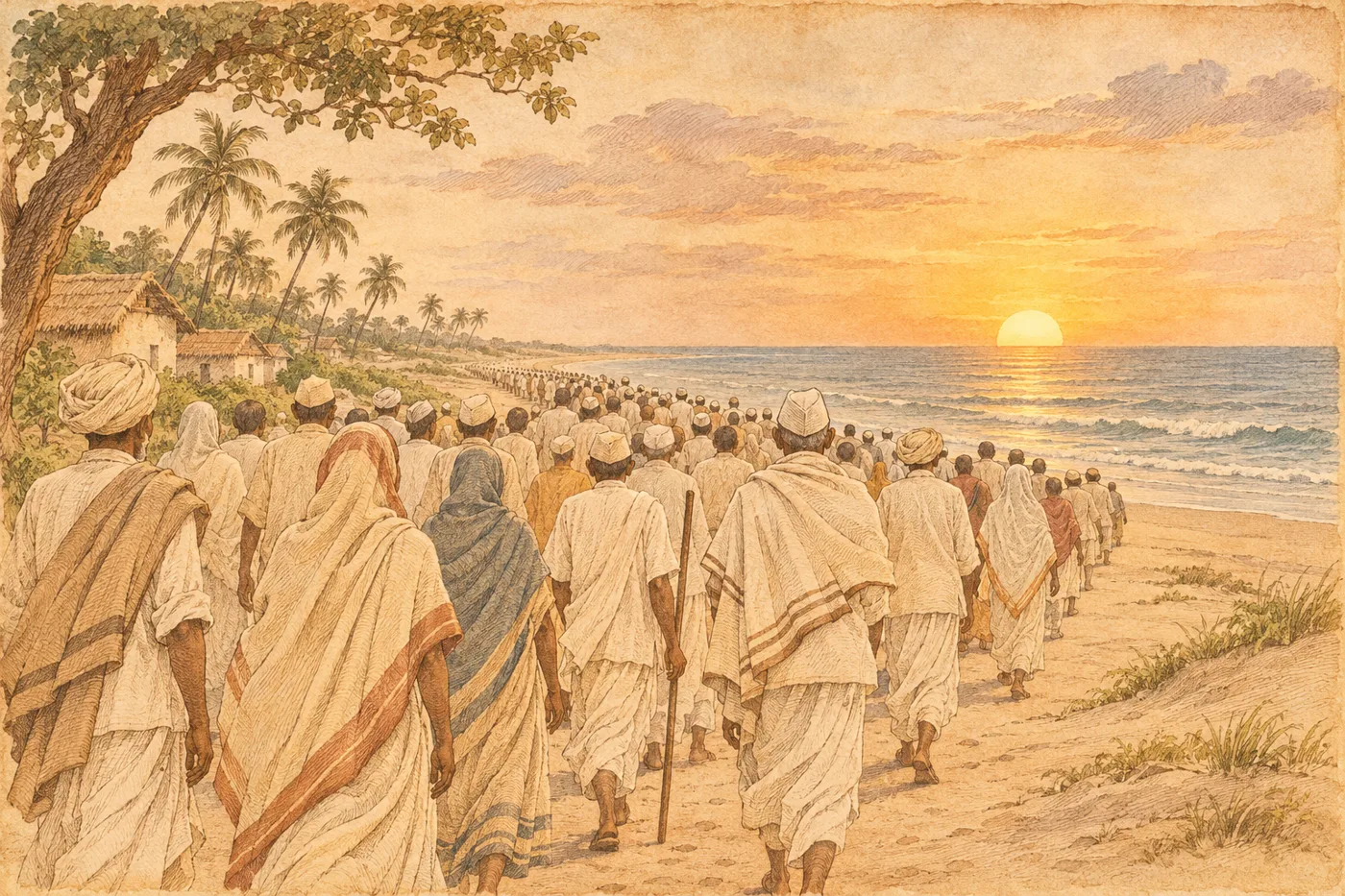
How could a movement that refused to bear weapons move a vast empire?
Even after the 1857 rebellion, India remained under British rule. At the end of the 19th century, English-educated Indians founded the Indian National Congress in 1885. At first it was an organization that sought the right to participate in politics through petitions and discussion.
As the 20th century began, the movement grew stronger. When Britain partitioned Bengal along religious lines in 1905, opposition spread, and the partition was annulled in 1911. In 1906, the political organization for Muslims, the All-India Muslim League, was also formed.
In 1915, lawyer Mohandas Gandhi returned from South Africa. He called his movement of not using weapons and not obeying unjust laws —“nonviolence and civil disobedience”—“Satyagraha (the force of grasping truth).” In 1919, when British troops fired on a crowd gathered in Amritsar, the movement to refuse cooperation with Britain expanded greatly.
In 1930, he carried out the Salt March to protest the salt monopoly. Gandhi walked about 390 km to the coast over several weeks and made salt with his own hands. As he walked, the number of participants grew, and it became world news.
After World War II, a weary Britain decided to withdraw from India. However, the Congress Party (Nehru and others), which wanted to keep India united as one country, and the Muslim League (Jinnah and others), which wanted a separate state for Muslims, could not reach a compromise. In August 1947, independence came as two countries: India and Pakistan.
The border was drawn hastily, dividing the Punjab and Bengal regions. More than 10 million people moved, and the number killed by violence is said to be between several hundred thousand and 2 million. Gandhi traveled to various places trying to stop the conflict, but in January 1948 he was assassinated by a young man with radical Hindu beliefs.
Mini timeline
- 1885Indian National Congress founded
- 1919Amritsar Massacre
- 1930Gandhi leads the Salt March
- 1947India and Pakistan become independent as separate countries
- 1948Gandhi is assassinated
People in this chapter
He led the movement of nonviolence and civil disobedience and is also called ‘Mahatma (Great Soul).’
He aimed for a separate country for Muslims and became Pakistan’s first governor-general.
Meanwhile, elsewhere
Connection to Japan
During World War II, the Japanese army advanced into eastern India (the 1944 Imphal operation), and with Japanese support, Bose and others formed the Indian National Army. Evaluations of this are divided even within India.
Why it still matters
Gandhi’s birthday, October 2, is a national holiday in India, and the United Nations designated it the International Day of Non-Violence in 2007. The memory of partition is still passed down through family stories, literature, and film.
Perspectives differ
- Number of partition victims
- Estimates of the number of people killed range widely, from 200,000 to 2 million. The number of people who moved is given as 10 million to 15 million.
- Responsibility for partition
- Various factors are cited: Britain’s hasty withdrawal, the conflict between the Congress Party and the Muslim League, the actions of local leaders, and so on. Opinions differ on who bears the greater responsibility, both in Indian and Pakistani historical narratives and among researchers.
- Gandhi’s role and evaluation
- Alongside the view that the nonviolent movement was decisive for independence, there is also the view that war exhaustion and other movements (including armed struggle) were important. There are also criticisms of his views on the caste system and women.
- ‘Independence’ and ‘Partition’
- While the same year, 1947, is celebrated in India and Pakistan for bringing the day of “independence,” for many people it is also a memory of “partition,” in which they lost their homes and families.
Facts checked (6, verified by AI on the web)
- Confirmed Indian National Congress founded in 1885 Britannica: Indian National Congress
December 1885 in Bombay. Hume (a former British civil servant) and others were also involved. - Confirmed The 1905 partition of Bengal was cancelled in 1911 after opposition Britannica: Partition of Bengal
The partition would have made the west Hindu-majority and the east Muslim-majority. It was revoked in 1911. - Confirmed In 1919 the military fired on a gathering at Amritsar World History Encyclopedia: Jallianwala Bagh Massacre
April 13, 1919, troops under Brigadier Dyer fired. Official figures: 379 dead and over 1,500 wounded; the actual death toll may be much higher (Britannica’s official report gives about 1,200 wounded). - Confirmed The Salt March was about 390 km (several weeks) Britannica Kids: Salt March
Britannica gives about 240 miles (385 km). Figures vary by source. It lasted about 24 days. - Confirmed Partition deaths: hundreds of thousands to 2 million; displaced: over 10 million Britannica: Partition of India
Deaths: 200,000–2,000,000. Displacement estimated at about 15 million, with some estimates between 10 million and 20 million. - Confirmed Gandhi assassinated in January 1948 by a young man with radical Hindu beliefs HISTORY: Gandhi is assassinated
January 30, 1948, while heading to a prayer meeting at Birla House, New Delhi, he was shot by Hindu nationalist Nathuram Godse, as confirmed in the main text.
Sources
Britannica: Indian National Congress
Britannica: Partition of Bengal
World History Encyclopedia: Jallianwala Bagh Massacre
Britannica Kids: Salt March
Britannica: Partition of India
HISTORY: Gandhi is assassinated
* AI-drafted and cross-checked; human review is in progress. Status: